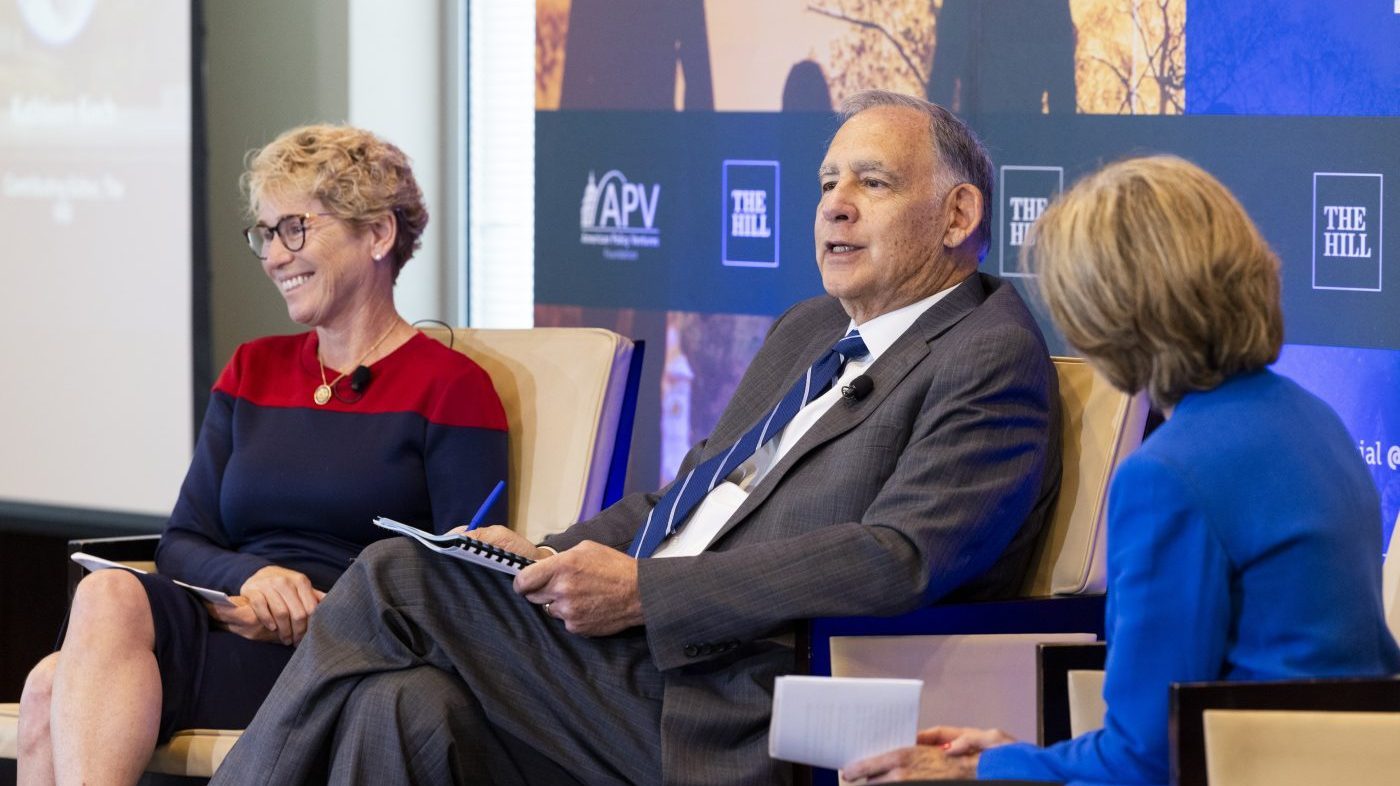
Lawmakers from both parties gathered Thursday to make the case that Congress has unfinished business when it comes to supporting American families, spotlighting new legislative pushes for paid family leave and a tax credit for newborns.
The event, dubbed the “Future of Supporting American Families,” was hosted by the American Policy Ventures Foundation in partnership with The Hill. The bipartisan lineup included Sen. John Boozman (R-Ark.), Reps. Chrissy Houlahan (D-Pa.), Debbie Dingell (D-Mich.) and Blake Moore (R-Utah), as well as Kellyanne Conway, a former campaign manager for President Trump.
At the center of the discussion was the More Paid Leave for More Americans Act, introduced in both chambers. The bill, co-led by Houlahan and Boozman in the Senate and by Houlahan and Rep. Stephanie Bice (R-Okla.) in the House, would create a state-driven, public-private partnership model to expand access to paid leave, while setting a national framework for employers to administer benefits across state lines.
Houlahan emphasized the incremental approach, arguing that expanding paid leave is a win for workers and businesses alike. “With Stephanie and I, our mantra is ‘more paid leave for more people,’” she said. “Incrementally, anything that we do opens that door so that more people recognize that, again, that the businesses empirically, objectively do better if they allow things like paid leave.” She added that while employers should retain the freedom to choose, the trend points toward universal adoption because it’s “just the right thing to do.”
Boozman acknowledged the measure has bipartisan support across both chambers, calling that “a good recipe to start out with.” He noted, “That doesn’t happen very often.” Houlahan expressed hope that the bill could be revisited during the lame-duck session after the November midterms.
The conversation also turned to the Supporting Newborn Parents Act of 2026, introduced by Dingell and Moore along with Reps. Tom Suozzi (D-N.Y.) and David Valadao (R-Calif.). The legislation would provide a tax credit of up to $2,000 for families with a newborn. Moore pointed to declining birth rates as a reason for targeted relief: “It’s tough. We’re seeing declining birth rates, and so we’ve got to look at the data and say, what can we do to target this? There’s tax credits abounding for multiple different things in this world. Why not focus something on what’s one of the most important things for our culture and our economy is to help those, you know, just brand-new starting families and to give a little bit of relief tax-wise to these families that are going through a lot of expenses.”
Dingell stressed that caregiving is a nonpartisan issue. “Caregiving, being a parent, taking care of seniors — none of that’s Republican or Democrat,” she said. “Those are just real issues in our community that we need to work together on.” She also highlighted the struggles of the “sandwich generation,” caught between childcare and caring for aging parents. The bill has not yet been taken up by the House.
The push comes amid broader debates over family policy and economic relief. Some lawmakers have pointed to recent bipartisan efforts on family support as a rare area of agreement. Meanwhile, other political battles, such as the House GOP's abrupt adjournment, show how quickly partisan friction can overshadow legislative progress.