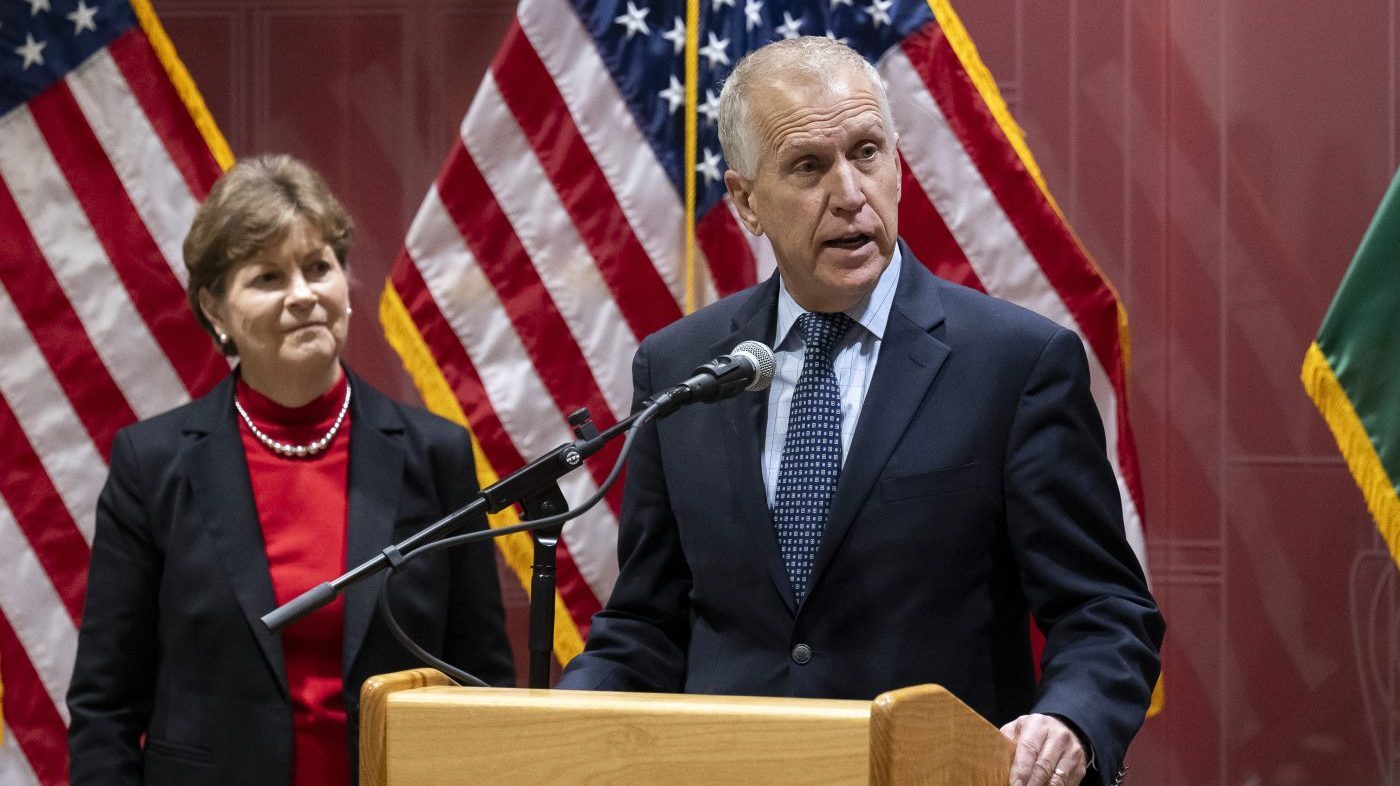
Two outgoing senators are escalating pressure on Congress to investigate recent disruptions to Ukraine's military-grade satellite service, a move that puts Elon Musk's SpaceX and the Pentagon in the crosshairs. Senators Jeanne Shaheen (D-N.H.) and Thom Tillis (R-N.C.) issued a joint statement obtained by The Hill, urging lawmakers to conduct oversight and determine who authorized the restrictions on Starshield, a secure satellite network used by Kyiv for targeting and drone operations.
“Congress must determine who ordered or approved these disruptions and hold those responsible accountable,” the senators wrote, noting they are both departing at the end of the 119th Congress. “The Pentagon and SpaceX must preserve all records, turn over the contracts and communications Congress needs to establish the facts, and put safeguards in place so this never happens again.”
The call comes after Ukraine reported a second round of Starshield outages in roughly a month, with the system reportedly throttling speeds for objects moving faster than 100 miles per hour. Denys Sienik, Ukraine's top diplomat in Washington, said the slowdown began gradually several days ago and has affected operations along the front lines. “We experienced speed limitation as of now on Ukrainian occupied territories and across the contact line,” Sienik said. “The contact line is the first line of our defense and the first point for interception of Russian drones. We don't have clarification from SpaceX or Pentagon at the moment.”
Last month, Musk acknowledged limiting Starlink service over Ukraine, claiming Kyiv violated the terms of service by using the commercial network for offensive purposes. Secretary of State Marco Rubio echoed that stance, saying Ukraine is bound by the private contract governing Starlink's use. “The bottom line is that that is governed by a private commercial contract as to how their stuff can be used and what speeds they'll allow it to be used at,” Rubio told reporters.
Shaheen and Tillis argue these restrictions are dangerously undermining Ukraine's ability to defend itself, especially as Russia continues heavy aerial bombardments. They cited an overnight attack involving 163 drones, including 91 jet-powered aircraft traveling at speeds over 310 mph, as well as loitering munitions and at least one cruise missile. The strikes damaged at least six major power substations and caused outages in eight regions.
“Ukraine's military has determined that these disruptions are systematic restrictions, and SpaceX admitted last month that it limited Ukraine's service,” the senators wrote. “SpaceX has yet to offer any explanation for these latest disruptions. These repeated restrictions raise further dire questions about why Ukraine is being deliberately deprived of the capabilities it needs to defend itself.”
The Starshield slowdown comes as Ukrainian and Russian delegations concluded two days of talks in Abu Dhabi, the first such meeting in nine months, which resulted in an agreement on a major prisoner-of-war swap. Shaheen and Tillis stressed that Ukraine is negotiating in good faith while Russia continues attacking civilians and infrastructure. “Russia has shown no such good faith,” they wrote. “While President Trump's envoys travel to Moscow, Putin continues attacking innocent civilians, including bombing a center in Kremenchuk serving children with special needs. Just last week, Putin killed 55 civilians as they were attempting to get humanitarian aid.”
The senators are urging their colleagues to keep pressure on the Trump administration and SpaceX to ensure Ukraine has the tools it needs to counter Russian aggression. The dispute also highlights broader tensions over the role of private contractors in providing critical military technology, a topic that has drawn attention in oversight battles on Capitol Hill.