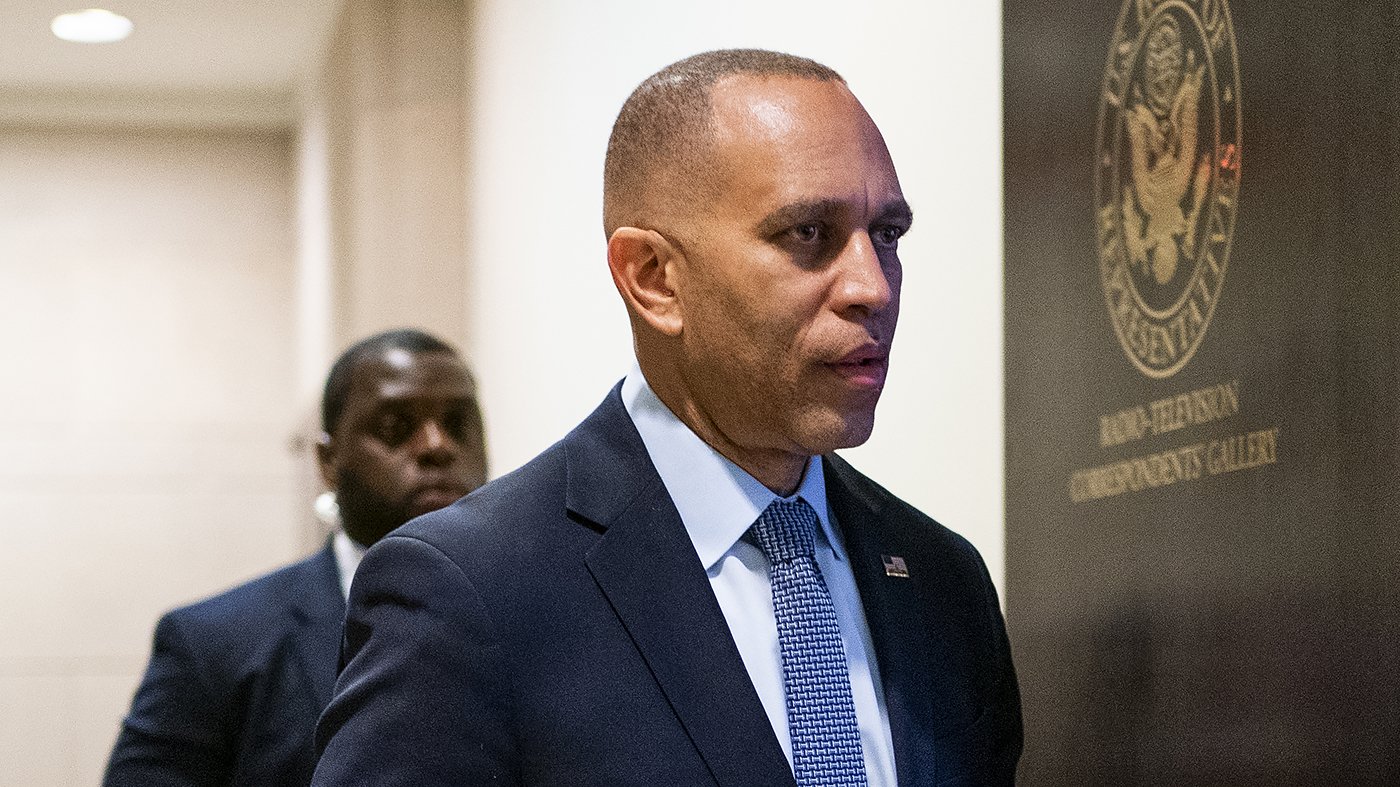
House Minority Leader Hakeem Jeffries sparked controversy this week by comparing a call for Black athletes to boycott Southeastern Conference teams to a “Jackie Robinson moment.” But the comparison drew immediate fire for turning the civil rights icon’s legacy on its head.
Jeffries was responding to the Supreme Court’s decision in Louisiana v. Callais, which struck down racial gerrymandering used to create majority-minority congressional districts. The ruling, which applied the 14th Amendment’s equal protection clause uniformly, ended a practice that had long guaranteed the election of non-white—and largely Democratic—House members.
A Call for Sacrifice
In an interview on MSNBC, Jeffries called on Black athletes to turn down scholarship offers and current players to “abandon SEC schools” to protest the decision. “There should be no athletic or sports participation,” he said. “This is a Muhammad Ali moment. This is a Bill Russell moment. It’s a Jackie Robinson moment.”
The NAACP had earlier urged players and fans to boycott SEC teams. Jeffries acknowledged the move would “require a level of courage and character and conviction,” but insisted it was worth the fight.
Critics were quick to note the irony: Jeffries was asking young athletes to risk their NFL careers to preserve a system that packs or cracks Black voters into districts—a practice the Court now deems unconstitutional. “Self-serving demands are nothing new for politicians,” wrote Jonathan Turley, a law professor and author, in a sharp rebuke. “But this was truly the Super Bowl of self-serving political pitches.”
Robinson’s Real Legacy
Jackie Robinson broke baseball’s color barrier in 1947, ushering in an era where race played no role in competition. He famously said, “It would make everything I worked for meaningless if baseball is integrated but political parties were segregated.” Robinson, a Republican, later warned against the “doctrine of racial division.”
Turley argued that invoking Robinson to defend racial discrimination in politics “denigrates his legacy.” The Callais decision, he noted, “brought consistency” to constitutional law, ending the tolerance of racial quotas in redistricting under the Voting Rights Act. The law still prohibits intentional discrimination against minority voters.
Political Fallout
Jeffries’ plea comes as he eyes the Speaker’s gavel. But the optics of asking Black athletes to sacrifice their careers for a gerrymandering system that benefits Democrats have drawn scorn across the political spectrum. Meanwhile, California Governor Gavin Newsom faced his own backlash for urging residents to boycott Chevron after the company highlighted the state’s high gas prices—a move Turley called “trivial” compared to Jeffries’ request.
The debate also echoes broader tensions over racial justice and political power. Some have pointed to the Jeffries campaign against a Virginia Republican as part of a pattern of racialized politics. Others see the Callais decision as a victory for colorblind law, akin to earlier rulings on affirmative action.
Turley concluded: “Maybe Jeffries is right. This is a Jackie Robinson moment after all—but not the one he thinks it is.”