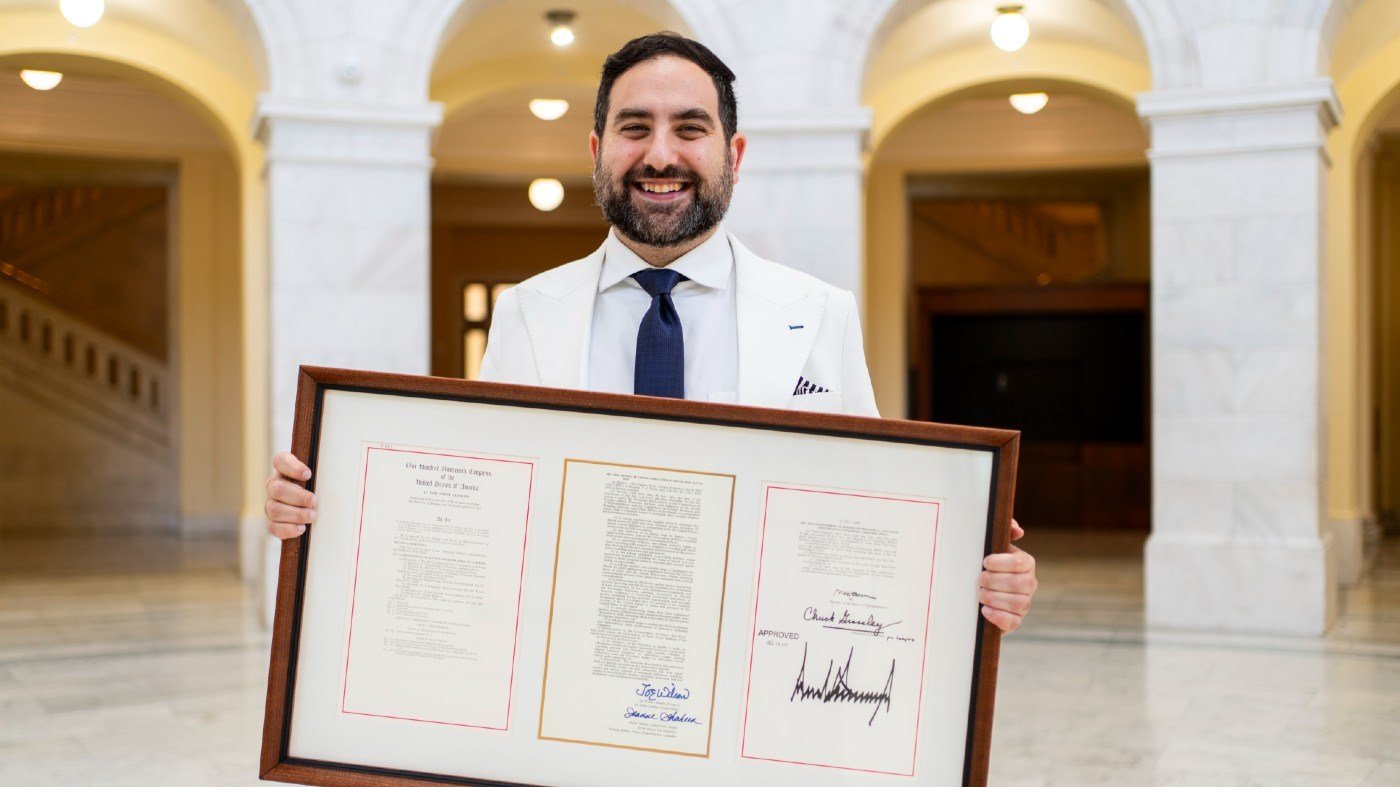
In Washington, few honors carry more weight than being blacklisted by America's enemies. For Omar Hossino, the national security adviser to the House Republican Policy Committee, that distinction has become a measure of his effectiveness. Rep. Joe Wilson (R-S.C.) put it bluntly: Hossino's greatest achievement was getting Wilson named an enemy of the state by Syria's Assad regime. "That means you're really being very effective," Wilson said.
Hossino's path to Capitol Hill began in Charleston, W.Va., where he was born to Syrian immigrant parents. As a fourth-grader, he became obsessed with C-SPAN, a habit that shaped his conservative worldview. Watching the realities of socialism and dictatorship firsthand through his family's history, he said, fueled a lifelong drive to confront authoritarians and human rights abusers.
That mission reached its peak with the Caesar Syria Civilian Protection Act of 2019, a law Hossino counts among his proudest achievements. The comprehensive sanctions regime stripped the Assad government of revenue and punished its atrocities, helping pave the way for the dictator's eventual downfall in December 2024. When Syrian rebels toppled Assad, Hossino pivoted—advocating for the law's repeal to give the new authorities access to capital needed to stabilize the country. "When it did its duty, we were able to meet our objective," he said. "That shows you Congress had a major role in foreign policy."
Hossino's work extends beyond Syria. As a key staffer for both the House Republican Policy Committee and the Republican Study Committee, he has helped shape conservative foreign policy while emphasizing that durable legislation requires bipartisanship. In April 2024, when President Biden's supplemental aid for Ukraine faced growing GOP opposition—amplified by Donald Trump's campaign against further assistance—Hossino helped craft a compromise that turned the funds into a loan, added strict oversight, and increased sanctions on Russia. The package ultimately passed.
Navigating such partisan whiplash, Hossino relies on a maxim from a colleague: "The administration writes in pencil, and Congress writes in pen." The legislative process, he acknowledges, is often slow and painful, but its results carry a permanence that shifts U.S. policy in lasting ways.
His approach mirrors the broader dynamics of a House GOP conference that has increasingly turned to foreign policy as a political battleground ahead of the midterms. And as the post-9/11 security framework evolves, Hossino's focus on sanctions and oversight remains central to Republican strategy.
For Hossino, the job is personal. Growing up with Syrian roots, he saw how dictatorship "destroys the human spirit." That conviction now drives his daily work—whether drafting sanctions against tyrants or pushing for their repeal once the mission is accomplished.