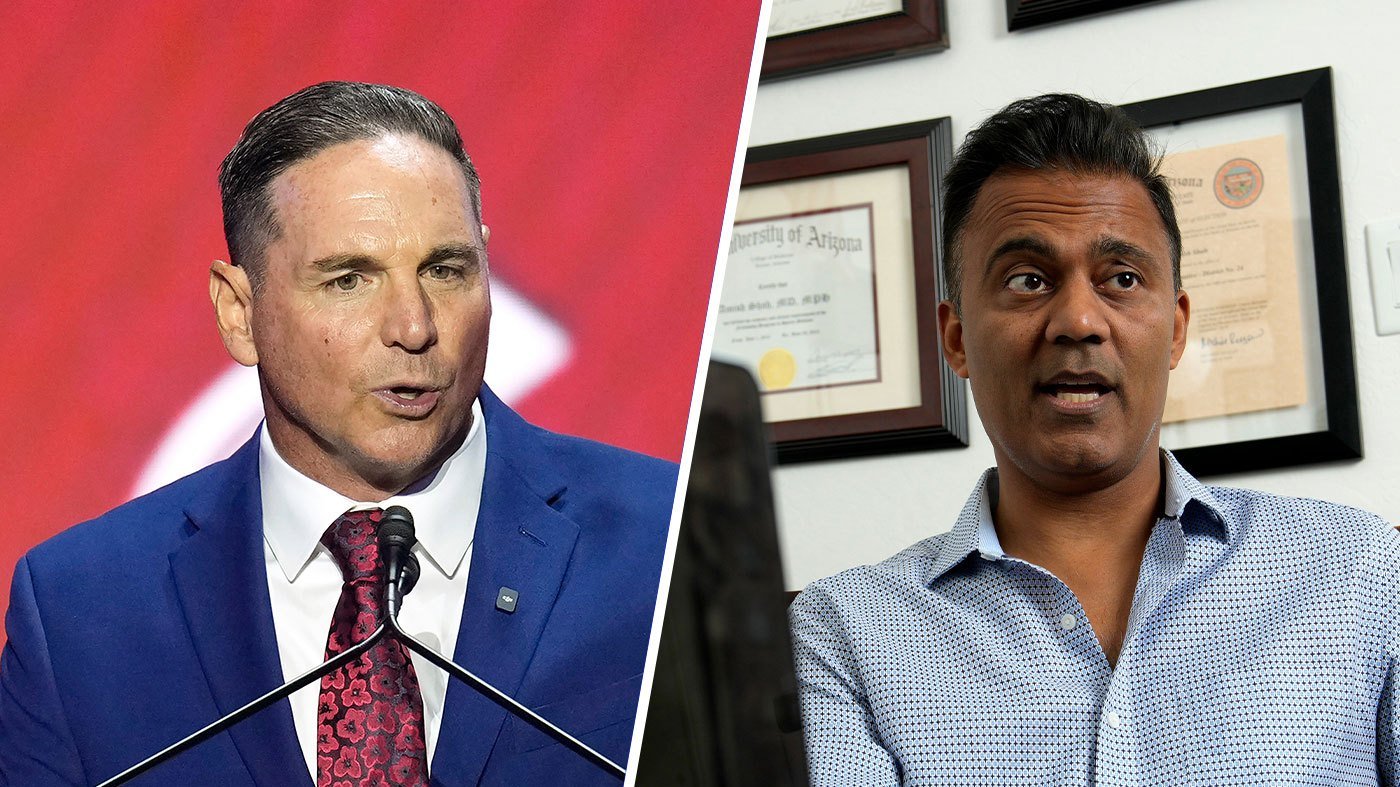
As the midterm campaign season intensifies, a notable trend has emerged: several congressional candidates are running in districts they don't actually live in, putting their connections to the communities they hope to represent under scrutiny.
In Arizona's 1st Congressional District, Democrat Amish Shah and Republican Jay Feely are both seeking the seat despite residing outside its boundaries. Shah, a former state legislator, lives just a mile from the district line, while Feely, a former NFL kicker, is building a house within the district. Feely defended his candidacy, noting that four of Arizona's nine current House members also live outside their districts. "I've spent the last year on the campaign trail listening to voters from all corners of the district," he said, emphasizing his commitment to addressing their concerns.
Similarly, in New York's 1st District, Republican Rep. Nick LaLota and Democratic challenger Chris Gallant are competing, with LaLota residing in Amityville (in the neighboring 2nd District) and Gallant in Amity Harbor. The Constitution only requires House members to be inhabitants of the state they represent, not their specific district, but voters often expect deeper local roots.
Democratic strategist Antjuan Seawright told The Hill that living outside a district can hinder a candidate's ability to truly understand the community. "It puts both parties at a disadvantage," he said, since personal connections are vital for effective representation.
Redistricting is a key factor in some races. In Virginia, Democrat Elaine Luria, who lost her seat in 2022, is running again in the 2nd District—but the redrawn lines have placed her home outside it. Her campaign blames Republican-led gerrymandering for her previous defeat. Independent candidate J. Matt Baker faces a similar situation, noting that his neighborhood was shifted into the 3rd District. "I did not leave the district; the mapmakers simply shifted a line less than a mile to the east," he wrote on his website.
In Arizona and New York, however, redistricting isn't the issue; court battles have blocked Democratic attempts to redraw lines. GOP analyst Rob Stutzman argues that in sprawling suburban areas like Phoenix's metro, living just outside a district may not matter much because the broader community is interconnected. He also suggested that name recognition, like Feely's football fame, can offset residency concerns.
Despite these arguments, opponents are quick to attack residency. The Republican National Committee, for example, criticized Luria for buying a home outside the district, accusing her of lying to voters. Such attacks highlight the political vulnerability of candidates who don't live in the areas they seek to represent.
As the campaign trail heats up, these races illustrate the ongoing tension between legal qualifications and voter expectations, with candidates forced to defend their ties to communities they may not call home.