Former U.S. Ambassador to the United Nations Nikki Haley argued Sunday that President Trump’s handling of the recent trilateral summit handed Russian President Vladimir Putin a public relations victory, allowing him to project an image of global stature that his strained circumstances don’t merit.
Speaking on Fox News’s “The Sunday Briefing,” Haley told host Jacqui Heinrich that the meeting in Shenzhen, China, was less about substantive diplomacy and more about stagecraft—and that Putin walked away with the most to gain. “Look, the biggest winner of the trilateral was Putin,” she said. “All he has wanted is to be seen as a global heavy hitter, and they allow that to happen by having him sit at the table. It’s unfortunate.”
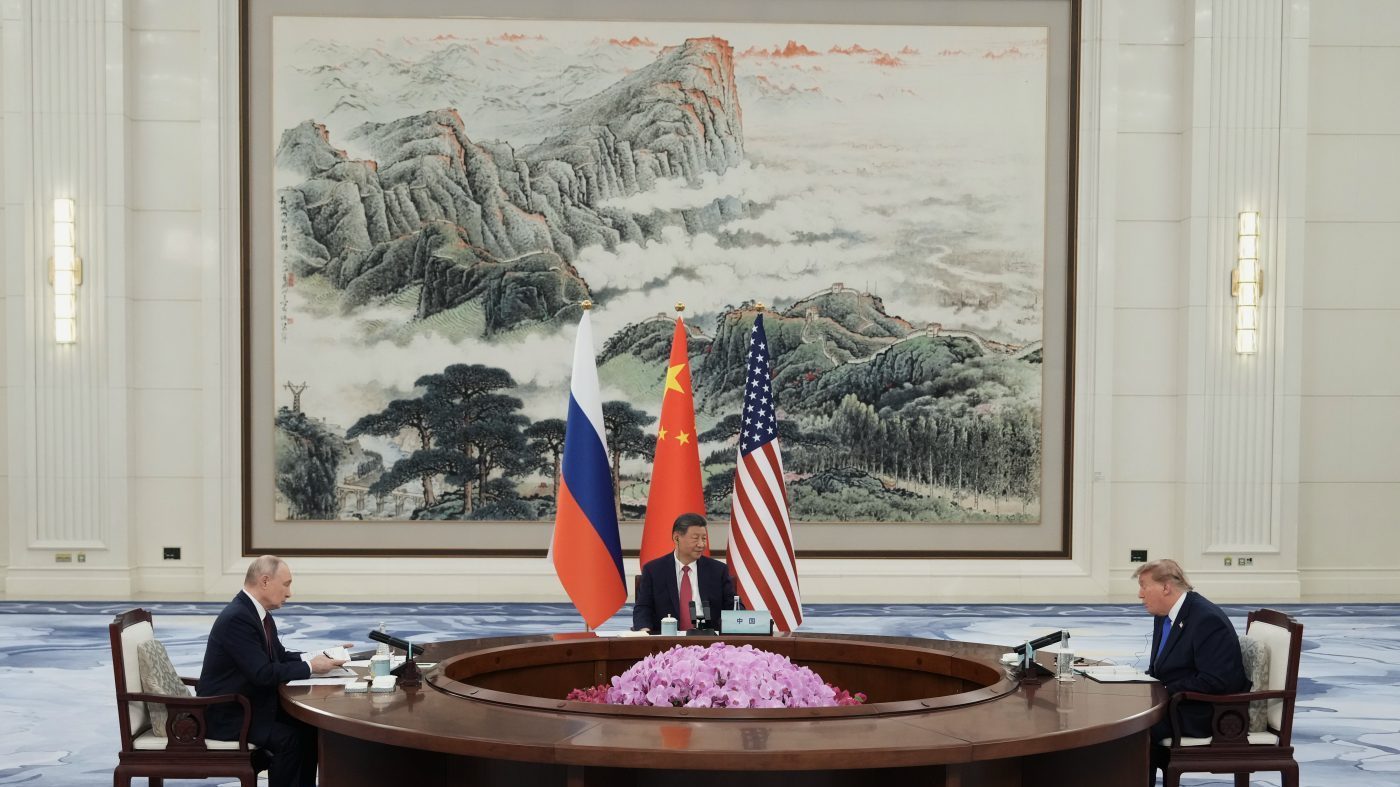
Haley’s remarks zeroed in on the seating arrangement captured in a widely circulated photograph from the Nov. 19 talks. In the image, Trump and Putin are seated opposite each other at a circular table, with Chinese President Xi Jinping positioned between them, facing reporters. Haley suggested that layout visually elevated Putin, giving him “stilts to make him think he’s taller and bigger and stronger.” She added that the photo made Putin “look like the winner at the end of the day.”
The former ambassador also argued that Xi was the true beneficiary of the optics. “I think President Xi saw that. He doesn’t see Putin as an equal, and I think he treated him that way,” Haley said. “Who was sitting at the middle of the table? Who looked like they were holding court? It’s President Xi. That’s exactly what he wanted. This was all about optics.”
The trilateral meeting, which also included discussions on Russia’s war in Ukraine and China’s role in the U.S. conflict with Iran, lasted about 70 minutes behind closed doors. According to The Associated Press, the leaders ultimately agreed to a narrower agenda focused on U.N. reform, fossil fuel refinement, and limiting the reach of the International Criminal Court. The limited scope drew criticism from foreign policy analysts who saw the summit as more symbolic than substantive.
Putin, for his part, praised the talks as “open and candid,” calling the trilateral format “useful and substantive.” When asked whether the meeting’s imagery mattered more than its content, he described the session as “a serious collaborative work.”
Haley’s critique aligns with broader concerns among some Republicans that Trump’s engagement with authoritarian leaders often boosts their international standing without securing concrete U.S. concessions. Her comments also echo warnings from other officials, such as Clayton’s assessment that Putin is not America’s friend in Ukraine, and come as the administration faces scrutiny over its foreign policy posture.
The summit’s optics have also been compared to past meetings where seating and photo opportunities were seen as diplomatic signals. As one analysis noted, Kennedy backed the three-power summit but urged a tough posture, highlighting the tension between engagement and appearing weak.
Haley’s remarks are likely to fuel debate over Trump’s approach to great-power diplomacy, especially as the administration navigates complex relationships with both Moscow and Beijing. With the midterm wipeout sparing the GOP a 2028 catastrophe but leaving Trump’s shadow looming, foreign policy missteps could have lasting political repercussions.