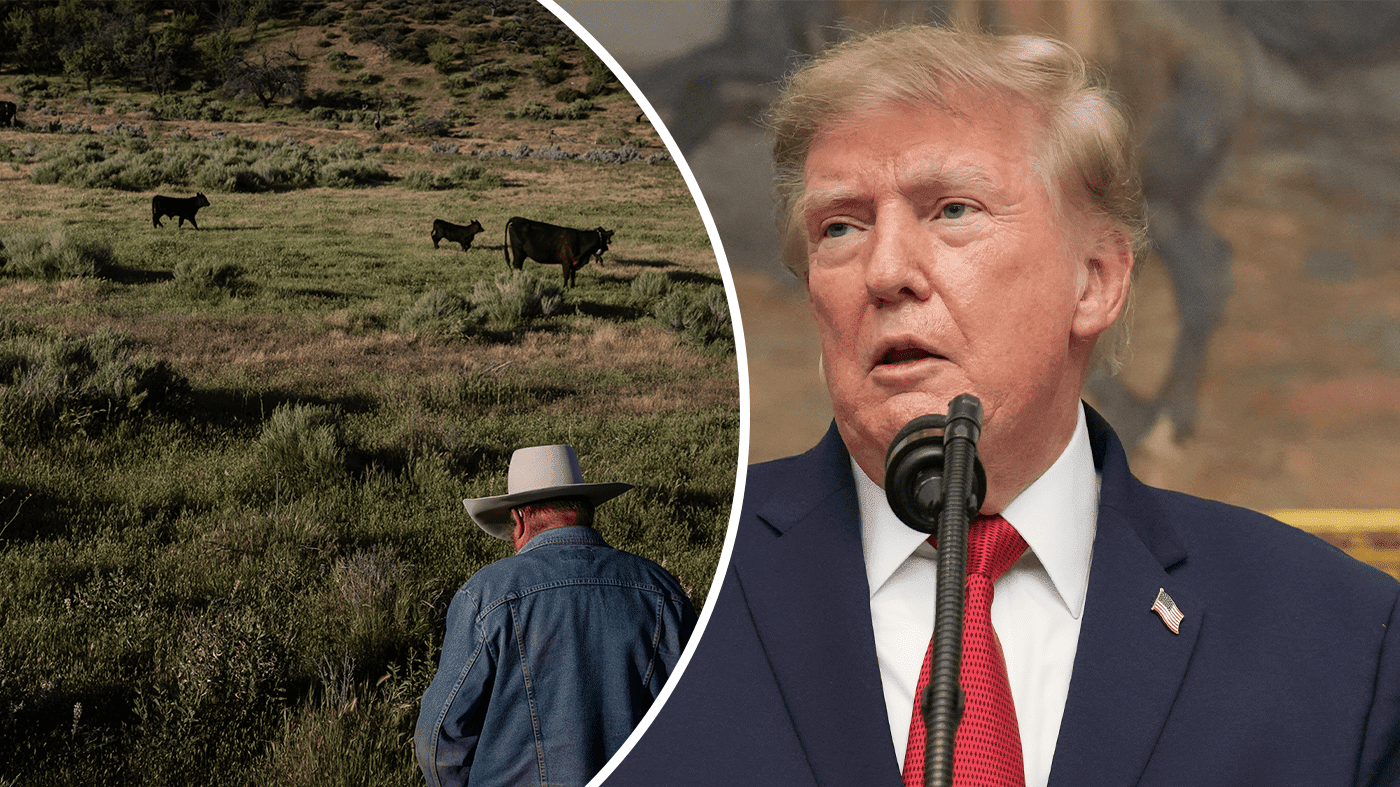
President Trump's announcement Friday that he would temporarily suspend tariffs on imported ground beef to bring down consumer prices has ignited a firestorm of criticism from Republican lawmakers and cattle ranchers, who accuse the administration of undermining the domestic cattle industry.
The president said the 90-day tariff pause would allow up to 300,000 metric tons of ground beef product to enter the U.S. market, with the goal of cutting prices for American consumers by 25%. However, the administration did not specify which countries would supply the beef, leaving many in the industry uneasy.
Colin Woodall, CEO of the National Cattlemen's Beef Association, said in a statement that while the industry shares the goal of affordable groceries, "flooding the market with government-subsidized, below-market beef is not the way to rebuild the American cattle herd." He noted that cattle markets had already fallen sharply on the news, and he warned that the timing could not be worse as ranchers prepare for herd expansion decisions. "This announcement throws cold water on the idea of expanding herds," Woodall added.
Meriwether Farms, a Wyoming-based cattle operation, took to social media to call the move a "betrayal" of American ranchers. The backlash was swift and bipartisan in tone, with several prominent Republicans voicing concerns.
Rep. Kat Cammack (R-Fla.) said on X that while she supports lowering grocery costs, "short-term relief can't come at the expense of American ranchers, free markets and long-term solutions." She noted that ranchers in her state had already battled drought, rising input costs, and regulatory burdens.
Sen. Tim Sheehy (R-Mont.) said he had advised the president against this course of action for a year, arguing that it would further harm ranchers who have been struggling against the "packer monopoly" for decades. "The reality is this action will make it more difficult for American ranchers to rebuild our herd and bring prices down for the American people," he wrote on X.
The administration defended the move, with a White House official pointing to supply shortages that began under the Biden administration. "The American cattle herd size is at a multi-decade low, while domestic demand for beef continues to be high," the official said. "This short-term action allows foreign imports to fill a gap to meet domestic ground beef demand at affordable prices."
But critics argue the move exposes the inconsistency of Trump's tariff policy. Marian Tupy, a senior fellow at the Cato Institute, said the decision "once again exposes the absence of a coherent economic philosophy within MAGA." He noted that when tariffs are imposed, defenders claim they don't raise prices, but when tariffs are cut, the same defenders celebrate lower prices—both cannot be true simultaneously.
Even some of Trump's staunchest supporters, like Fox News personality Tomi Lahren, expressed frustration, calling for mandatory country-of-origin labeling so consumers know where their beef comes from. She warned that imported beef would undercut American ranchers who cannot differentiate their product from cheaper foreign imports.
The move also drew criticism from progressive groups, with Groundwork Collaborative's Alex Jacquez saying it "once again explicitly admits his broad-based tariffs raise prices for Americans."
Beef prices have been soaring, with the average price of ground beef around $6.89 per pound, according to the Bureau of Labor Statistics. The U.S. cattle inventory at the start of the year was the lowest since 1951, driven by drought and high input costs. The administration's decision comes after a similar plan was shelved in May following internal pushback, as reported by Politico.
As the 90-day window approaches, the political fallout is likely to intensify, with GOP ranchers and lawmakers vowing to keep pressure on the administration to protect American producers. The debate over tariffs and their impact on domestic industries is far from over, and this episode has added a new flashpoint in the ongoing trade policy battles.