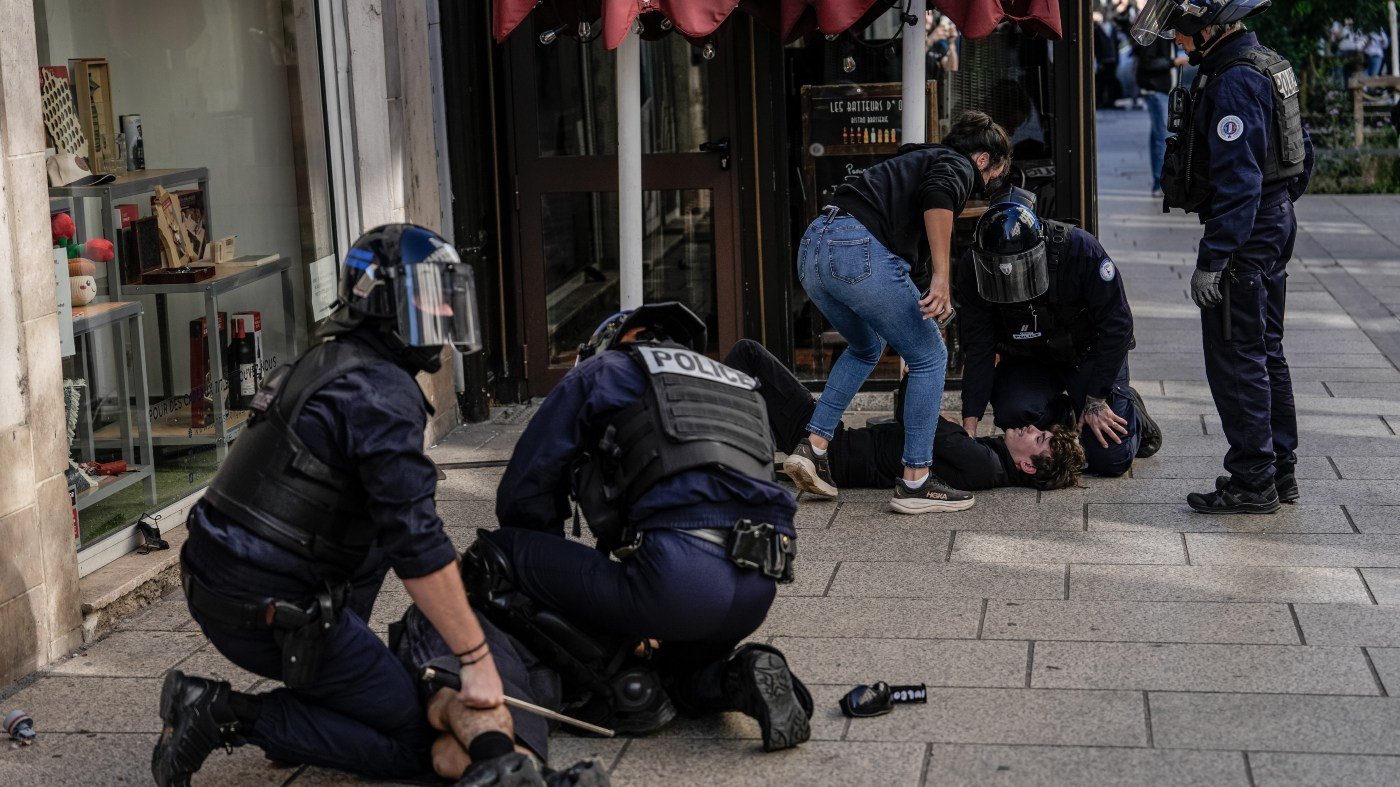
Student demonstrations that began in a Paris suburb have snowballed into a nationwide movement, forcing hundreds of schools to shut down and prompting a new day of action scheduled for Tuesday. The protests, initially sparked by teacher vacancies and dilapidated facilities, have turned violent, with clashes between students and police leaving more than 100 people injured and thousands of minors in custody.
The unrest started on September 21 at a high school in Saint-Denis, where students complained about overcrowded classrooms, broken ventilation, and a lack of permanent teachers. The grievances quickly resonated across the country, with nearly 500 schools closed this month as students took to the streets in cities from Paris to Marseille.
“Classrooms are not ventilated, and we can barely open the windows,” Issam Makhloufi, a student at Rosa Parks High School, told The New York Times. Another protester told Reuters that the education system is “classist and racist,” pointing to chronic underfunding in suburban and immigrant-heavy districts.
The movement has drawn support from some teachers’ unions and the far-left France Unbowed party, though its leaders deny orchestrating the protests. Prime Minister Sébastien Lecornu accused politicians of exploiting the anger, saying, “The duty of a republic’s elected official is to protect young people and call for calm. Exploiting their anger for partisan purposes is a fault.” Bally Bagayoko of France Unbowed countered that the protests are a direct result of “a considerable shortfall in the resources allocated for our children’s education.”
The violence escalated as police used tear gas and other dispersal tactics. Education Minister Édouard Geffray reported that at least 24 schools have been ransacked or set on fire, with damages running into millions of dollars. A 15-year-old lost his lower arm after detonating a police stun grenade, according to La Voix du Nord, and the BBC documented students suffering eye injuries and lost teeth.
Justice Minister Gérald Darmanin has called for a firm criminal response and said parents of minors could face civil liability. “Social unrest is legitimate, but it cannot be expressed through violence,” he wrote on X. Human rights groups, including Amnesty International, have condemned the police response as “disproportionate,” arguing that students are merely “demanding their right to education.”
Despite meetings with activists, Geffray’s promises to address teacher shortages and involve students in reform have been dismissed as too vague. “One of the difficulties of this movement is that there are no national demands. It all started with local demands,” he admitted.
The protests come as France gears up for a presidential election next year, with incumbent Emmanuel Macron term-limited. The political stakes are high, and some conservatives abroad are already drawing parallels. Fox News host Tomi Lahren called the unrest a “cautionary tale” for the U.S., linking it to immigration policies—a framing that critics say oversimplifies the complex educational and social issues at play.
Student unions are urging a massive turnout on Tuesday, calling for blockades of universities and high schools. “Students and high school students, while the authorities seek to drive us out of our places of study through budget cuts, the closure of places, dilapidated buildings, selection, or repression, let’s not let them,” two unions said in a joint statement.
The situation remains fluid, with no clear end in sight. As one student told The Guardian, “Young people just want to study and learn in decent conditions. The French state seems surprised about worsening school results, but they’re doing nothing to remedy that.”