Americans' confidence in the news media has risen for the first time in years, but the shift is almost entirely partisan. According to a Gallup survey released Tuesday, 33 percent of U.S. adults now say they trust newspapers, television and radio to report the news fully, accurately and fairly—a five-point increase from 2025, when trust hit its lowest level in the poll's 25-year history.
The overall improvement masks a widening partisan gap. Republican trust jumped to 22 percent, up eight points from last year and the highest reading for the GOP in a decade. That figure had not exceeded 20 percent since 2018. Meanwhile, Democratic confidence fell to 50 percent, a historic low for the party. Independents registered 31 percent trust, a modest three-point gain from 2025.
Lydia Saad, Gallup's director of U.S. social research, noted that the partisan trends point to a different political climate for the media in President Trump's second term compared with his first. She also stressed that trust remains historically weak across the board. An equal 33 percent of respondents said they have "not very much" confidence in the media, while another 33 percent have "none at all."
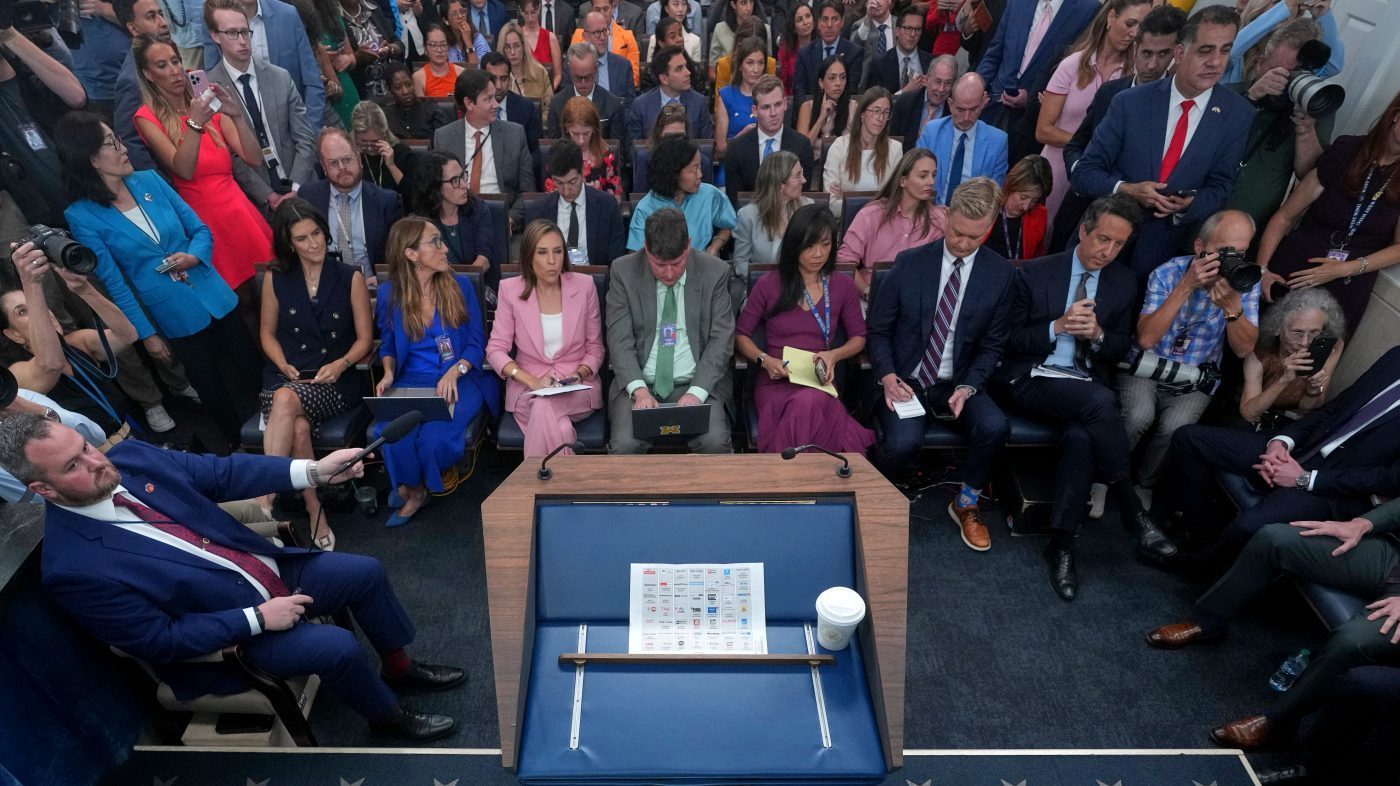
The survey period, Sept. 1-17, overlapped with a fresh confrontation between the White House and major news organizations. On Sept. 18, Trump barred CNN, MS NOW and Politico from the White House, labeling CNN "fake news" and criticizing MS NOW for its rebranding from MSNBC. He also attacked the roughly $8 million in government subscriptions to Politico Pro, calling the payments "illegal and ridiculous."
A federal judge swiftly reversed the ban on Sept. 24, ordering the White House to restore press credentials for the three outlets. But the administration has continued to spar with the press: over the weekend, CNN was excluded from the press pool traveling with the president on Air Force One. The ongoing dispute has drawn legal challenges from media organizations, including a coalition seeking a court order to block further restrictions.
The Gallup findings suggest that Republican voters may be rallying behind Trump's aggressive posture toward the mainstream press. That dynamic could have electoral implications as midterm campaigns heat up. Some analysts see the White House's media strategy as a double-edged sword, with the potential to backfire and overshadow other priorities.
While the overall trust number improved, it remains far below the levels seen in the 1990s and 2000s. The decline in Democratic trust is particularly striking: just half of Democrats now express confidence in the media, down from much higher levels in previous years. That erosion mirrors a broader loss of faith in institutions. For instance, public confidence in the Supreme Court has also fallen to historic lows during Justice Clarence Thomas's tenure.
Gallup surveyed 1,000 U.S. adults between Sept. 1-17, with a margin of error of plus or minus 4 percentage points. The poll offers a snapshot of a polarized media landscape in which partisan identity increasingly shapes where Americans turn for news—and how much they believe what they hear.