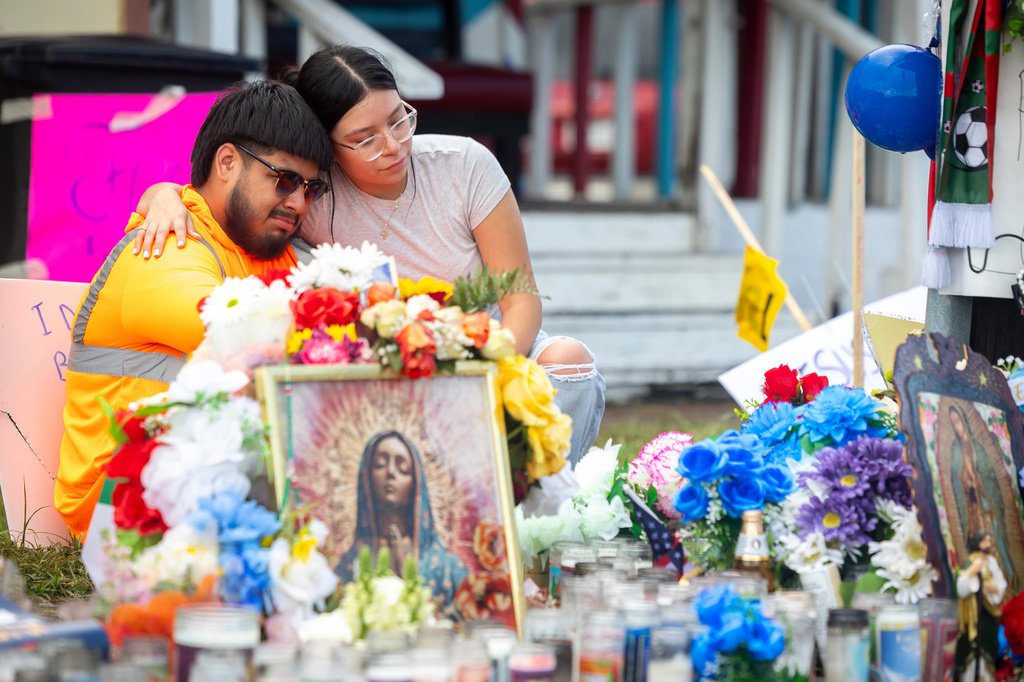
Over the past week, two events have laid bare the contradictions and failures of America's immigration system. On one hand, Folarin Balogun—a U.S. birthright citizen born to a visiting mother—became the breakout star of the World Cup, his citizenship questioned by those who oppose birthright citizenship. On the other, Lorenzo Salgado Araujo, an immigrant who lived in the U.S. for 35 years without a criminal record, was killed by ICE agents in Houston, reigniting calls for reform.
Balogun's Rise and the Citizenship Question
Balogun, who played for the U.S. men's national team after a youth career with England, found himself at the center of a political firestorm when Donald Trump interfered with his suspension over a controversial call. Critics noted that Balogun—born in the U.S. to a mother visiting temporarily—embodies the birthright citizenship Trump has long sought to end. Despite spending only two months in the country as an infant, Balogun's citizenship allowed him to represent the U.S., a choice that benefited the team but exposed the hypocrisy of those who celebrate his talent while opposing the policy that made it possible.

As one commentator observed, the same voices that cheered Balogun's performance often deny the legitimacy of his citizenship. This tension reflects a broader debate about who qualifies as a "real" American, a question that has intensified under the Trump administration's dismantling of post-Watergate ethics reforms. The contrast with Salgado's fate could not be starker.
Salgado's Death and the Human Cost
Lorenzo Salgado Araujo, an immigrant from Mexico, was killed by ICE agents during an operation in Houston. The government claims he attacked agents with his car, but witnesses dispute this account, and no body cameras were worn by the agents. Salgado, who had no criminal record, was not the target of the operation. He had been in the U.S. for 35 years, working, raising a family, and paying taxes—a story common among undocumented immigrants.
Advocates argue that Salgado's death exemplifies the dangers of a system that prioritizes enforcement over compassion. As the nation marks its 250th anniversary, stories of immigrant sacrifice are celebrated, yet current policies often vilify those who come without documents. This disconnect has fueled calls for reform, with some pointing to rising police decertification rates as a sign of broader accountability failures.
The Need for Comprehensive Reform
The juxtaposition of Balogun and Salgado highlights the arbitrary nature of U.S. immigration policy. Balogun's citizenship, though legally sound, is questioned by those who see immigrants as a threat. Salgado, who contributed to his community for decades, was killed while trying to regularize his status. The system, critics say, is broken—failing both those who seek opportunity and the nation that depends on their labor.
Proposals for reform, such as the bipartisan college sports reform bill that has stalled in Congress, show that cross-party cooperation is possible. Yet immigration remains a divisive issue, with mass deportations touted as a solution despite the human cost. The path forward, many argue, requires acknowledging the contributions of immigrants like Salgado and creating a system that offers a pathway to citizenship, as George W. Bush once championed.
As the investigation into Salgado's death continues, the broader question lingers: How did the U.S. move from proposals for compassionate reform to shooting immigrants in the street? The answer, for many, lies in the political exploitation of fear—a fear that blinds the nation to the value of those who come not to score goals, but to build lives.