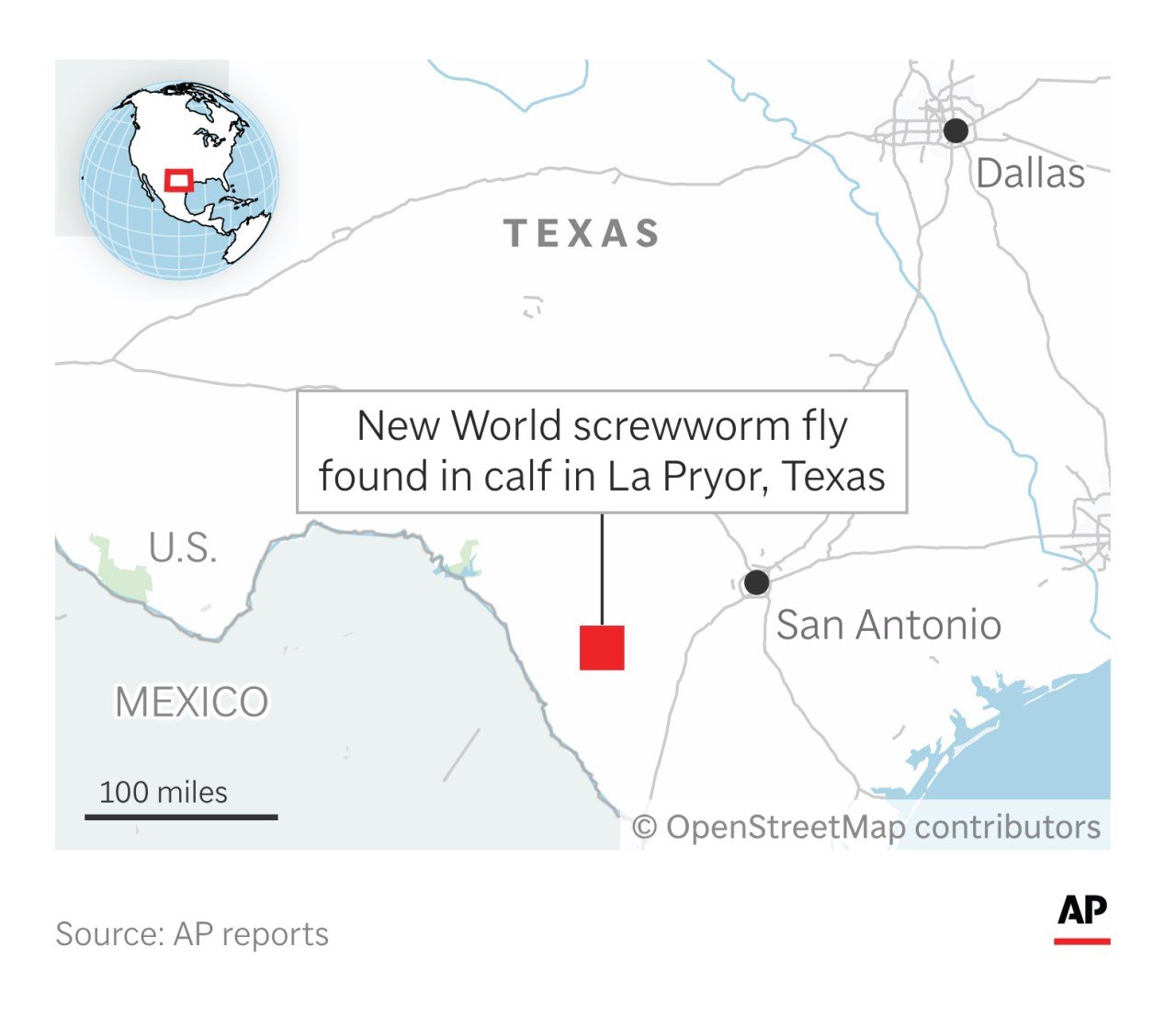
The New World screwworm fly has reappeared in the United States for the first time in more than half a century, with an infestation confirmed in a three-week-old calf in La Pryor, Texas. The discovery threatens the nation’s $113 billion cattle industry and has prompted an immediate quarantine and stepped-up eradication efforts.
Federal and state authorities confirmed the case on July 10, 2025, in Zavala County, about 100 miles southwest of San Antonio and just 50 miles from the U.S.-Mexico border. Texas is the top cattle-producing state, with an inventory worth $17 billion, making the outbreak a major economic and political flashpoint.

How the parasite spreads and why it’s dangerous
Unlike common maggots that feed on dead tissue, New World screwworm larvae consume live flesh and bodily fluids. Females lay eggs in open wounds or mucous membranes of any warm-blooded animal—livestock, wildlife, pets, and occasionally humans. A single infestation can kill an animal if untreated.
“Standard cattle handling—shearing, dehorning, even moving them through corrals—can create small breaks in the skin that attract the fly,” said Lee Haines, an associate research professor at the University of Notre Dame. Texas rancher Stephen Diebel, president of the Texas & Southwestern Cattle Raisers Association, warned that even wounds “as small as a tick bite” put cattle at risk.
Agriculture officials stress the fly does not infest food products, and U.S. Agriculture Secretary Brooke Rollins has said it is unlikely to disrupt beef supplies, though consumers already face record prices.
Quarantine and response
Texas State Veterinarian Bud Dinges imposed a 12-mile quarantine zone covering most of Zavala County and a sliver of neighboring Uvalde County. No animals may leave without inspection. Sheriff Eusevio Salinas said state officials set up road checkpoints to enforce the order, with hopes of containing the outbreak within days.
The U.S. Department of Agriculture has been dropping sterile male screwworm flies over south Texas since February, a technique that eradicated the pest in the U.S. by the 1960s. The most recent U.S. case before this was in 1966.
Ranchers are also taking proactive measures, including preventive injections and extra wound care after ear tagging and other procedures.
Political tensions and climate factors
The fly’s northward march has fueled cross-border friction. Rollins closed border entries to livestock in May 2025, a move she says delayed the parasite’s arrival by a year. She has criticized Mexico for insufficient animal movement controls—a charge Mexican authorities reject.
But experts point to climate change as a key driver. “Warmer temperatures are expanding the fly’s habitat, and cold snaps that used to kill them off are becoming less frequent,” Haines said. The pest was detected in Mexico in late 2024 after being confined to Panama for decades. Cases later spread to Costa Rica and Nicaragua, and a 2016 outbreak in the Florida Keys was contained after affecting wildlife.
Outside the U.S., the parasite has sickened more than 171,700 animals and 2,000 people across Central America and Mexico, with 10 human deaths, according to the CDC. A case was also confirmed last year in a Maryland man who had traveled to El Salvador.
The political clash over the response is intensifying as lawmakers debate funding for eradication. Meanwhile, the House recently passed a $7.1 billion agriculture and FDA funding bill that includes provisions for pest control.
“It’s hard to stay ahead of it because of how fast that fly is able to move and regenerate,” said University of Florida entomologist Edward Burgess. With the quarantine in place and sterile drops ongoing, officials are racing to prevent a wider outbreak that could devastate the cattle industry.