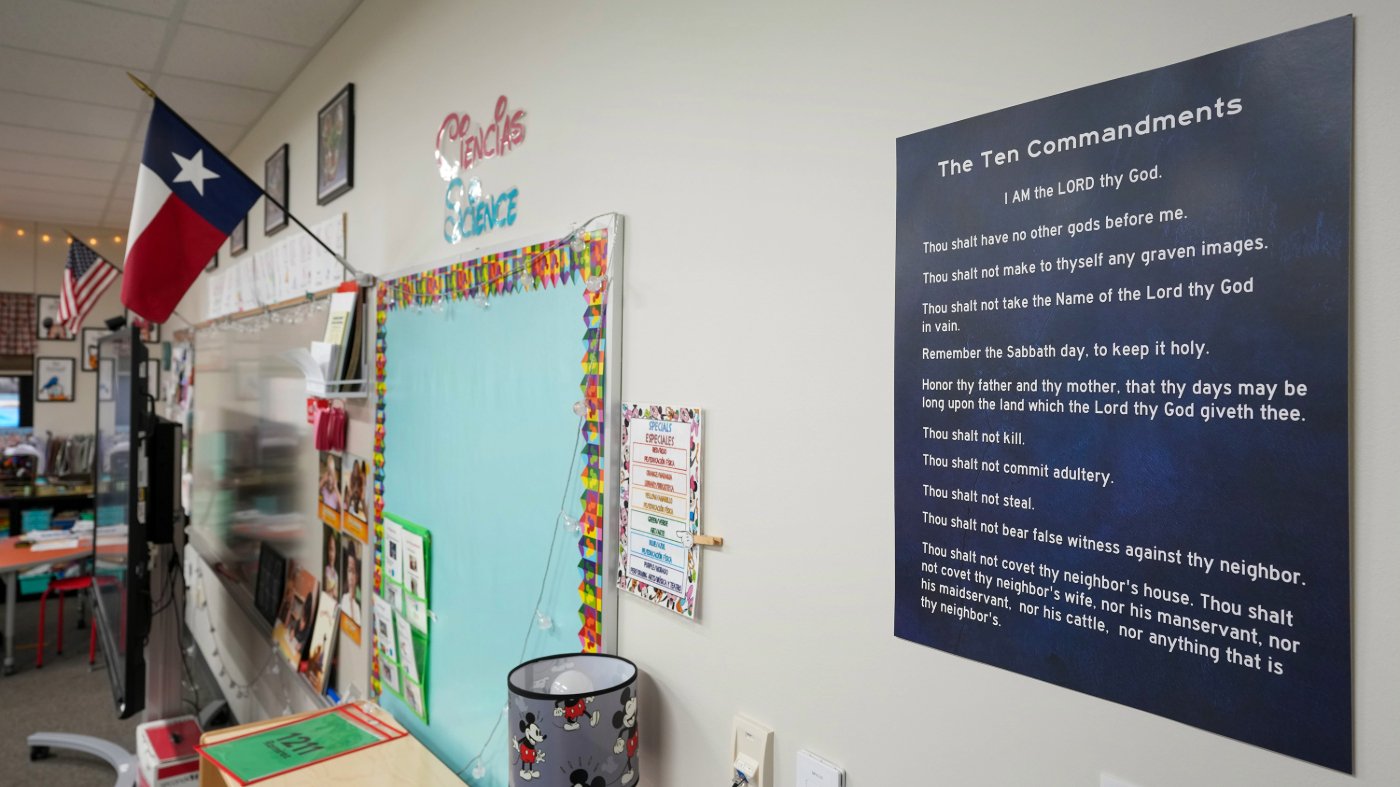
A federal appeals court has breathed new life into a Texas law that compels every public school classroom to display the Ten Commandments, a decision critics say effectively guts the First Amendment's Establishment Clause. The ruling by the Fifth Circuit Court of Appeals, issued by a narrow 9-8 majority, overturns earlier lower court injunctions and sets up a potential Supreme Court showdown.
Judge Kyle Duncan's majority opinion directly contradicts a 1980 Supreme Court precedent that struck down a nearly identical Kentucky law. But beyond that, legal scholars argue, the reasoning would make it nearly impossible to challenge any official state endorsement of a particular religious doctrine.
The Ten Commandments exist in multiple versions across different faith traditions. The Texas statute specifies the Protestant King James Bible text, which differs from Jewish and Catholic renderings. For instance, the Protestant version reads 'thou shalt not kill,' while the Jewish Bible says 'thou shalt not murder,' a distinction with implications for debates over pacifism and capital punishment. Catholics treat the prohibition on graven images as part of the first commandment, allowing religious statues, while the Protestant version treats it as a separate, stricter commandment—a divergence that historically fueled iconoclasm.
By mandating one specific version, the state effectively declares Protestantism correct and other interpretations wrong. The Supreme Court has repeatedly held that 'the clearest command of the Establishment Clause is that one religious denomination cannot be officially preferred over another.'
Judge Duncan dismissed that concern, arguing that for a court to even recognize the discrimination would require making a theological judgment, which he claimed would itself violate the Establishment Clause. Under that logic, a court could not find fault with a classroom poster declaring 'The Pope is the Antichrist' or 'Jews are damned,' because doing so would involve evaluating religious claims.
Legal experts point out that this reasoning makes nondiscrimination protections unenforceable. 'You can't perceive race discrimination if you can't tell who is Black,' noted one constitutional scholar.
Duncan also argued that the law imposes no penalty on students who disagree, and that they can ignore or laugh at the display. But University of Virginia law professor Douglas Laycock, in an amicus brief, countered that students 'will be confronted with the state's religious instruction every minute of every day and cannot opt out from this pervasive messaging,' which is more pervasive than the limited school prayers the Supreme Court has already ruled unconstitutional.
Texas Attorney General Ken Paxton, who faces his own legal troubles, defended the law, saying, 'The Ten Commandments have had a profound impact on our nation, and it's important that students learn from them every single day.'
The ruling comes as the U.S. religious freedom post remains vacant amid rising global persecution. For non-Christian and non-Jewish families, the law represents official proselytization they cannot shield their children from.
The Supreme Court, which now has a 6-3 conservative majority, may be sympathetic to Duncan's approach. James Madison, principal author of the First Amendment, warned that 'the Civil Magistrate is a competent Judge of Religious Truth' is 'an arrogant pretension.' The Texas legislature evidently disagrees.