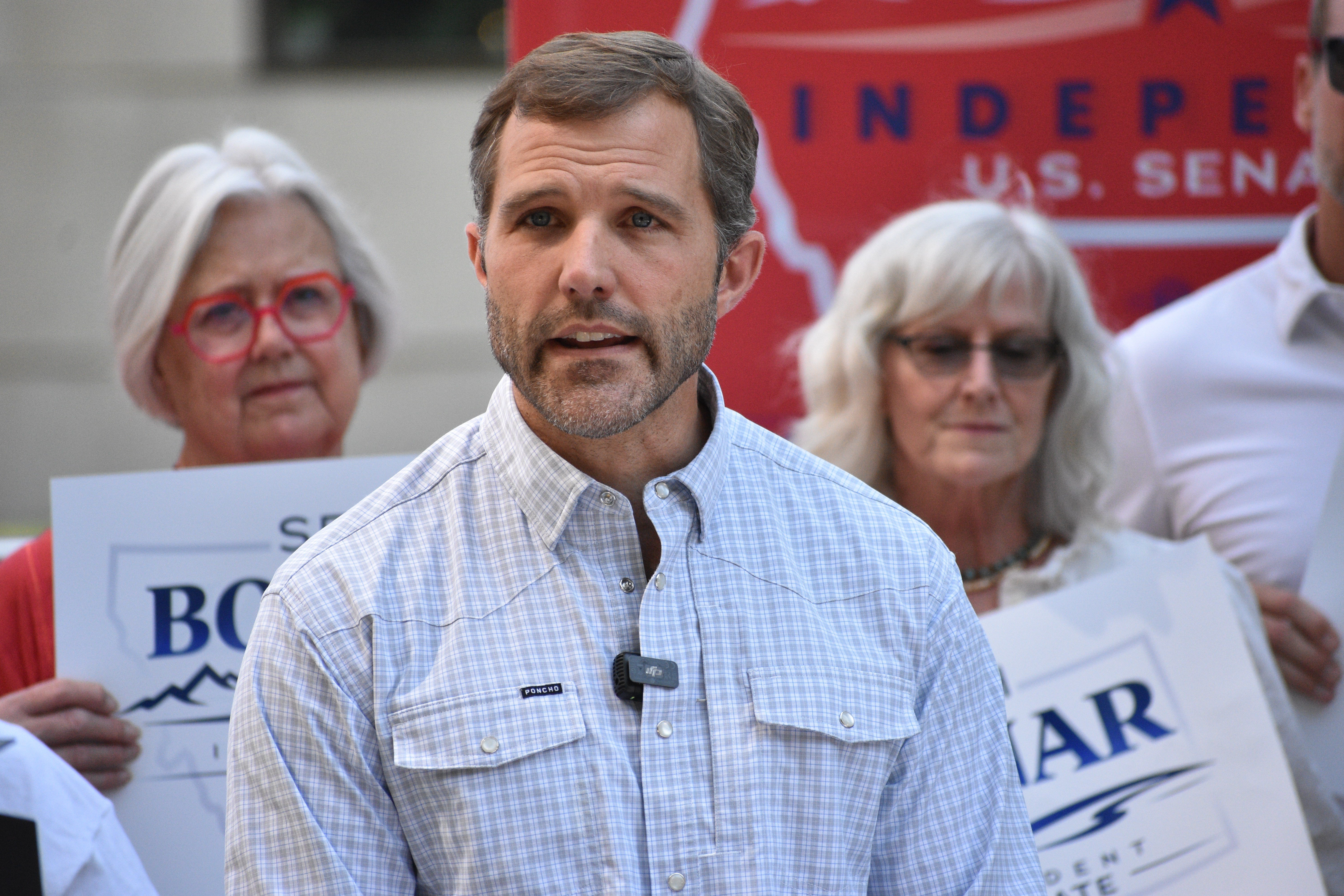
When Democrat David Roth ended his U.S. Senate campaign in Idaho on July 28, he did not mention the man his exit was designed to help. Todd Achilles, a former Democratic state representative, is now running as an independent against Sen. Jim Risch (R-Idaho). When Achilles called it a two-person race, he didn't mention Roth either.
Neither man wanted to draw attention to what had just happened.
That silence was notable, because this wasn't an isolated incident. It's the third time this cycle a Democratic Senate nominee has stepped aside to let a supposedly independent candidate—or at least someone without an official “D” next to his name—take the field alone against a Republican incumbent.
Individually, each case looks like a local story about a longshot candidate fizzling out. Together, though, they look like a nationwide Democratic strategy—something the party would certainly never admit to, and one that says more about the state of the Democratic brand than its leaders likely want to discuss.
In Nebraska, Cindy Burbank won the Democratic Senate primary in May after openly promising she would drop out if she saw no path to victory. She kept that promise on July 17, exiting the race just as independent Dan Osborn qualified for the ballot by petition. This set up a one-on-one race against Sen. Pete Ricketts (R-Neb.). The secretary of state had already tried to remove Burbank from the ballot for not being a “good-faith candidate.” She sued her way back on, then dropped out to help Osborn, exactly as expected.
In South Dakota, Democrat Julian Beaudion dropped out in early August after months of insisting he'd never quit the race. A former state trooper, Beaudion looked like an ideal Democratic candidate on paper. But the challenge to Sen. Mike Rounds (R-S.D.) will now fall to independent Brian Bengs, a former Democrat who was trounced by Sen. John Thune (R-S.D.) in 2022.
In Idaho, the Ada County Democratic Central Committee—covering Boise, the state's Democratic stronghold—sent Roth a public ultimatum in early July: Raise real money and produce a new plan, or the party would consider endorsing Achilles instead. Roth had raised just over $8,000 to Achilles' $700,000 and Risch's $3.5 million. Roth called the demand “ridiculous” and vowed to stay in, but three weeks later, he dropped out without explanation.
The same conversation is happening in Montana. Democratic nominee Alani Bankhead (D) has so far refused pressure to withdraw in favor of independent Seth Bodnar, even after the state party chair was found to have quietly solicited legal advice on handling a potential vacancy.
Four states, four Republican-held Senate seats, four Democratic parties pulling or considering the same maneuver of vacating their own ballot line so that a technically unaffiliated candidate can run without the baggage of the Democratic label.
None of this is illegal, and it's not new—Angus King and Bernie Sanders have caucused with Senate Democrats for years without anyone calling it a scandal. What's new is the intentionality. National Democrats aren't just tolerating friendly independents anymore; in at least two of these races, state party infrastructure actively worked to clear the field for them.
It makes a certain amount of sense. In states like these, “Democrat” is usually a losing brand in statewide races, regardless of a candidate's actual positions. An independent can absorb anti-incumbent energy and deep-red dissatisfaction with national Republicans in ways a Democratic nominee simply cannot, no matter how moderate that nominee might be.
Timing matters, too. These withdrawals are landing just as centrist Democrats panic over the rise of the Democratic Socialists of America. The New York Times recently reported that Third Way and other centrist organizations are preparing for what one leader called the “next war”—not against Republicans, but against the party's own socialist wing, newly emboldened by Senate primary victories by Michigan's Abdul El-Sayed (D) and Florida's Angie Nixon (D).
Democrats are purging their brand from red-state ballots and bracing for a civil war over that same brand everywhere else. When a party isn't sure what it stands for, it is easier just not to say anything.
Idaho Democrats had made a habit of swapping candidates on their own ballot line, but the legislature closed that loophole in 2025, declaring that the winner of the primary must be the candidate in November, barring death or disqualification. Simply withdrawing in favor of an independent does not violate that law, but it is still a betrayal of the party's own voters.
How voters respond to this nationwide strategy remains to be seen. The independents in these four races still trail their Republican opponents in the polls and in fundraising. But the strategy tells on itself. A party confident in its own name doesn't need to find ways not to use it. Is that shrewd coalition building? Or a quiet admission of brand failure? It depends on which Democrat you ask.
Brian Almon is chairman of Idaho's District 14 Republican Party, a trustee of the Eagle Public Library Board, and editor of the Gem State Chronicle.