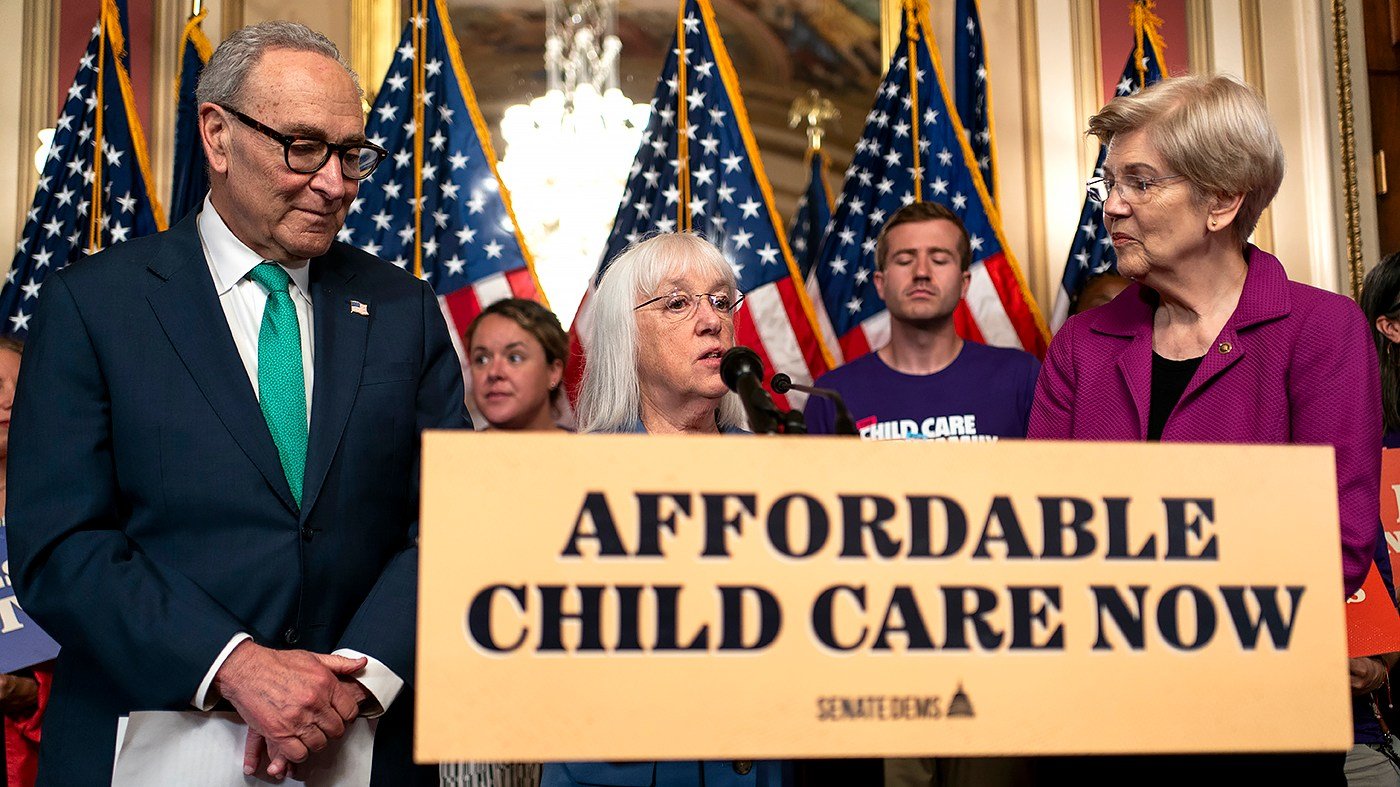
As the 2026 midterm elections approach, Democratic candidates, policymakers, and advocacy groups are coalescing around a once-fringe issue: affordable childcare. The party’s emerging affordability platform treats childcare as essential economic infrastructure, on par with roads and broadband, and a key to lowering everyday costs for working families.
Recent off-year victories in Virginia, New Jersey, and New York City were powered in part by candidates who made childcare subsidies and availability central to their campaigns. Now, with control of Congress potentially within reach, Democratic leaders are preparing to translate that momentum into legislative action.
“It’s become a prerequisite for running for president that you need to have a plan to solve for childcare,” said Julie Kashen, founder of Women’s Economic Futures, a policy research group. Kashen noted that the COVID-19 pandemic exposed the fragility of the childcare system and demonstrated what sustained federal investment could achieve. Emergency relief funds, which expired in 2024, allowed states to experiment with new models, and many saw tangible improvements in affordability and access.
In Congress, a working group co-chaired by Sens. Elizabeth Warren (D-Mass.) and Patty Murray (D-Wash.), along with Reps. Alexandria Ocasio-Cortez (D-N.Y.) and Bobby Scott (D-Va.), released a framework in June calling for a “strong and stable public infrastructure” for childcare, including higher pay for workers. Rep. Katherine Clark (D-Mass.), the House Democratic whip, has introduced the Child Care is Infrastructure Act, which would fund facility construction and student loan relief for early educators.
State-level experiments are providing blueprints. New York City is phasing in universal pre-K for 3- and 4-year-olds; Washington, D.C., offers free pre-K in public schools; and New Mexico, using oil revenue, now guarantees no-cost childcare. These initiatives have raised expectations for what federal policy could achieve.
“Any solution must have a supply-side answer,” Kashen said. “You can’t just put money into tax credits and hope for the best. We don’t have enough childcare for every family that wants it, and even when we do, many can’t afford it.” She argued that simply giving parents more money won’t work if there are no available slots.
The issue is not entirely partisan. In 1971, Congress passed a bipartisan national daycare bill, but President Nixon vetoed it. Today, some Republicans support reauthorizing the Child Care and Development Block Grant, which helps low-income families. However, the Trump administration has sought to cut federal childcare spending and reduce regulation, framing it as an effort to curb fraud and government overreach.
With the 2028 presidential race already looming, childcare is likely to become a litmus test for Democratic hopefuls. The party’s ability to deliver on this promise could shape both the midterm outcome and the next primary season. As Ocasio-Cortez’s political future remains tied to her progressive advocacy, the childcare push may also influence her and others’ national trajectories.
Democratic leaders are aware that the window for action is narrow. If they win majorities, they will face pressure to prioritize childcare alongside other affordability measures. The question is whether they can forge a consensus between those favoring direct subsidies and those pushing for systemic supply-side reforms.