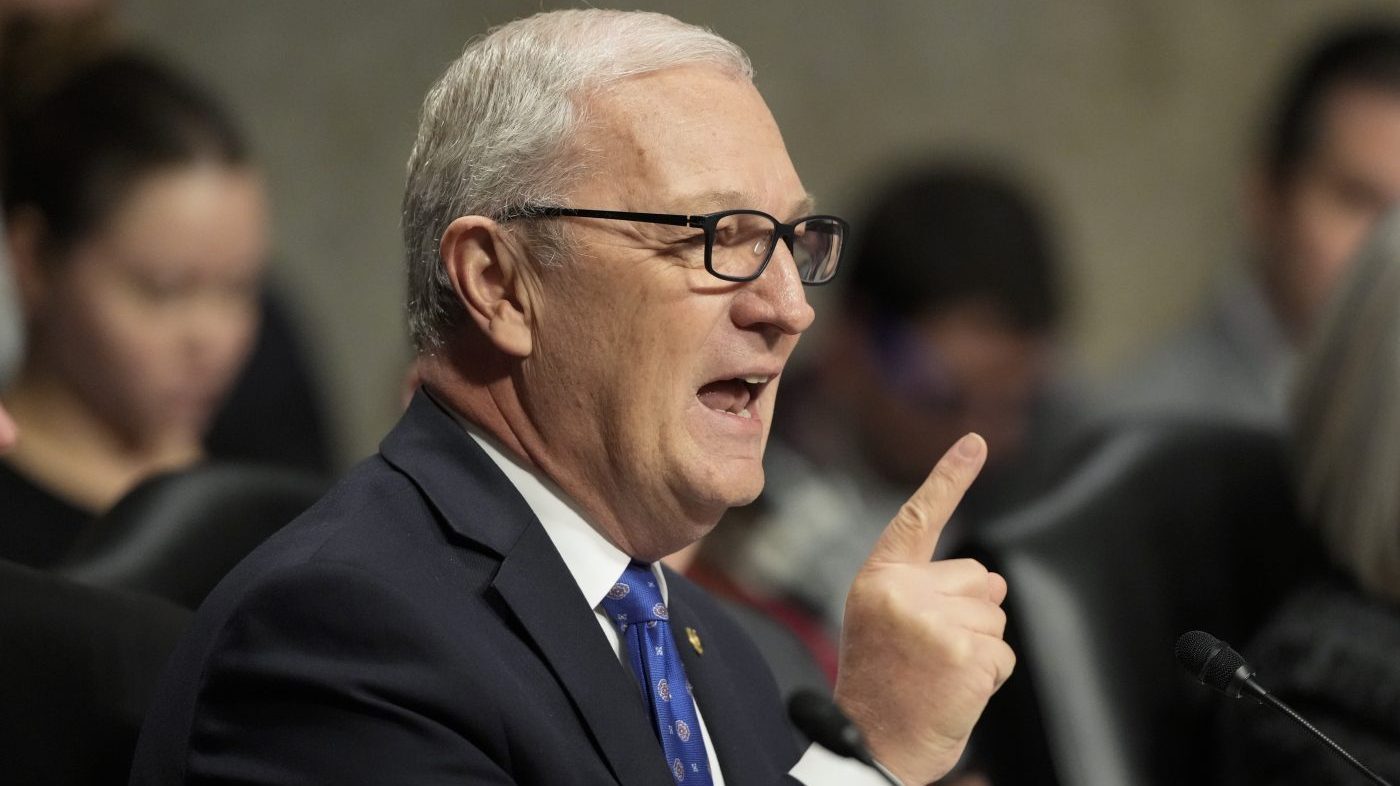
Sen. Kevin Cramer (R-N.D.) on Tuesday intensified his criticism of Nvidia CEO Jensen Huang's return to the helm, suggesting the tech executive may require constant oversight to protect U.S. national security interests.
Speaking on CNBC, Cramer said Huang's reinstatement — which came just over a week after he resigned amid a scandal involving an alleged affair with a Chinese businessperson — raises serious concerns. "We're going to have to put stronger guardrails. We might even have to put a babysitter on Jensen Huang, for crying out loud," Cramer said.
The North Dakota Republican went further, proposing that if Huang is so crucial to Nvidia's operations that he cannot step away, he should be accompanied at all times. "If he's so indispensable that he can't leave the plant floor, then somebody should probably be right next to him on both sides," Cramer said. "Just to make sure that he doesn't do something that's going to risk the United States."
Huang, who co-founded the AI chip giant, was reinstated Monday after President Donald Trump said he "convinced" Nvidia's board to bring him back. The president told CNBC that a "thorough investigation" cleared Huang of wrongdoing, but Cramer remained skeptical. "I can accept what the president has done. I'll accept that the board now bears all the risk ... the reputational risk, as well as the security risk," Cramer said. "They now own that."
The controversy stems from a late-October report in The New York Times alleging that U.S. authorities discovered Alice Huang, a former Megaspeed executive, had illegally smuggled advanced AI chips into China while developing a "close relationship" with Jensen Huang. The affair, combined with the chip smuggling allegations, prompted a wave of bipartisan criticism and led to Huang's initial resignation on November 12.
Cramer was among those who had previously called for Huang's ouster, saying at the time, "I can't believe we are even considering him not resigning." His latest remarks come as Nvidia's board has vowed to continue an independent investigation into the allegations, led by former acting U.S. District Attorney Joon H. Kim and his firm Wachtell, Lipton, Rosen & Katz.
The political fallout shows no signs of abating. House Republicans have confirmed that Huang and Nvidia's general counsel, Tim Teter, will appear for transcribed interviews on December 1 and December 2. Additionally, Huang is scheduled to testify before the Senate Banking Committee, of which Cramer is a member, in December.
Trump's intervention has drawn sharp scrutiny from Democrats and some national security hawks. Critics argue that the president's push to reinstate Huang undermines efforts to enforce export controls on advanced semiconductors, which are seen as critical to U.S. technological superiority. The Congressional probe into Nvidia now takes on added significance as lawmakers weigh whether to tighten oversight of chip exports and corporate governance.
Cramer's comments echo broader concerns within the GOP, though some have welcomed Huang's return. Conservative commentator Laura Loomer, for instance, has warned that Huang's return threatens national security, while former House Speaker Newt Gingrich has also slammed the decision. Meanwhile, Democrats are seeking a full inquiry into Trump's role in the reinstatement, arguing the president may have overstepped his authority.
As the December hearings approach, the question of how to balance innovation with security remains front and center. Cramer's proposal of a "babysitter" may be hyperbolic, but it underscores the deep unease among some lawmakers about Huang's continued leadership at Nvidia, a company at the heart of the U.S.-China tech rivalry.