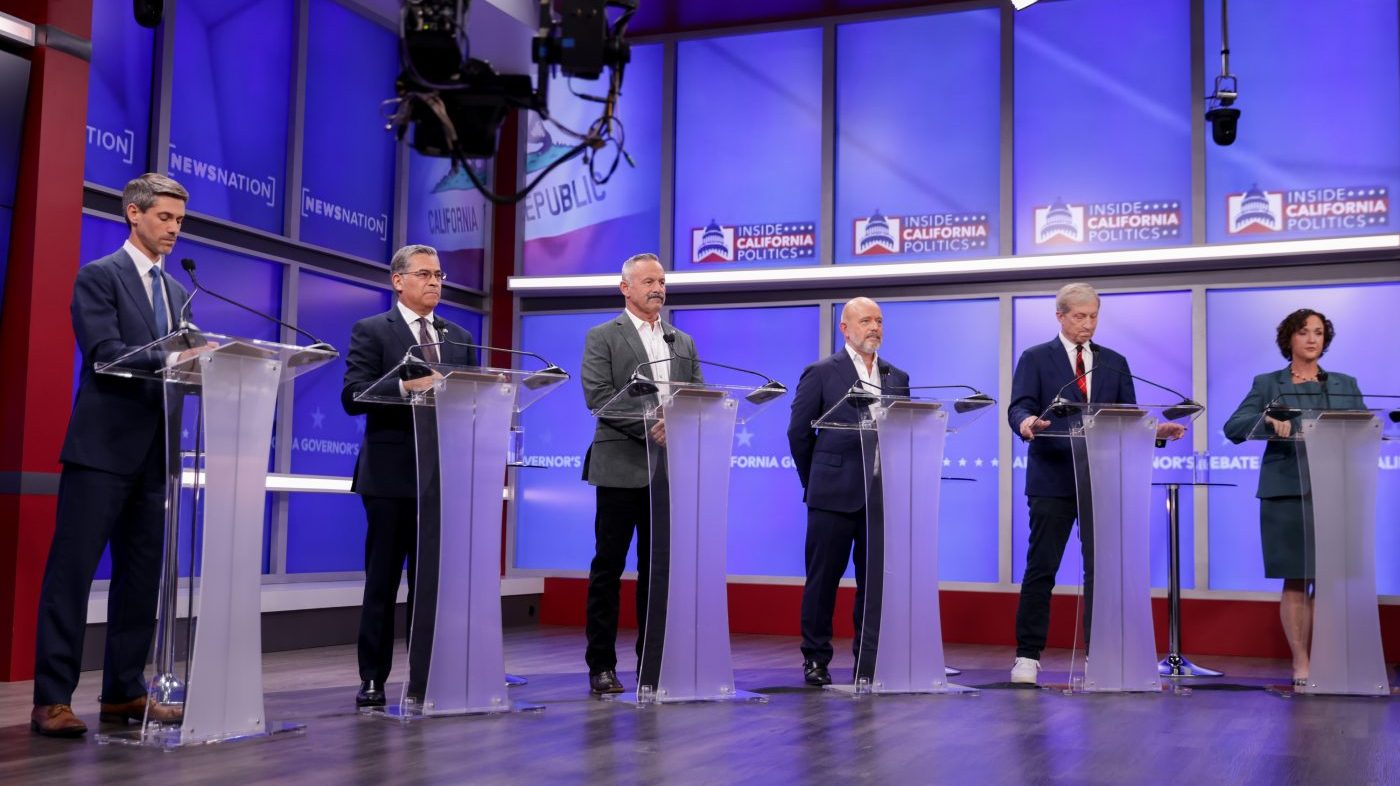
Six candidates vying to become California's next governor met Wednesday in a debate that did little to clarify a crowded and unsettled Democratic field just weeks ahead of the June primary. The forum, which followed the abrupt exit of former frontrunner Rep. Eric Swalwell, left political observers with more questions than answers as the party struggles to unify behind a standard-bearer.
The debate unfolded against a backdrop of recent upheaval. Swalwell, a Democratic congressman seen as a leading contender, suspended his campaign and resigned from Congress after facing sexual assault allegations, which he denies. His departure, coupled with Democrat Betty Yee dropping out this week, has narrowed the field but amplified concerns that a splintered Democratic vote could allow two candidates from the same party to advance to the general election under California's top-two primary system.
A Civil Stage Without a Commanding Presence
Despite high stakes with the primary just over a month away, the 90-minute debate in San Francisco was notably civil and lacked the political fireworks candidates needed to create a breakout moment. The rivals engaged in generally polite exchanges, largely avoiding controversial territory. All Democratic participants pledged to support whichever party member advances to the general election.
The onus was on the Democrats to distinguish themselves and capitalize on Swalwell's absence, but it remained unclear whether any candidate succeeded in shifting the dynamics of the race. Campaigns quickly turned to social media to amplify moments, with billionaire Tom Steyer's team highlighting a verbal stumble by former Health and Human Services Secretary Xavier Becerra, who mistakenly referenced a "war in Iraq" instead of Iran.
Democrats Tread Lightly on Newsom's Record
A notable feature of the debate was the Democratic candidates' reluctance to offer sharp criticism of term-limited Governor Gavin Newsom, who has refrained from endorsing a successor. When asked to grade Newsom's handling of homelessness, Becerra awarded an "A for effort," the highest mark among Democrats. Former Rep. Katie Porter gave a B, crediting Newsom for calling attention to the problem, while Steyer offered a B-minus.
San Jose Mayor Matt Mahan attempted to sidestep the question before settling on a B for policy and a D for implementation for all Democrats. In contrast, the two Republican candidates—former Fox News host Steve Hilton and Riverside County Sheriff Chad Bianco—both gave Newsom failing grades. Newsom, for his part, has remained publicly neutral, telling reporters this week he is "supporting a Democrat in the runoff" and noting there are "a lot of outstanding candidates."
Swalwell's Shadow and a Focus on Rumors vs. Facts
The controversy surrounding Swalwell's exit received limited attention during the debate. Becerra, who served with Swalwell in Congress, was asked about rumors he had heard regarding the former lawmaker during their time together in the House Democratic Caucus. Becerra deflected, stating, "You hear rumors all the time about all sorts of things. Rumors are not facts, and the caucus... is not a place that adjudicates those things. It's law enforcement that does."
He praised survivors for coming forward with allegations and noted his own work on sex trafficking cases as California attorney general. The discussion underscored how the party is navigating the sensitive fallout from Swalwell's campaign collapse, which has further scrambled a primary where Democrats are keen to avoid a scenario that could benefit Republican candidates like Chad Bianco, who is positioning himself as a conservative alternative.
With the primary rapidly approaching, the debate failed to produce a commanding frontrunner, leaving the field in a state of flux. The candidates now face the challenge of breaking through in a condensed timeframe, as the party grapples with internal cohesion ahead of a critical election that will shape California's political future. The dynamics of this race echo broader national tensions within the Democratic party, reminiscent of shifts seen in other states following significant electoral changes, such as the recent redistricting victory in Virginia that bolstered Democratic prospects.