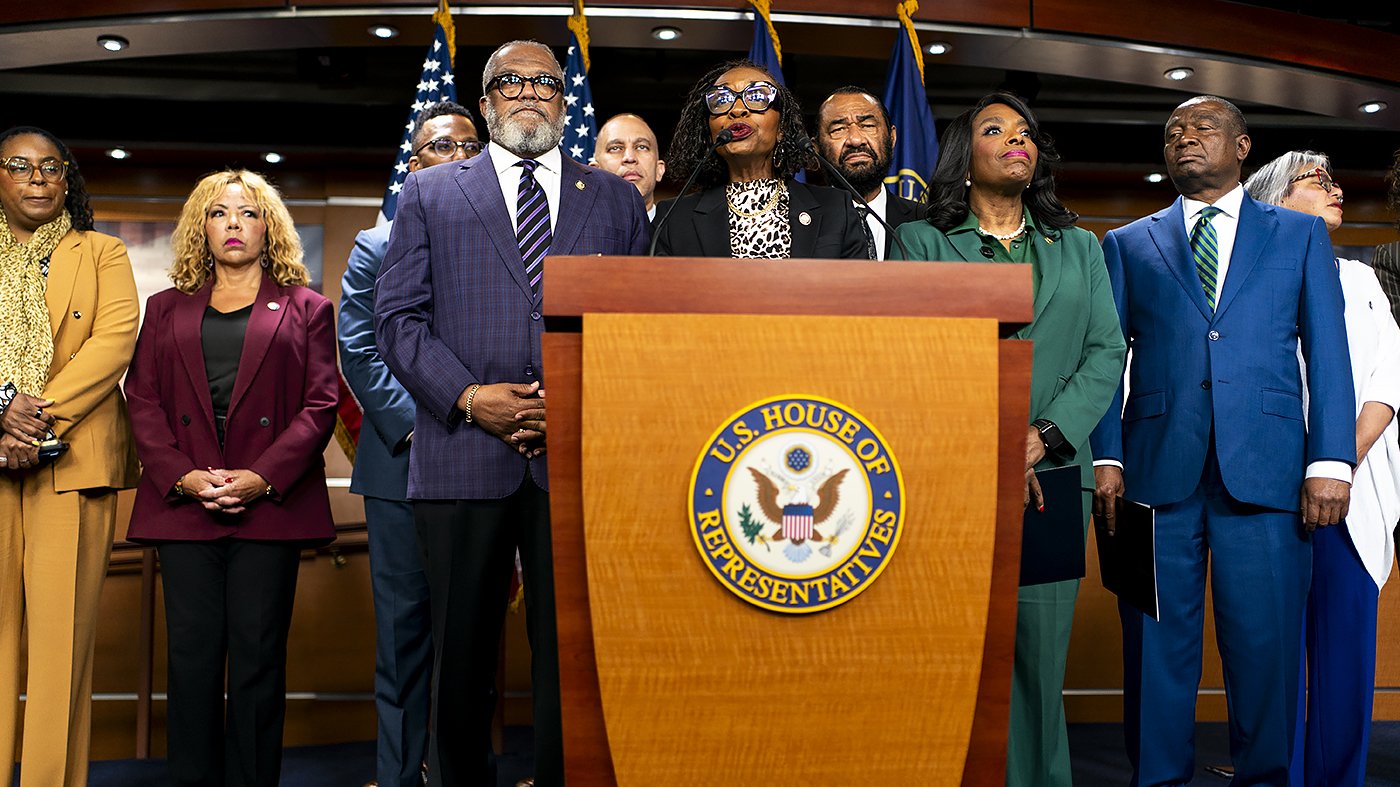
Black Democrats on Capitol Hill are escalating their condemnation of Republican-led redistricting efforts, charging that the GOP is systematically dismantling minority representation in Congress. Lawmakers argue that these moves, combined with a recent Supreme Court ruling, are effectively reviving the discriminatory practices of the Jim Crow era.
“What they have done in eviscerating the Voting Rights Act is to put us back in a position where Jim Crow can be the rule of the day for Black people,” said Rep. Hank Johnson (D-Ga.). “We are now, legally, in a posture where Black communities are not able to enforce a right to elect the representatives of their choice. And that is undemocratic, it’s racist, it’s wrong.”
The fury is particularly acute inside the Congressional Black Caucus (CBC), which faces the loss of several members due to newly drawn maps. Republicans insist their goal is to remove race as a factor in redistricting, but Democrats see a more sinister motive: suppressing the Black vote. “It has nothing to do with party, it’s about race,” charged Rep. Bennie Thompson (D-Miss.). “Republicans are acting irrational by kicking Black folk out of Congress.”
The tension spiked after the Supreme Court ruled in Louisiana v. Callais that the state’s creation of a second Black-majority district was an unconstitutional gerrymander. Writing for the 6-3 majority, Justice Samuel Alito argued that Black voter turnout had improved so dramatically that the anti-discrimination goals of the Voting Rights Act were largely met. “Vast social change has occurred throughout the country and particularly in the South,” Alito wrote.
Black Democrats reject that reasoning. They echo the late Justice Ruth Bader Ginsburg, who warned in 2013 that gutting the VRA based on progress was “like throwing away your umbrella in a rainstorm because you are not getting wet.” House Minority Leader Hakeem Jeffries (D-N.Y.) called the developments an “unprecedented assault on Black political representation — the likes of which we have not seen since the Jim Crow era.” He added, “The ghost of the Confederacy has afflicted the United States Supreme Court majority and is invading and haunting the nation right now.”
The ruling has triggered a rush among red states to redraw maps. Tennessee led the way, carving up the Black-majority Memphis district held by Rep. Steve Cohen (D-Tenn.) into three Republican-leaning seats. Cohen, who is white, announced his retirement, noting that Republicans split the Black vote evenly among the new districts — a move he said proves race was a factor. “It’s power, but it’s definitely race, too,” Cohen said.
Louisiana’s state Senate has passed a map eliminating one of its two Black districts. Alabama is moving to remove one of its two Black Democratic incumbents. And South Carolina Republicans are targeting Rep. James Clyburn (D-S.C.), a civil rights icon and the state’s lone Democrat, for ouster. Clyburn has vowed to fight, calling the GOP “white nationalists” orchestrating a coordinated return to racial discrimination. “This is no... [the article continues with further details on Clyburn’s stance],” he said.
The developments have sparked broader concerns about the erosion of voting rights. Some Democrats warn that the party’s failure to address working-class economic issues could compound their midterm losses, while others point to the Virginia governor’s sharp criticism of the Supreme Court’s redistricting decisions. As the battle intensifies, the CBC is bracing for a prolonged fight to preserve Black political power in Congress.