Sen. Bernie Sanders (I-Vt.) has transformed from a political outlier into the central force reshaping the Democratic Party. Once dismissed as a gadfly socialist, Sanders now sees his policy platform and endorsed candidates driving the party's direction, particularly among younger voters.
Traditional left-leaning Democrats are finding themselves sidelined as Sanders-backed progressives notch victories nationwide. The party's center of gravity has shifted decisively leftward, leaving many centrist incumbents struggling to adapt.

Sanders first entered Congress in 1991 as a House member and moved to the Senate in 2007. Though he caucuses with Democrats as an independent, his two presidential runs—first in 2016, when he won 23 primaries and 46 percent of the vote against Hillary Clinton, and again in 2020, when he briefly led the field before the establishment coalesced around Joe Biden—cemented his influence.
Now 85, Sanders is too old to run again in 2028 but remains a powerful kingmaker. Progressive candidates across the country seek his endorsement, much as Republican hopefuls court Donald Trump's backing. Politico reports that Sanders-endorsed candidates "cleaned house" in recent primaries, including a resounding win for his Senate pick in Maine, Graham Platner, despite Platner's vulnerabilities.
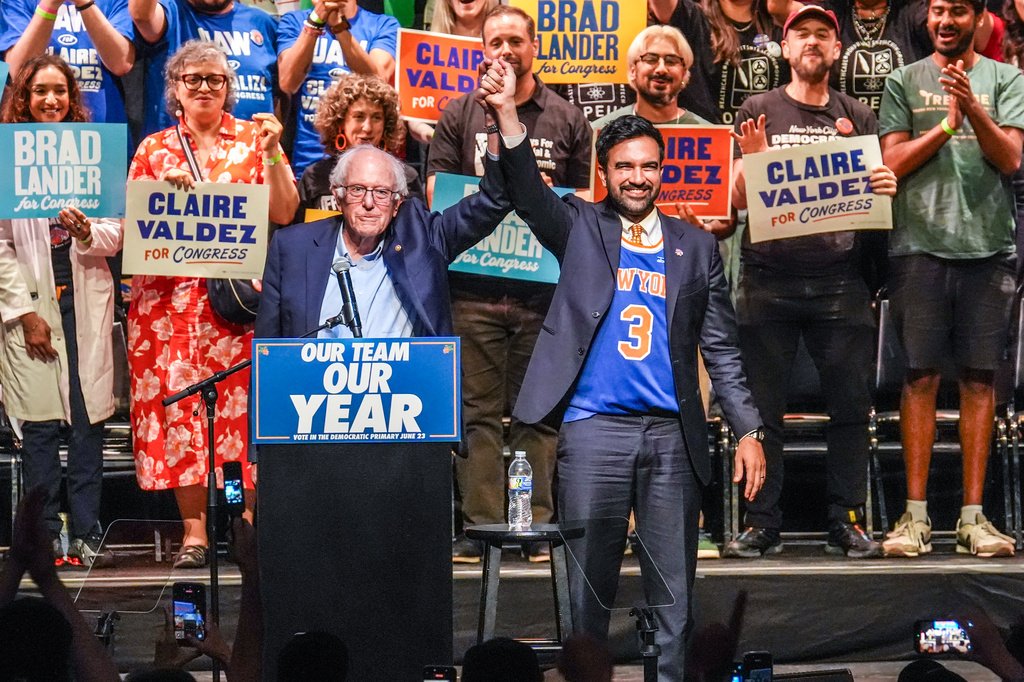
Sanders' endorsement list features 20 new House and Senate candidates and 69 state and local contenders. He also rallies with progressive incumbents like Rep. Alexandria Ocasio-Cortez (D-N.Y.), part of the so-called Squad, on a "fighting oligarchy" tour drawing massive crowds even in red states.
The shift is reflected in polling. A September 2025 Gallup survey found 66 percent of Democrats view socialism positively, compared to 42 percent for capitalism. Republicans overwhelmingly favor capitalism, 74 percent to 14 percent. Democrats' approval of big business has hit a new low of 17 percent, while 36 percent of independents share that view.
The progressive agenda includes raising taxes on the wealthy, imposing new wealth taxes, expanding government regulation, and establishing a government-run universal healthcare system. Two non-negotiable demands are opposition to Israel—including calls to condemn Israel's actions in Gaza as genocide—and denouncing billionaires.
Centrist Democrats like Pennsylvania Gov. Josh Shapiro and former Obama aide Rahm Emanuel face an uphill battle to prevent the party from drifting further left. The question for 2028 is whether the party will fracture, as it did in 1948 when segregationist Dixiecrats broke away. A Berniecrat split could reshape the electoral map.
As Sanders' influence grows, Democrats must decide whether to embrace his socialist vision or risk internal conflict. The outcome will define the party's future and its ability to compete nationally.