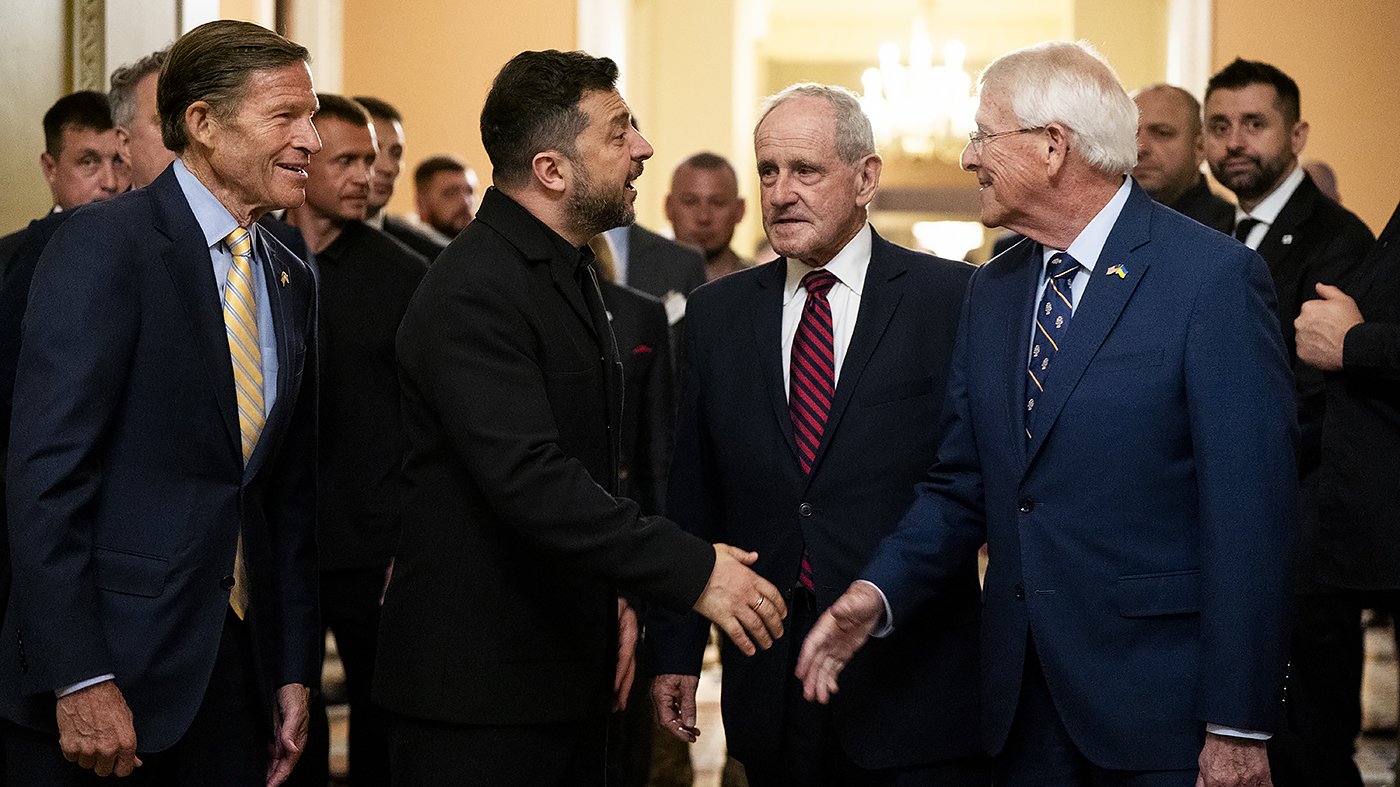
Ukrainian President Volodymyr Zelensky met with senators at the Capitol on Tuesday, making a direct appeal for additional U.S. military support—specifically anti-ballistic missiles—and underscoring what he described as Ukraine's growing battlefield momentum in the war against Russia. The meeting came just before the Senate voted to advance legislation that would impose new sanctions on Moscow and slap steep tariffs on nations that purchase Russian energy.
“This bill is very important, sanctions pressure on Russia is very important,” Zelensky told reporters after the closed-door session. “It's not only about money, how to stop Russia financing this war, but it's also a big signal to Europe, big signal to Ukraine, big support of our people.”
The more-than-hour-long meeting included Finland's President Alexander Stubb. Both leaders were in Washington to attend memorial services for the late Sen. Lindsey Graham (R-S.C.), who had been the driving force behind the Russia sanctions bill. Graham had secured a breakthrough with the White House to gain President Trump's backing for the legislation shortly before his sudden death earlier this month.
Sen. Katie Britt (R-Ala.) said Zelensky and Stubb emphasized that passing the sanctions bill is essential not only to financially hold Putin accountable, “but also morale and showing that we're ready to see this result.” Lawmakers said Zelensky provided a battlefield update, noting that Ukraine's increasing use of drones has pushed Russian forces onto the defensive, both on the front lines and in strikes against Russian oil facilities and military targets deep inside the country.
Sen. Roger Wicker (R-Miss.) said Zelensky “realizes we're not out of the woods yet. The momentum is in Ukraine's favor, but winter's coming on in just a few months and there's much more to do.” Fighting is expected to continue through the winter without a ceasefire breakthrough, and Ukrainians suffered heavily last year under Russian attacks on the energy grid aimed at freezing them in their homes.
Sen. John Hoeven (R-N.D.) said Zelensky specifically requested more anti-ballistic missiles in the short term, while awaiting advanced technology from NATO allies expected “next year.” Zelensky also highlighted Ukraine's success with drone warfare. “Overall, they're doing very well,” Hoeven said. “They're inflicting much more casualties on the Russians than the Russians are on the Ukrainians. The ratio is like eight to one, which is remarkable.”
Hoeven added that when he asked about troop recruitment, Zelensky said Ukraine is raising about 30,000 recruits a month compared to Russia's 40,000, but compensating with technological superiority. The senator described the meeting's tone as “upbeat,” more so than previous Zelensky visits, because Ukraine “has changed the tenor of the war” through its tech advances.
Zelensky has long stressed the need for air defense systems to counter Russian ballistic missiles. In a recent interview with Sky News, he said sanctions have failed to curb Russia's ballistic missile production. “Ukraine's domestic production allows us to down drones and many other things, but we can't shoot down ballistic missiles,” he noted.
The sanctions bill also featured prominently in the meeting, with Zelensky urging senators to vote for it, arguing any financial squeeze on Russia will help. The legislation already enjoys broad Senate support, but some Democrats have expressed caution because it grants Trump more authority to impose tariffs. The bill also includes Iran sanctions, a key priority for the president.
Zelensky has increasingly highlighted the Russia-Iran axis, especially as the U.S. war with Iran enters its fifth month. Over the weekend, Zelensky said Ukraine struck a Russian vessel carrying military cargo and a warship in the Caspian Sea that originated from Iran. Iran countered that the target was a commercial vessel and that a sailor was killed. The incident underscores how the two conflicts are converging. Iran has long supplied Russia with Shahed attack drone technology, and Zelensky claims Ukraine has evidence Russia is sharing satellite imagery of U.S. troop positions in the Middle East.
Zelensky's discussion with lawmakers followed his meeting with Trump earlier in the day, which the White House described as positive and productive. That meeting led to talks about reviving peace negotiations, with an offer to send Steve Witkoff and Jared Kushner to Kyiv and then Moscow. Witkoff, a close Trump ally and special envoy for peace missions, and Kushner, Trump's son-in-law, have been the main points of contact with Russian President Vladimir Putin but have never visited Ukraine.
Trump, speaking alongside Zelensky earlier this month at the NATO summit, acknowledged Ukraine's battlefield gains and long-range strikes were pressuring Putin to negotiate. It was at that meeting that Trump agreed to green-light Patriot missile co-production. Zelensky used Tuesday's meeting to follow up on those Patriot licenses, critical for defending against Russian ballistic missiles—though any production is likely still years away.