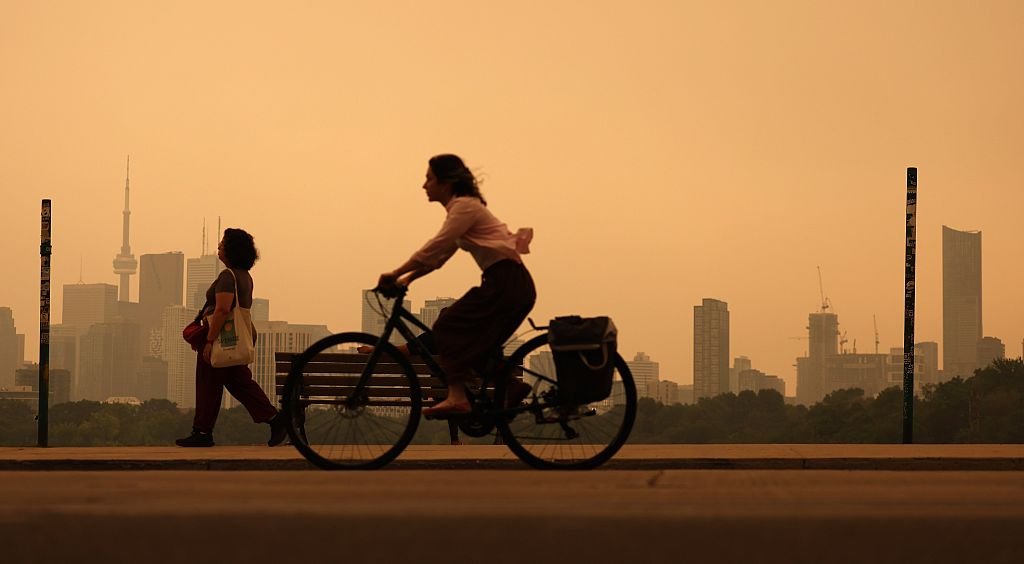
Wildfires raging in Canada and Minnesota have pushed a thick plume of smoke across a vast stretch of the United States, turning skies an eerie orange and raising serious air quality concerns. The haze, which descended on Wednesday, is forecast to stick around—and in some areas intensify—before a potential reprieve arrives over the weekend.
According to meteorologist Darrius Stringer, the densest smoke on Wednesday settled over Buffalo, New York; Michigan’s Upper Peninsula; and eastern Minnesota. Upper-level winds are expected to continue funneling the smoke south and east from the more than 100 active Canadian fires through Thursday and into early Friday. By Thursday morning, heavy smoke is predicted for New York, Ohio, Michigan, and Wisconsin, while lighter to moderate haze could stretch from Philadelphia to Chicago and Minneapolis.

“Our major cities are still going to be dealing with some pretty extensively deep smoke,” Stringer said, pointing to forecasts for Milwaukee, Cleveland, and Philadelphia. The smoke is projected to push even farther south into the Midwest, Appalachia, and along the East Coast by Friday, even as conditions improve slightly in northern areas.
The first sign of relief may come Saturday, when storms and rain are possible in the Northeast and upper Midwest. If those storms materialize, they could help clear the smoke from the air. “Maybe by Saturday into Sunday, we start to see those conditions improve,” Stringer noted, “but the smoke will continue to linger around for the next several days.” By Sunday, most states are expected to see cleaner air, with the worst air quality confined to Minnesota’s border with Canada.
However, the smoky summer may be far from over. Minnesota officials warn that large fires could burn for months. “It could well be we’re having significant fires throughout the summer until we have snow. Snow would be a good thing,” said Patty Thielen, director of the state Department of Natural Resources. Counterfeit fire shelters have also been flagged as a danger to crews battling these blazes.
The combination of thick smoke and extreme heat has created dangerous breathing conditions outdoors. “Those two things coinciding with each other is not good from a health perspective,” said Tyler Hasenstein, a meteorologist with the National Weather Service in Chanhassen, Minnesota. High levels of fine particulate matter from wildfire smoke can be especially harmful to children, older adults, and people with heart or lung conditions, causing shortness of breath, coughing, dizziness, or fatigue, and aggravating chronic health issues.
Experts advise staying indoors, closing windows, and using air purifiers or air conditioners to keep indoor air clean. If you must go outside, wearing an N95 mask is recommended. Millions across the Midwest and Northeast are already facing hazardous air as the smoke persists.
While the immediate forecast offers some hope for cleaner air by the weekend, the broader outlook suggests these smoky conditions could recur throughout the summer. With climate change fueling more frequent and intense wildfires, such events may become a recurring challenge for public health and emergency management.