The U.S. military's decision to pull all B-1 bombers from a British airbase over an alleged Iranian drone plot has sharpened concerns about Tehran's capacity to hit targets well beyond the Middle East, far outside its missile range.
Officials said the threat, reportedly a drone attack orchestrated by Iran's Islamic Revolutionary Guard Corps, prompted the Pentagon on Sunday to relocate the 12 bombers stationed at RAF Fairford in southern England back to bases in the United States. The move comes amid the Trump administration's seven-month-old war against Iran and has triggered fresh alarm over the vulnerability of Western military installations and assets.
“It obviously was quite serious if the U.S. felt compelled to so abruptly move the bombers,” said Mona Yacoubian, director of the Middle East Program at the Center for Strategic and International Studies. “Unfortunately, I do think this could be part of a longer-term trend in which we see Iran in various ways relying on these asymmetric drone, in particular, capabilities, taking lessons from other war zones,” she told The Hill.
One such war zone is Ukraine, where Kyiv has dramatically expanded its counterattack capabilities using drones. In a coordinated attack dubbed “Operation Spiderweb,” Ukraine smuggled truckloads of drones into Russia to strike five military bases inside the country. The incident has highlighted how modern warfare can threaten areas far from the frontlines, forcing the U.S. to shift personnel, assets, and equipment.
President Trump on Monday told reporters that the U.S. moved the bombers “around a little bit, not very far” because the British airbase was under threat of attack by Iran. “There was some threats . . . so why should we leave them there?” Trump said as he departed the White House. Vice President Vance echoed that sentiment, saying the military acted “out of an abundance of caution trying to protect our guys,” and accused Tehran of plotting attacks against the U.S. and other nations. “We do feel with some confidence that the Iranians are, you know they’re trying to do what the Iranian state has done for 49 years, which is engage in acts of terrorism against the United States and against a lot of other people as well,” Vance told reporters at Joint Base Andrews. “We are being extremely cautious,” he added.
Secretary of State Marco Rubio, however, sought to downplay the move, describing it as “not unusual” and saying he “wouldn’t directly tie” the British terror plot to the bomber movements. But this is not the first time the U.S. has been forced to relocate military assets in Europe over perceived Iranian threats. In August, two Air Force KC-135 refueling planes were moved from a Bulgarian airbase after Tehran warned the Balkan nation against allowing its territory to be used as a launching point for American military action. Iran has said it “has the right to target the point of origin and source of any act of aggression against” it, and that “any base used for aggression against Iranian territory constitutes a legitimate target for our forces.”
Iran has also demonstrated its ability to strike far outside its borders. An Iranian drone hit a British airbase in Cyprus in March, and the same month, it fired two ballistic missiles at the remote U.K.-U.S. base in the Indian Ocean, Diego Garcia. The regime also killed three U.S. service members in a ballistic missile and drone attack in Jordan in July.
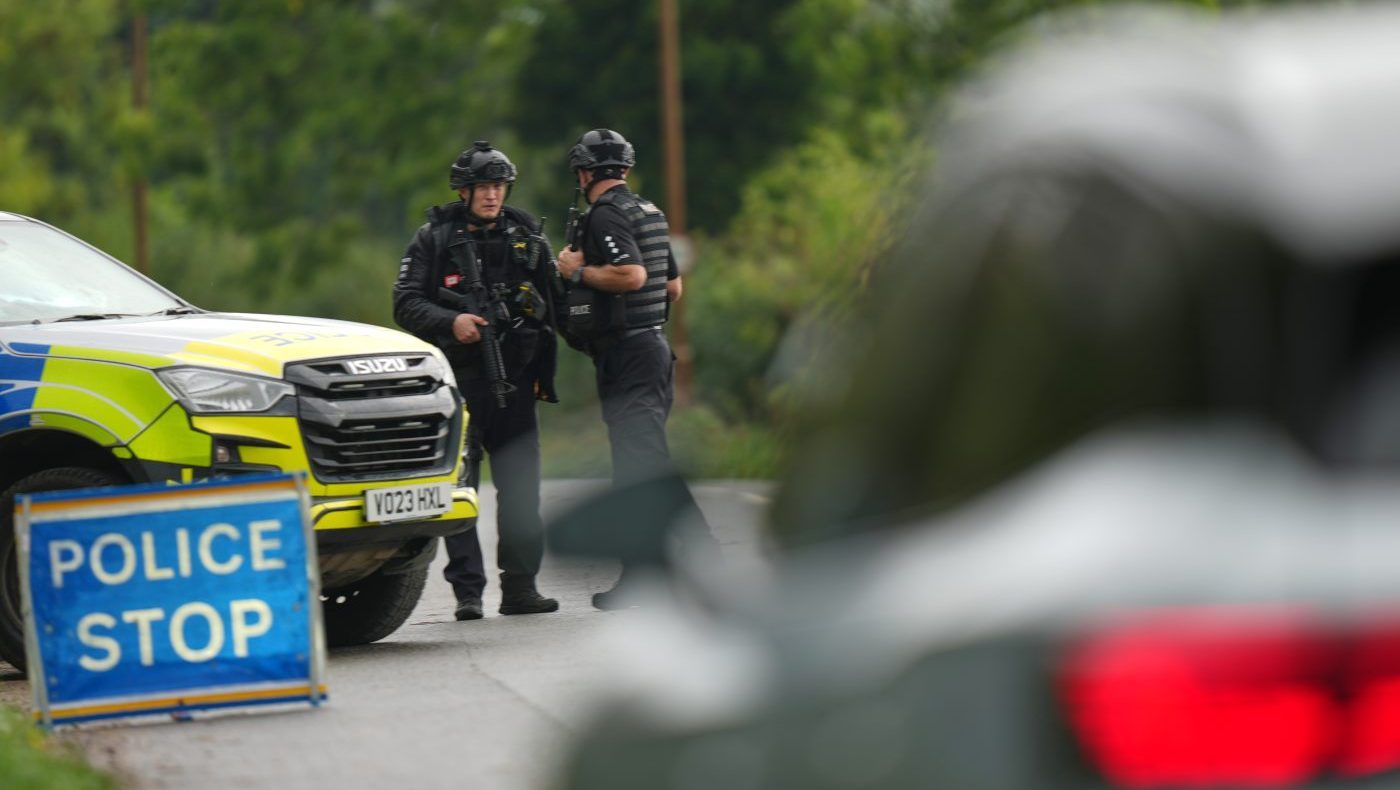
In the latest incident pinned on Iran, British authorities said they thwarted an alleged terrorist plot, initially arresting five men on explosives and terror charges near RAF Fairford on Sept. 27. The men, all British nationals in their 20s, were released on bail a day later, but two additional men were later arrested on suspicion of preparing terrorist acts. British Prime Minister Andy Burnham said his government believes Iran “played a part” in the incident, though Tehran has denied the accusations.
U.S. and British officials told The New York Times that the two allies believe Iran plotted to strike aircraft and kill some of the several hundred American personnel stationed at RAF Fairford, which the U.S. has used to position B-52 and B-1 bombers as part of the Trump administration's war against Iran. Some officials said the plot was thought to be loosely modeled after the Ukrainian drone attack launched from semi-trucks last year, which destroyed or damaged at least a dozen Russian aircraft.
Yacoubian said there is new knowledge being gained from different war zones “and we will see asymmetric powers like Iran seek to exploit that learning, exploit those lessons, and translate them in new ways to cause problems for the United States.” She added that while Iran's attacks outside the Gulf region are not new, the timing suggests the regime seeks to demonstrate it would rather escalate the conflict than capitulate to the U.S. and economic pressure to end the war, pointing to recent rhetoric between Washington and Tehran.
Trump in September told the United Nations General Assembly he faces a “big decision” on whether to restart a bombing campaign against Iran or broker a peace deal, adding that he could “annihilate” the regime. Last week, the president said ramped-up military strikes against Iran were under consideration, raising the stakes in the ongoing confrontation.