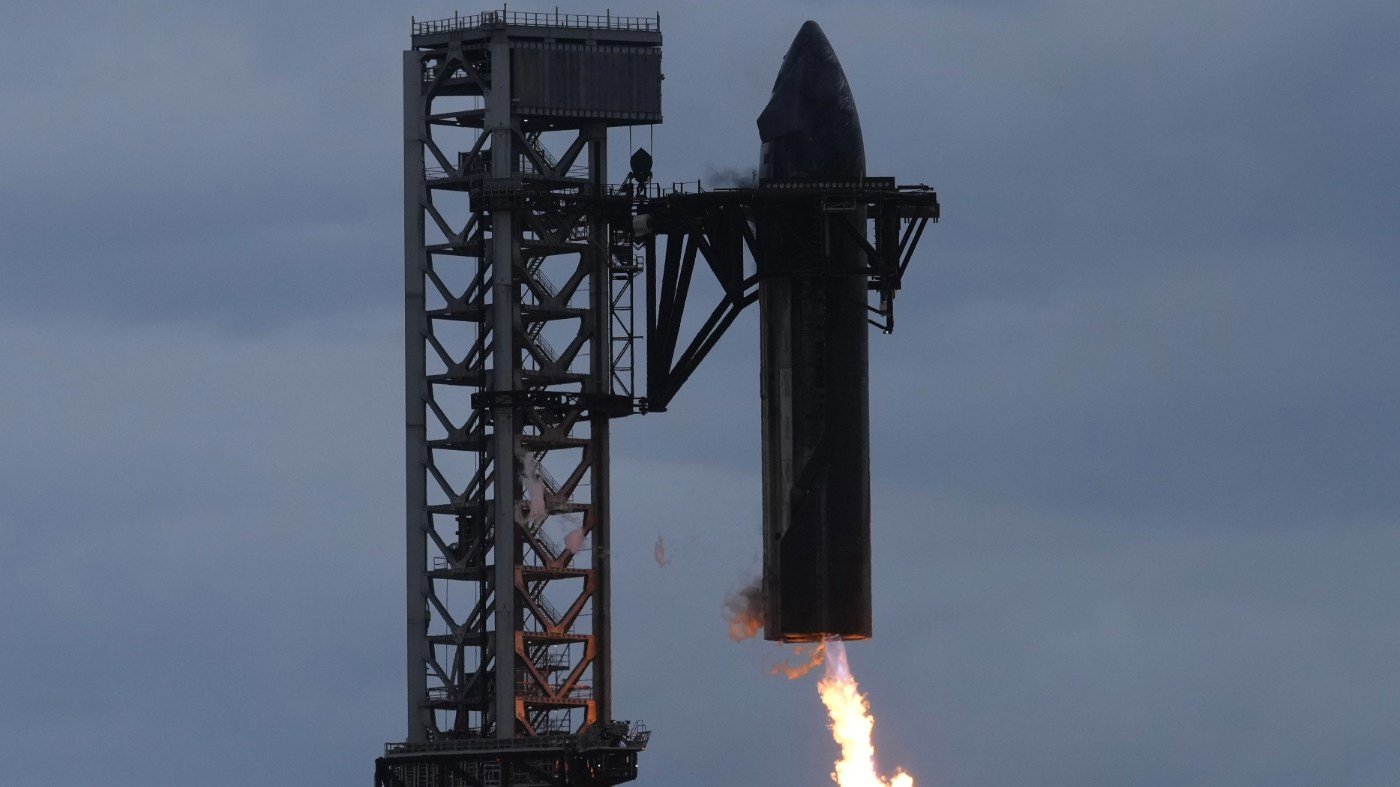
Elon Musk is juggling a lot: developing the Starship super rocket into an operational vehicle that can land astronauts and cargo on the Moon, running his other ventures, and fending off a newly elected political class in both Austin and Washington that has made him a target.
On Nov. 13, SpaceX conducted its 15th test flight of the Starship system. The objectives were to capture the Super Heavy first-stage booster back at the launch pad, send the Starship into low Earth orbit, deploy 26 of the latest Starlink satellites, and then bring the Starship back to the pad for a capture landing. The Starship reached orbit and deployed the satellites, but a guidance issue forced SpaceX to divert the Super Heavy booster to a splashdown in the Gulf and initiate the destruct mechanism as it hit the water.

The next day, SpaceX successfully returned the Starship from orbit and landed it at the pad, where it was caught by the Mechazilla arms. This achievement is a significant step toward regular Starship operations, opening the door to commercial space travel to the Moon, Mars, and beyond. The Starship, which is the size of a small building, was brought back from low Earth orbit, decelerated, and captured with precision engineering that has been described as unparalleled in human history.
The successful capture of the Starship rivals the Artemis crewed lunar mission as the greatest space story of 2026. SpaceX now has a flown Starship to study, allowing engineers to make design improvements for future generations of the vehicle. The company must also master capturing both the Starship and the Super Heavy first stage consistently to achieve full reusability and reduce launch costs. Additionally, in-orbit refueling is a critical capability needed to turn Starship into a true cislunar and eventually interplanetary spacecraft.
Flight Test 15 comes as Democrats prepare to take power in both Washington and Austin, with some vowing to target Musk and SpaceX. Critics, including Douglas MacKinnon, have warned that such a lawfare campaign could jeopardize the Artemis return-to-the-Moon program and even put the human species at risk. Musk's vision of spreading humanity beyond Earth is seen by some as essential for survival in the face of nuclear war, biological holocaust, or other catastrophes.
The capture has drawn bipartisan praise in Washington. Some on social media have compared Musk to Ayn Rand's hero Howard Roark, with his enemies cast as the villains. Senator-elect James Talarico (D-TX) has indicated he might be willing to work with Musk, despite Musk's efforts to deny him a Senate seat. Talarico is a fan of SpaceX and Tesla, and his stance offers a potential path for Musk's detractors to step back from their threats of hearings and investigations.
The political climate suggests a possible shift: instead of interrogating Musk about his capitalist practices, congressional hearings could focus on how to support his efforts in building reusable rockets, electric cars, and other transformative technologies. As one observer noted, the late Sen. Joe McCarthy might appreciate the irony of the current situation.
If lawmakers choose to cooperate rather than confront, they could turn these hearings into a positive legislative exercise, helping to advance space exploration and technological innovation. The success of Flight Test 15 provides a strong argument for collaboration over conflict.