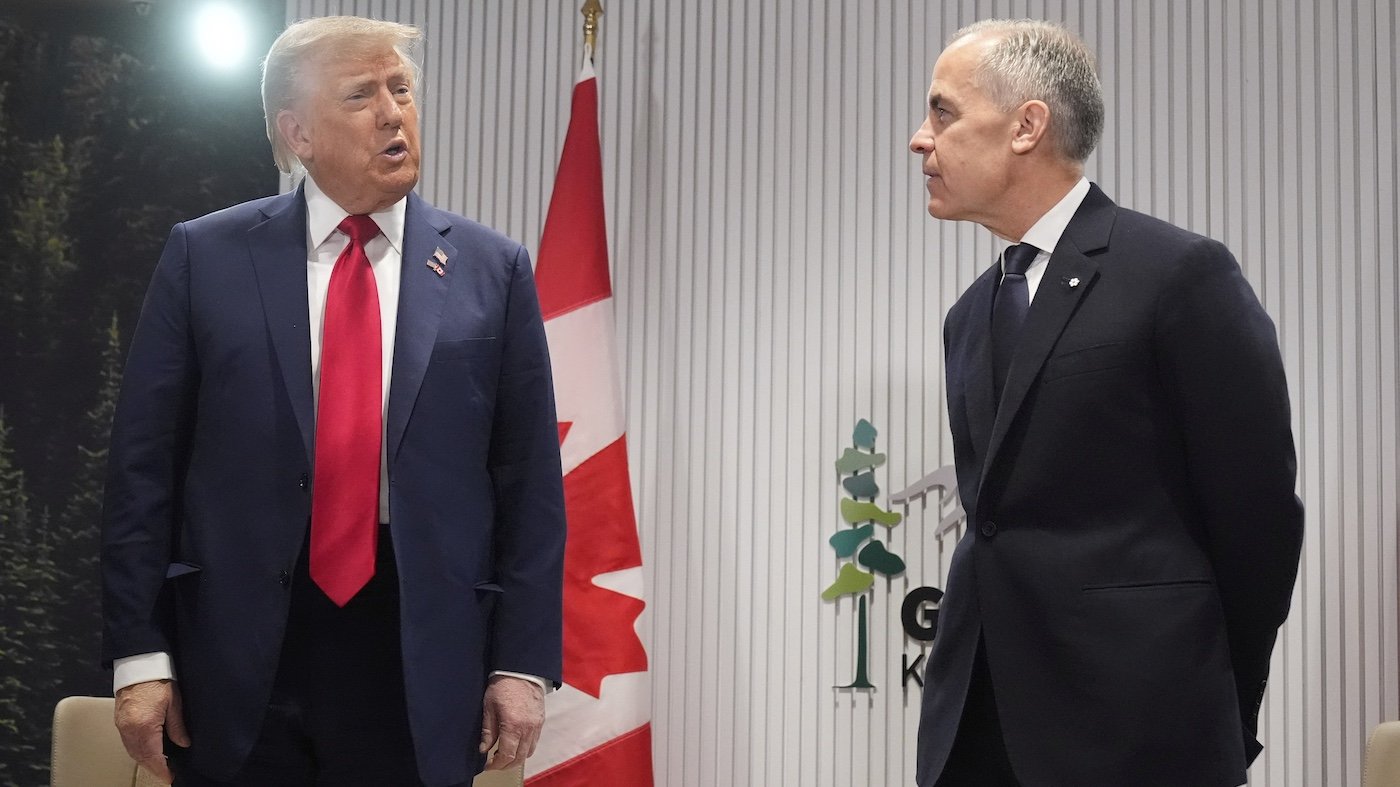
President Donald Trump has escalated pressure on Canadian Prime Minister Mark Carney, threatening to impose tariffs in response to the wildfire smoke that has drifted across more than a dozen U.S. states. The move adds a new layer of friction to an already strained U.S.-Canada relationship, which has been tested by trade disputes and personal clashes between the two leaders.
Trump has publicly described the smoke as “poisoning” American air and accused Canada of neglecting forest maintenance. In a social media post on Truth Social, he wrote, “Canada has refused to engage in basic Forest Management and Debris Removal, knowing that such refusal will lead to exactly this result.” He called the situation “willful negligence” and suggested the cost of the pollution should be added to existing tariffs on Canadian goods.

Experts, however, are skeptical that tariffs would address the root causes of the wildfires. Imran Bayoumi, a deputy director at the Atlantic Council’s GeoStrategy Initiative, told The Hill that such threats “are not going to fix the problem” and risk “further eroding the U.S.-Canada relationship, which has already been at a kind of a low point over the past year and a half.” He warned that this pattern of behavior could “drive a wedge between Washington and Ottawa and make it harder for cooperation to occur on issues where we need close bilateral coordination, like actually fighting wildfires.”
The Canadian Wildland Fire Information System reports hundreds of active fires, with new ones continuing to emerge. Trump raised the issue directly with Carney during a brief conversation at the World Cup final on Sunday, telling reporters afterward that he had pressed the prime minister on the smoke problem.
Republican lawmakers have also joined the fray. Sen. Bernie Moreno (R-Ohio) announced plans to introduce legislation that would “sanction Canada and the responsible Canadian government officials for this atrocity.” A group of Michigan House Republicans—including Reps. Jack Bergman, John James, Lisa McClain, and John Moolenaar—sent a joint letter to Carney expressing frustration. “We are done accepting apologies in place of action,” they wrote. “If Canada will not manage its forests to prevent these fires, the United States will look elsewhere, and act on our own, to protect our people.” James also said he and Moreno would send Trump a bill proposing 25 percent tariffs on Canada to fund a victim compensation fund and cleanup efforts.
On Monday, Trump imposed additional 50 percent tariffs on certain Canadian goods, though a senior administration official said those were unrelated to the wildfires. The official noted that the president “has asked for options on that and options are being shared with him.”
Legal experts question the viability of such tariff threats. Gary Hufbauer, a nonresident senior fellow at the Peterson Institute for International Economics, called the wildfire tariff threat “one of the least credible” of Trump’s many tariff proposals. He said that while Trump could issue an executive order, it would have “a very low chance of surviving in the courts.”
Canadian officials have pushed back. Ontario Premier Doug Ford called the criticism “absolutely unacceptable” and noted that Canada has assisted the U.S. in fighting wildfires in the past. “With all the assets the U.S. has, and he’s sitting there complaining,” Ford said. “Why don’t you send up some water bombers? Why don’t you start helping us, like we would help you in a heartbeat?”
Eleanor Olszewski, Canada’s minister of emergency management and community resilience, said the country has invested $12 billion in forest sustainability and fire prevention since 2020, but warmer and drier conditions are increasing wildfire risks. Carney, for his part, stressed that “climate change is the responsibility of everyone…including the United States.” He told reporters on Monday that he had a “series of conversations” with Trump over the weekend and explained the scale of Canada’s forests and the drought conditions stretching “from the equivalent of Texas all the way to Minnesota.”
Over 100 million Americans have been under air quality alerts as the smoke continues to spread, releasing microscopic particles that pose health risks. The dispute underscores how environmental crises are increasingly becoming flashpoints in international relations, with the Trump administration’s tariff threats adding a new dimension to the ongoing tensions between the two neighbors. For more on the broader geopolitical context, see our coverage of how the U.S. death toll in Iran conflict is pushing Trump toward escalation, and the political fallout from Spain's World Cup win.