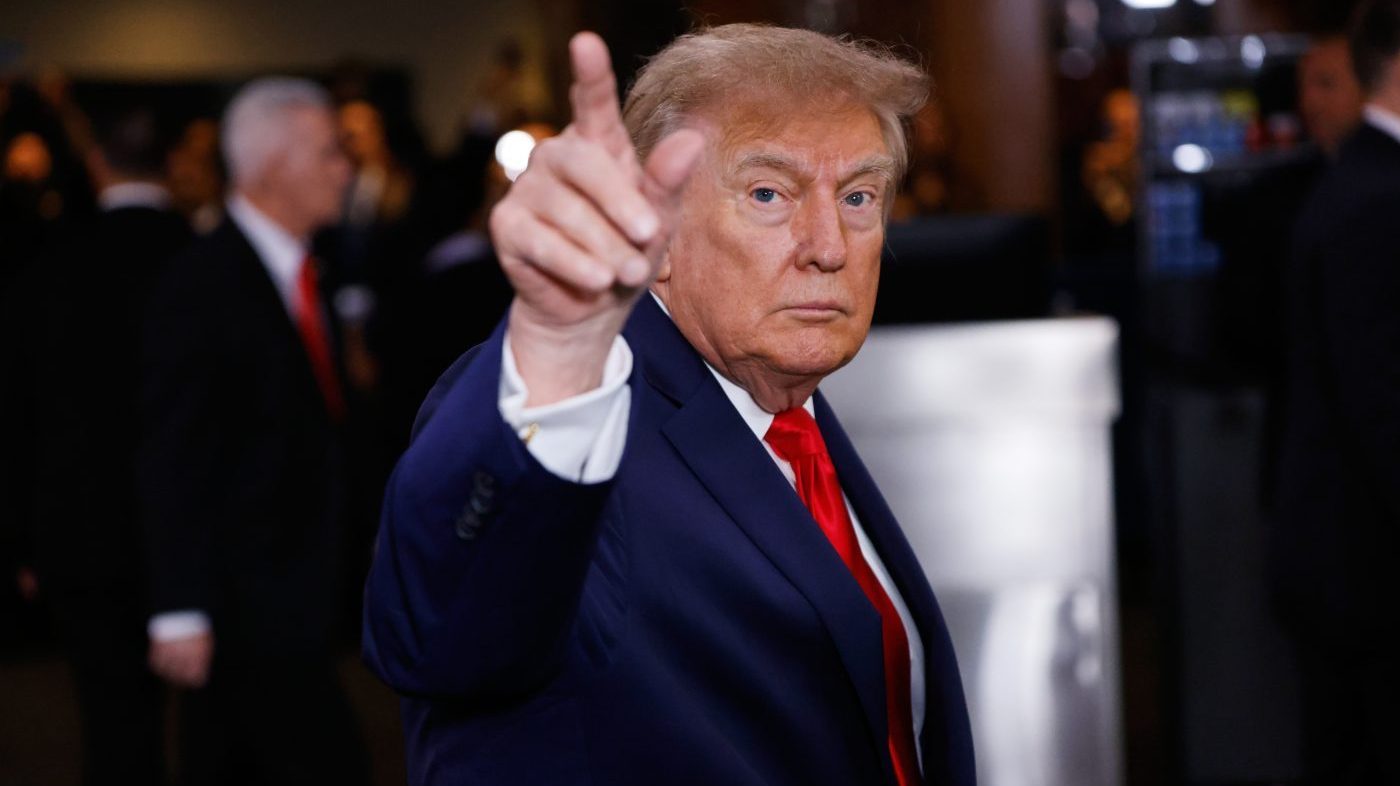
President Trump used his address to the United Nations General Assembly on Tuesday to announce a semantic shift with strategic implications: the United States will officially refer to artificial intelligence as “super intelligence” in all government documents. The declaration, delivered from the world’s most prominent multilateral stage, signals both a branding exercise and a rejection of international regulatory ambitions.
Trump framed the change as a corrective to what he described as a misleading label. “The use of the word artificial makes intelligence sound fake,” he said. “It is not fake. It’s actually amazing. But we have to be careful. In fact, it is exactly the opposite of what it purports.”
The president also used the moment to push back against any attempt to construct a global governance regime for the technology. “The United States also totally rejects any attempt to construct a globality scheme to control for the artificial intelligence being spoken of so much now, hereinafter called super intelligence. Changing the name,” he told the assembly. The remark drew a line against binding international rules, a position consistent with his administration’s broader deregulatory posture.
“From this point forward, all of United States documents and hopefully the world’s will be changed to use the much more accurate term super as opposed to artificial,” Trump continued. He concluded with a flourish: “In other words, welcome to the new world of super intelligence – S.I. Let’s see if that goes. It sounds much better. It is much better, and it’s much more accurate.”
A Term Already Loaded With Meaning
“Super intelligence” is not a neutral phrase. In the technology and national security communities, it denotes a form of artificial intelligence that surpasses human cognitive abilities across all domains. It is simultaneously the aspiration of leading AI labs and the nightmare scenario for researchers who warn about existential risk. Trump’s adoption of the term thus carries significant weight, even if his stated rationale was linguistic.
The announcement came amid escalating anxiety over rapid advances in AI. A former researcher at Anthropic recently warned that the technology could soon threaten humanity, a claim that has intensified the debate in Washington over whether and how to regulate AI. Trump has consistently advocated for minimal regulation, arguing that heavy-handed rules would hamper American competitiveness against China.
That geopolitical dimension is likely to dominate the week. AI is expected to be a central topic not only at the UN General Assembly but also when Chinese President Xi Jinping arrives in Washington for a state visit. The two leaders are set to discuss a range of issues, with technology policy near the top of the agenda.
Domestic and Diplomatic Ripples
Trump’s UN appearance was part of a broader diplomatic push that included his threats to Iran and his focus on cartels and Greenland. His comments on AI also follow his administration’s ongoing clash with the press, including a tense exchange with CNN’s Collins at the UN. Meanwhile, as Xi prepares to visit, Trump faces pressure from hawks to take a tough stance on Taiwan, adding another layer to the superpower competition in which AI is a key battleground.
The president’s directive to rename AI in US documents may seem cosmetic, but it reflects a deeper strategy: reframing the narrative around a technology that is reshaping economies, militaries, and societies. By rejecting the “artificial” label, Trump is attempting to elevate the perceived value and seriousness of the field—while simultaneously resisting any global effort to constrain it. Whether the rest of the world follows his linguistic lead remains to be seen, but the debate over super intelligence is only intensifying.