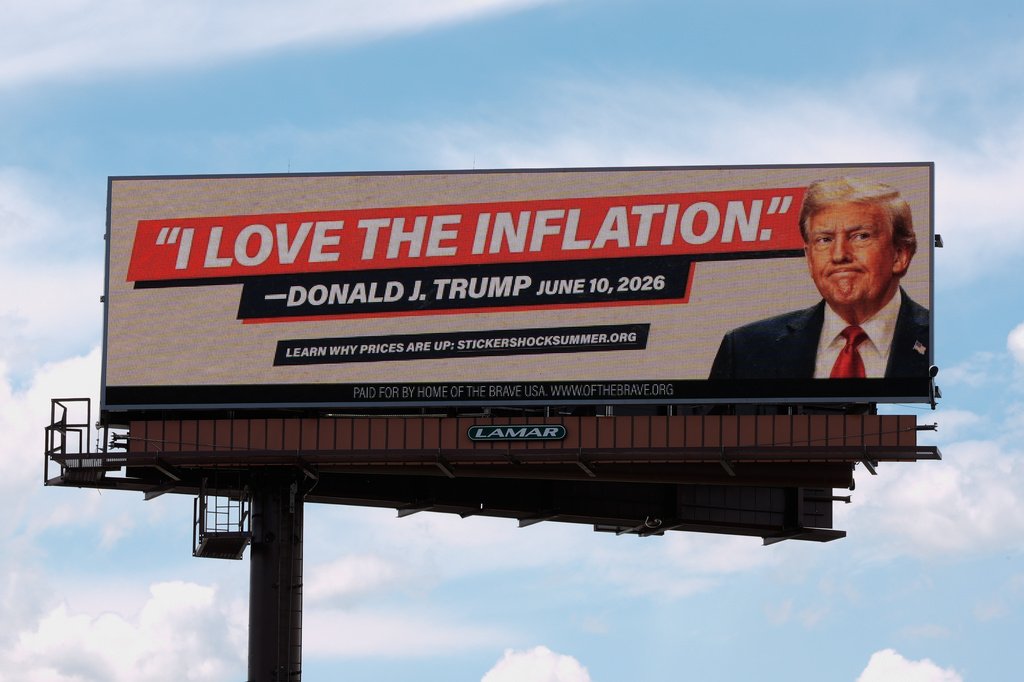
President Trump, reacting to a Consumer Price Index report showing inflation at 4.2 percent—a three-year high—told reporters, “You know what I really love? I love the inflation.” He argued that the ongoing war with Iran is the sole force keeping prices elevated, and that a peace agreement would cause inflation to “come down like a rock.”
If Trump truly cherishes rising prices, he’s in for a treat: more inflation is on the way, and no diplomatic breakthrough can stop it. The economic effects of the conflict can’t be switched off at a signing ceremony.

Gasoline Prices: The Slow Drift Down
The first blow to household budgets has already hit at the pump. While the president insists peace will bring immediate relief, the reality is that gas prices will stay high for months after the Strait of Hormuz reopens. Economists call this pattern “rockets and feathers”—prices shoot up like a rocket when costs spike, but drift down like a feather when pressures ease.
Research from the Federal Trade Commission shows retail gas prices rise more than four times faster than they fall. This isn’t conspiracy; when a visible shock hits an entire industry, every firm knows competitors face the same cost pressures, so they raise prices in unison. On the way down, no one wants to cut first.
We saw this play out three years ago. After Russia invaded Ukraine, gas jumped $1.48 a gallon in about four months, peaking at $5.02. It took nine months to return to pre-war levels, and even that required the government releasing emergency oil reserves. With the national average now above $4 a gallon for the first time since 2022, anyone expecting a rock should prepare for a feather.
The federal government’s own data backs this up. The Energy Information Administration projected in January that gas would average $2.95 a gallon in 2027; it now forecasts $3.64. Trump’s own forecasters are pricing in the war’s effects more than a year after any plausible peace, even as he promises pre-war prices the moment the ink dries.
Supply Chains and Food: The Long Tail of Inflation
Gasoline is just the fast channel. The Producer Price Index, measuring what businesses pay before consumers see a price tag, rose 6.5 percent year-over-year in May—its hottest reading since 2022. Worse, prices for raw inputs at the very start of the supply chain jumped 3.2 percent in a single month, the largest increase ever recorded. That inflation has already happened; it simply hasn’t reached store shelves yet. Higher costs for diesel, jet fuel, industrial chemicals, and freight will pass through to consumers over the coming months, whether the Strait of Hormuz reopens or not. A signature on a peace deal cannot un-ring that bell.
The longest fuse is food. Fertilizer is made from natural gas, and the war has sent gas prices soaring while trapping roughly 30 percent of the region’s urea exports behind a mined strait. Farmers in the Southern Hemisphere are planting now, and many cannot get or afford the fertilizer their crops require. Skimp on fertilizer this month, and the harvest comes up short half a year from now. The U.N. Food and Agriculture Organization is warning of a systemic shock to the global food supply, and the European Union just committed about $600 million to help its farmers buy fertilizer. Next year’s grocery prices are being set in the fields today, and no signing ceremony can retroactively fertilize them.
Relief will come eventually, but slowly and unevenly—drifting down like a feather. The only rock in this story is the one Trump hung around his own party’s neck when he told Americans paying $4 and up for gas that he loves their inflation. He had better mean it. It will be with him long past the midterms.
Nicholas Creel is an associate professor of business law at Georgia College and State University. The views expressed here do not necessarily reflect those of his employer or any other organization.