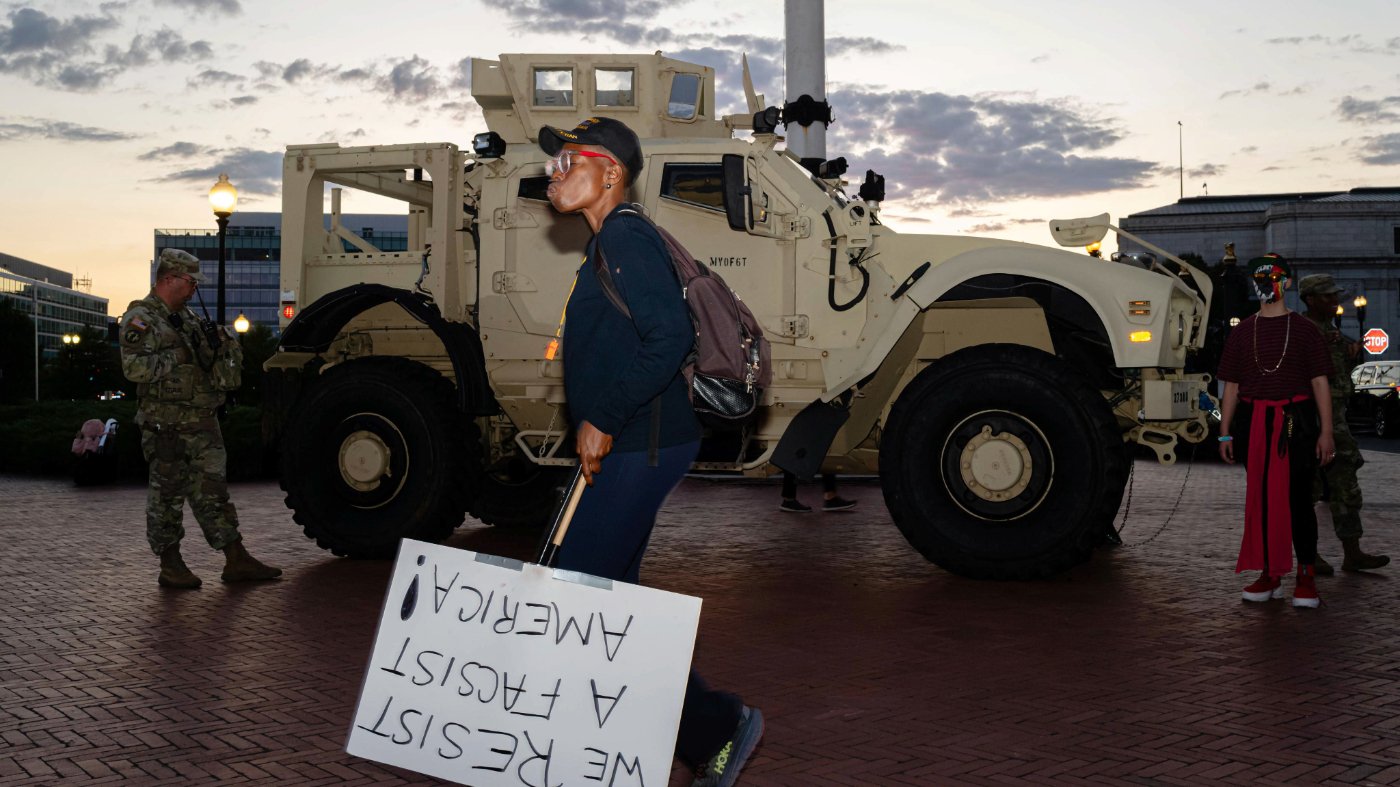
A year after President Trump declared a dubious “crime emergency” in Washington, D.C., the city remains under a massive military footprint that shows no signs of receding. The initial claim—that the capital had been “overtaken by violent gangs and bloodthirsty criminals, roving mobs of wild youth, drugged-out maniacs and homeless people”—was made without evidence, and the facts on the ground have not supported it. Homicides in the District actually fell from 274 in 2023 to 187 in 2024.
Nevertheless, the administration deployed roughly 800 D.C. National Guard members and more than 1,000 from cooperating states, ostensibly to protect residents. A year later, about 4,600 troops patrol the city, against the explicit wishes of the District’s elected government. This unprecedented use of military force for routine law enforcement violates long-standing American traditions, has cost taxpayers hundreds of millions of dollars, and has shown no measurable effect on violent crime. Yet Trump is determined to keep troops here, betting that public attention will wane. That’s a gamble we cannot afford to lose.
Emergency powers misused
The invocation of emergency powers was flawed from the start. Emergency declarations are meant for sudden, unforeseen crises—situations where normal legal processes are too slow to respond. Urban crime, while serious, is a foreseeable and persistent challenge that should be handled through ordinary governance, not military intervention. By stretching the definition of an emergency, Trump has set a dangerous precedent.
The use of the military for domestic policing is not just unprecedented; it runs counter to centuries of American civic tradition. The Founders and subsequent generations have consistently rejected the idea of an “army turned inward,” recognizing that military involvement in civilian law enforcement can become a tool of tyranny. Domestic troop deployment is a last resort, reserved for when civilian authorities are overwhelmed—not when a president wants to project strength in a political stronghold.
Soldiers are not police
There are also practical dangers. National Guard members are trained for combat, not for upholding constitutional rights, gathering evidence, or navigating local criminal law. Over the past year, there have been troubling incidents of improper detentions and at least one documented case of excessive force. These are not isolated anomalies; they are the predictable consequences of putting soldiers in police roles.
The deployment has also largely failed its stated mission. While there was a narrow dip in opportunistic property crime in the first six months, recent analyses show little to no impact on violent crime. Meanwhile, the cost to taxpayers has ballooned to over $3 million per day—a figure that will only climb following the recent announcement of a $292 million deal to provide apartment-style housing for deployed troops. In exchange, many guardsmen spend their days standing idle at street corners and metro stations, a practice euphemistically called “presence patrols.”
A permanent occupation
Trump shows no intention of reversing course. A “summer surge” pushed troop numbers close to 5,000, and the administration plans to keep them in D.C. through January 20, 2029, at an estimated additional cost of $1.4 billion. The length of the deployment is perhaps the most telling indicator: no true emergency can be predicted to last another two and a half years. This is not a response to an immediate crisis; it is a deliberate effort to normalize the military as a domestic police force.
The implications are chilling. It would be a small step from guardsmen detaining people for minor infractions to policing protests. And if Trump were to attempt to interfere with the certification of the 2028 presidential election—this time using military force instead of inciting a mob—there would already be thousands of troops stationed near the Capitol, ready to act.
It is a bitter irony that this military presence coincides with the 250th anniversary of the Declaration of Independence, which condemned King George III for keeping “Standing Armies without the Consent of our legislatures” in times of peace. The Founding generation would have immediately recognized the danger of a president normalizing domestic troop use. We must see it too.
The longer the deployment persists, the less shocking it becomes, and the easier it is to accept as the new normal. But it must not be. Americans must demand an end to this occupation and insist that our military remain a defender of democracy, not a tool of political control. As Congress prepares for its August recess, lawmakers should hear from constituents alarmed by this overreach. The Pentagon's recent actions show that military decisions can be reversed. Similarly, political hurdles can be cleared when the public demands accountability. The cost of this deployment is a national scandal that must not be ignored.