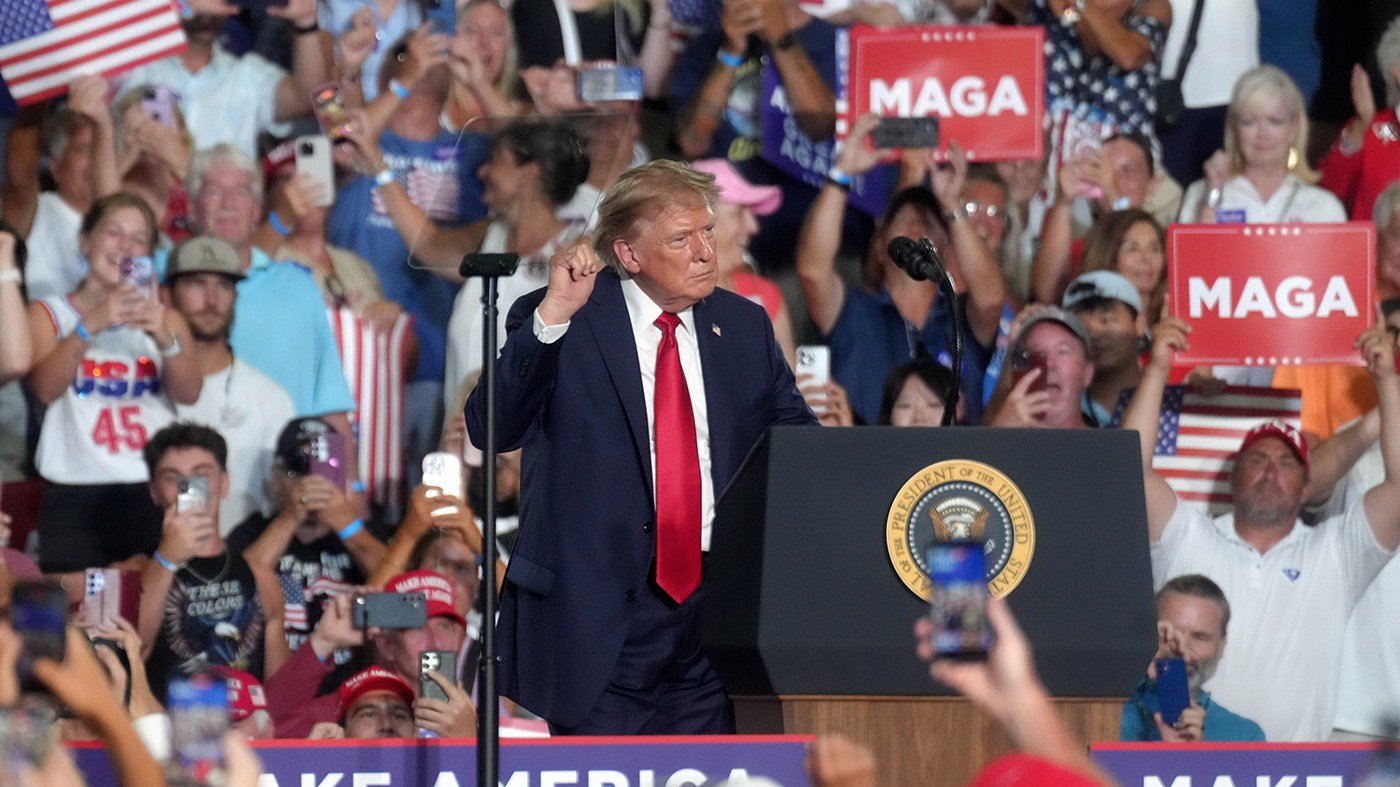
President Trump's escalating trade fight with Canada is turning into a political liability for Republican candidates in border states, with the midterms just ten weeks away and voters already feeling the pinch of rising prices.
The 50 percent tariffs on roughly $20 billion worth of Canadian imports went into effect Saturday after talks between Washington and Ottawa collapsed at the last minute. Trump has also threatened another round of 50 percent duties on cars, trucks, auto parts, and steel, set to take effect on Jan. 1, 2027, if no deal is reached.

Strategists say the timing could not be worse for the GOP, especially in states with deep economic ties to Canada. The tariffs threaten to undercut the party's message on affordability and hand Democrats a fresh line of attack.
"This escalation and the timing of it are problematic," said Jason Cable Roe, a Michigan-based Republican strategist. "It really undermines our messaging when we're trying to address affordability and we're already having to deal with the price of oil due to the war in Iran. But that affordability debate only gets more complicated when we're in a trade war with our largest trading partner, who happens to share a border with us."
Roe suggested the situation could offer "an opportunity for Republicans to separate themselves from the president's policy." So far, the most prominent Republican to do so is Sen. Susan Collins of Maine, who faces a tough reelection fight against Democrat Troy Jackson. Collins has repeatedly criticized Trump's tariffs on Canadian goods, and over the weekend she called the latest escalation a "mistake," urging both sides to return to negotiations.
"The on-again/off-again trade talks between the U.S. and Canada lead to higher costs, risk, and uncertainty for Maine businesses," Collins wrote on X. "If the Administration proceeds with these tariffs, they will increase costs for Maine families, as most businesses will have no choice but to pass on the tariffs to their customers through higher prices."
The trade war is also becoming a flashpoint in other battlegrounds. In Ohio, Sen. Jon Husted is facing former Sen. Sherrod Brown; in Michigan, former Rep. Mike Rogers is running against Abdul El-Sayed. Democrats are also eyeing opportunities in Iowa and Alaska. The nonpartisan Cook Political Report rates all four races as toss-ups.
Wayne Winegarden, a senior fellow at the Pacific Research Institute, said the tariffs would raise production costs for U.S. businesses along the border, and those costs would eventually hit consumers and families. "Those costs are at some point going to get passed down to their consumers," said Alfredo Carrillo Obregon, a trade policy analyst at the Cato Institute. "I don't think something like inflation will pick up from these tariffs, but I think there's going to be cost increases in specific sectors."
Vice President Vance defended the tariffs during a rally in Maine on Monday, which Collins skipped. "I think that we need to send a message loud and clear to the prime minister of Canada: Stop taking advantage of the people of Maine. Stop taking advantage of America. It's over, we expect fairness in our trade policy," Vance said.
Democrats are seizing on the issue. "Americans are paying more for everything because GOP Senate candidates have served as a rubber stamp for Trump's chaotic tariffs at the expense of their states," said Tommy Garcia, a spokesman for the Democratic Senatorial Campaign Committee. "Come November, voters will hold them accountable for making life more expensive."
Michigan-based Democratic strategist Adrian Hemond warned of severe economic fallout. "The President's ego may have disastrous effects for Republicans politically, but there's no question that the economic results for Michigan and Ohio will be disastrous," he said.
In New Hampshire, Democratic Rep. Chris Pappas is using the trade war to attack his Trump-backed opponent, former Sen. John Sununu. "Trump creates a mess he can't clean up. Once again," Pappas wrote on social media. "John Sununu won't speak out against it. Once again. Working families are paying for this recklessness." The Cook Political Report rates that race as "lean Democratic."
One Republican operative said candidates must navigate carefully. "Every candidate has to run the race that they see fit. They have to break with the administration when they see fit, when it benefits the state, and their region," they said.
The collapse of talks came after weeks of intense negotiations. Canada rejected the U.S.'s terms late Friday, with Prime Minister Mark Carney calling the last-minute additions "unfair, uneconomic, and called into question the reliability of any deal." Canada says it will "match those tariffs dollar for dollar" starting Sept. 8, with additional measures to support Canadian workers and businesses.
Canada is the U.S.'s second-largest trading partner, and the new tariffs affect everything from wine to hockey sticks and cement. Ontario Premier Doug Ford told the Associated Press that Canada is "all in" and warned Republican states could feel the pain. The escalating feud is already prompting some in the GOP to push back against the White House, while Democrats see an opening to expand the map in states like Maine and Michigan.