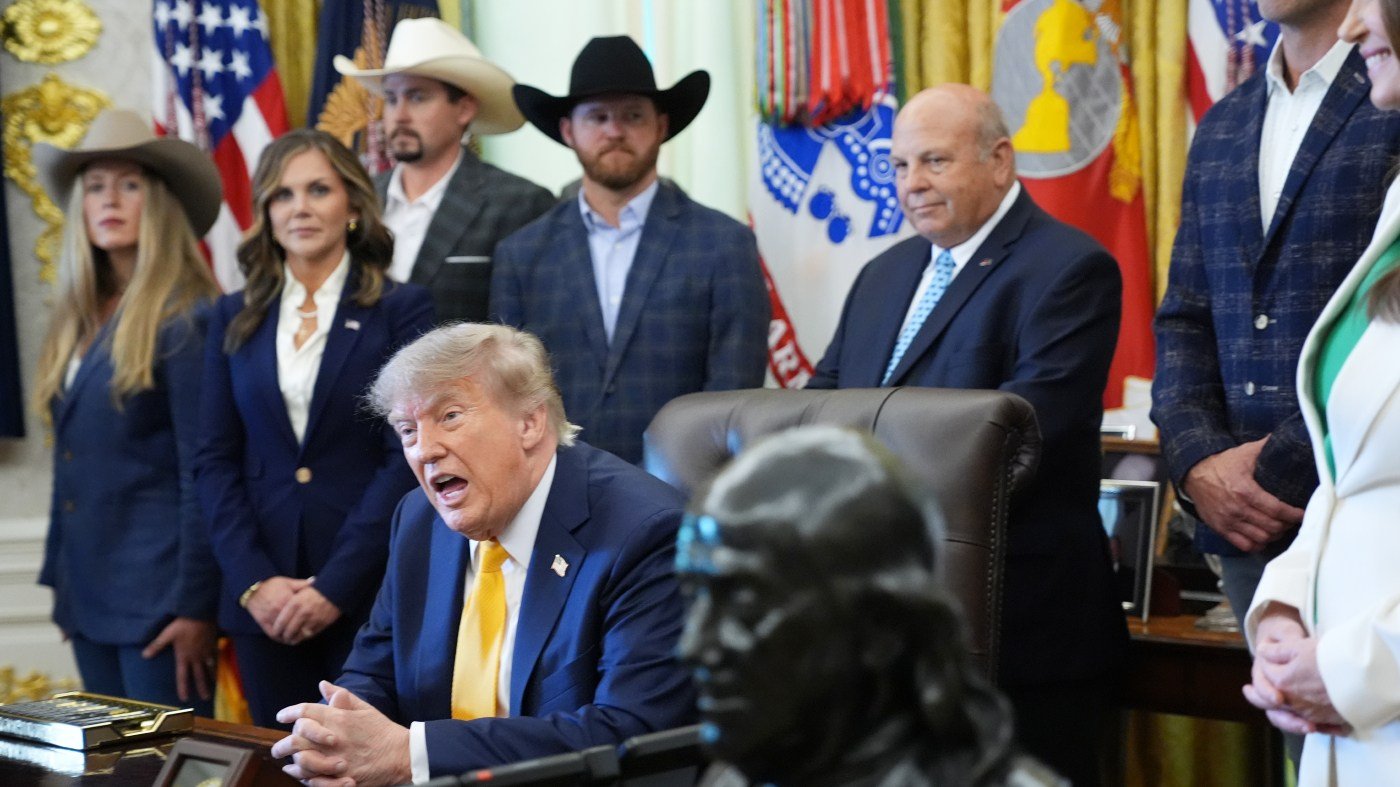
President Trump on Friday confirmed that tariff-free beef would begin flowing from Brazil and Argentina, among other nations, as his administration seeks to address persistently high consumer prices. Speaking at an Oval Office event surrounded by ranchers and farmers, Trump said, "It's coming from Argentina. It's coming from Brazil. It's coming from a couple of other places. We have our inspectors down. It's very clean. It's very good."
The announcement follows last month's decision to temporarily suspend tariffs on 300,000 metric tons of beef for 90 days, with the product to be sold at a 25% discount below market rates. Trump framed the move as a win for American consumers, arguing it would lower costs while allowing domestic ranchers to rebuild their herds. "We're doing it in a very limited fashion because our ranchers can handle it, but our ranchers really needed a little bit of help, and our ranchers want the prices to be down, too," he said.

Ranchers and lawmakers push back
The policy has drawn sharp criticism from the cattle industry and Republican lawmakers, who argue that cutting prices for consumers should not come at the expense of American ranchers. Critics contend that flooding the market with cheap imports will undercut domestic producers already struggling with rising feed and operational costs. The backlash has been intense enough that the White House has sought to frame the measure as temporary and narrowly tailored.
Ethics concerns over Brazilian influence
The decision has also raised ethical questions after The Wall Street Journal reported that a Brazilian billionaire with ties to the world's largest meatpacker met with Trump just before the tariff pause was announced. Joesley Batista, who shares control of JBS, met with the president a day prior to the announcement. Batista and his brother Wesley were fined by the Justice Department in 2020 for violating the Foreign Corrupt Practices Act, stemming from a bribery scheme used to expand their U.S. operations.
Adding to the controversy, the tariff pause comes on the heels of a recall of nearly 30,000 pounds of Argentinian beef that had been distributed in Texas and Florida, raising food safety concerns among some lawmakers.
Executive orders target processors and labeling
Trump used the event to sign two executive orders. The first allows ranchers and farmers to butcher, process, package, and sell their own products, aiming to bypass the dominant meatpacking companies. The second mandates country-of-origin labeling for all foreign beef, a move long sought by domestic producers who argue consumers deserve to know where their meat comes from.
Trump took aim at the "big four" beef processors—Tyson Foods, JBS S.A., Cargill, and National Beef Packing Co.—calling their grip on the industry a "monopoly." He said, "I've heard all about it. I've been listening to it... and they say they're a very nasty group, very difficult to deal with. And they cost our farmers a lot of money, and they cost our ranchers a lot of money, and they cost the public a lot of money in grief, and we're not going to let it happen any longer."
Congressional path ahead
When asked about the timeline for implementing the labeling requirement, Trump indicated he would need to work with Capitol Hill. "We're putting it in front of Congress right away," he said. "It should be no problem."
The moves come as the administration faces mounting pressure over food prices, a key issue for voters ahead of the midterms. The White House has also been touting other policy wins, such as a retro game arcade to highlight its achievements, but the beef deal threatens to alienate a core Republican constituency. The legal landscape for tariffs remains contentious, with ongoing challenges to tariff authority in the courts.
As the administration pushes forward, the tension between consumer relief and producer protection is likely to intensify, especially with midterm elections on the horizon. The president's executive actions on beef are a clear attempt to navigate that divide, but whether they will satisfy either side remains to be seen.