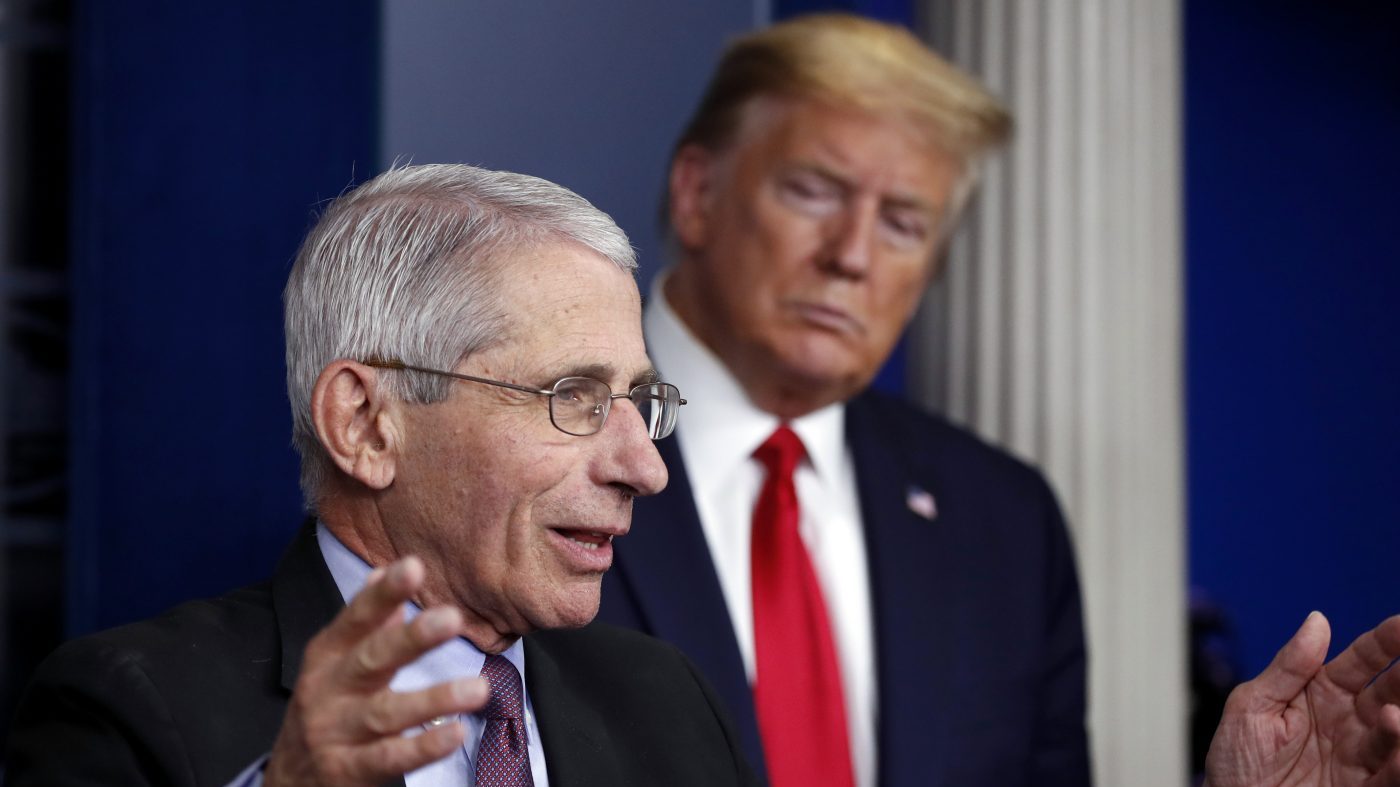
Former President Donald Trump on Tuesday dismissed Dr. Anthony Fauci as a figure who wore out his welcome in the White House, responding to the release of Fauci's personal diaries by Senator Rand Paul (R-Ky.). In an interview with Fox & Friends, Trump said he had grown tired of the former director of the National Institute of Allergy and Infectious Diseases.
"He was a much bigger player in the Biden administration. I grew tired of him," Trump said. "He wanted to close everything down. I allowed it to be up to the governors," adding that "many of the Republican governors didn't want to close."
The diaries, spanning over a thousand pages, were made public by Paul over the weekend. In one entry, Fauci wrote about using media appearances to shape public messaging on the coronavirus, noting that he found the attention "flattering." He also described tension with Trump's White House, writing: "Apparently the WH is very upset that I am being profiled and it looks like I am putting down the POTUS and becoming a star that outshines him. The press is playing into this as is the tweet storm. Very stressful!!"
Trump's comments come as Fauci is set to testify before the Senate Homeland Security and Government Affairs Committee on Wednesday. Paul, a frequent critic, has pushed for an indictment, claiming Fauci lied under oath about gain-of-function research and the COVID-19 pandemic. The diaries could provide fodder for the hearing, as Paul has long sought to portray Fauci as a central figure in what he calls a government cover-up.
The release of the diaries also reignites the broader political battle over pandemic response. Trump's handling of the crisis—including his early downplaying of the virus and his push to reopen the economy—remains a flashpoint. The diaries offer a rare, unfiltered look at Fauci's frustrations with the Trump administration, which he described as hostile to his public health messaging.
Paul's campaign against Fauci has been relentless. In recent months, he has called for criminal charges, arguing that Fauci misled Congress about the origins of the virus and the risks of gain-of-function research. The diaries, Paul claims, provide evidence of Fauci's intent to control the narrative. However, Fauci's defenders argue the entries show a dedicated public servant navigating a chaotic political environment.
Trump's dismissal of Fauci as "tired" is consistent with his long-standing criticism of the doctor, whom he once praised before turning against. The former president has frequently blamed Fauci for advocating lockdowns that Trump opposed, and the diaries now give him new ammunition. Meanwhile, Fauci's testimony on Wednesday is expected to draw intense scrutiny, as Paul and other Republicans prepare to question him on the diaries' contents.
The diaries also highlight the personal toll of the pandemic on Fauci, who became a household name and a target of both praise and vitriol. His writings reveal a man aware of his own celebrity and the resulting friction with a president who resented any perceived challenge to his authority. As Fauci faces another round of congressional questioning, the diaries ensure that the clash between science and politics remains front and center.