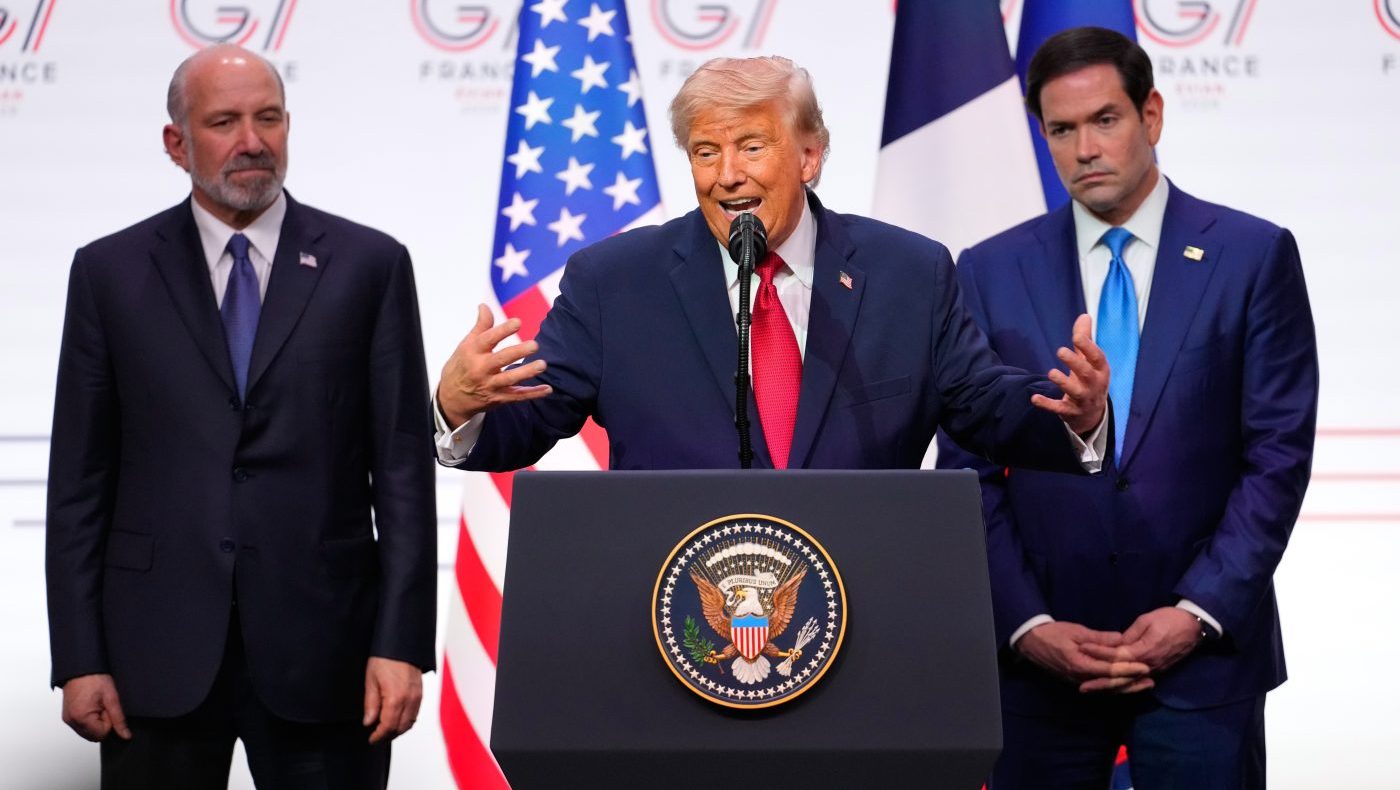
President Trump on Wednesday justified allowing Iran to hold onto a significant portion of its ballistic missile arsenal, even as negotiations progress to reopen the Strait of Hormuz. Speaking at a G7 press conference in France, Trump argued that Tehran cannot be expected to completely disarm when other nations in the region maintain similar capabilities.
“I mean, they have to have some, because other people have some. You got to have some,” Trump said, pushing back against unnamed advisers who urged a tougher stance. “I like some of these guys, but I…don’t think they’re smart. Sir. You shouldn’t let them have any missile,” he recounted. “I said, well, what am I going to do? Am I going to let Saudi Arabia have missiles, but they can’t have them? Yes, sir.”
The president dismissed the notion that missiles themselves pose an existential threat. “Doesn’t work that way, you know, it doesn’t work that way, and missiles aren’t the problem,” he said. “Missiles, they hurt a little location, but they don’t blow up the planet.”
Defense Secretary Pete Hegseth has previously claimed that U.S. and Israeli strikes, which began Feb. 28, have “functionally defeated” Iran’s ballistic missile production capacity, while acknowledging Tehran still holds stockpiles. Hegseth asserted in mid-March that every Iranian firm producing missile components “has been defeated, has been destroyed.” He also argued that Iran intended its missile arsenal to shield its nuclear program, justifying the focus on launchers and production sites during the strikes.
During negotiations, Iran has insisted that any changes to its missile program are a red line, given its recent use of such munitions against U.S. bases in the Gulf and targets in Israel. Trump later told reporters that Washington and its Gulf allies would address non-nuclear issues, including conventional missiles, but that Tehran would retain some ballistic missiles.
When pressed on why Iran should keep any of that capability, Trump pointed to the damage already inflicted. “We knocked out probably 84-85 percent of their missiles. The rest of them are underground; they can’t even get them out, you know,” he said. However, a mid-May report from The New York Times, citing U.S. intelligence, estimated that Iran still retains about 70 percent of its mobile launchers and roughly 70 percent of its prewar missile stockpile, including both ballistic and cruise missiles.
Trump downplayed the risk of immediate aggression, saying, “They don’t want to be firing missiles right now. They’re going to have a hard time rebuilding.” The comments came amid broader discussions at the G7, where Trump also declared himself the driving force behind the emerging Iran deal, overshadowing other agenda items.
The administration’s approach has drawn scrutiny from some lawmakers and allies who worry that permitting Iran to keep a substantial missile force could undermine long-term stability. Meanwhile, Trump signaled that the U.S. is prepared to work with Gulf partners on regional security, but he made clear that total missile elimination is off the table. “They have to have some, because other people have some,” he repeated.
As the Strait of Hormuz deal moves forward, the debate over Iran’s missile arsenal is likely to remain a flashpoint, especially given the urgent timeline Trump has set to avoid depleting U.S. oil reserves.