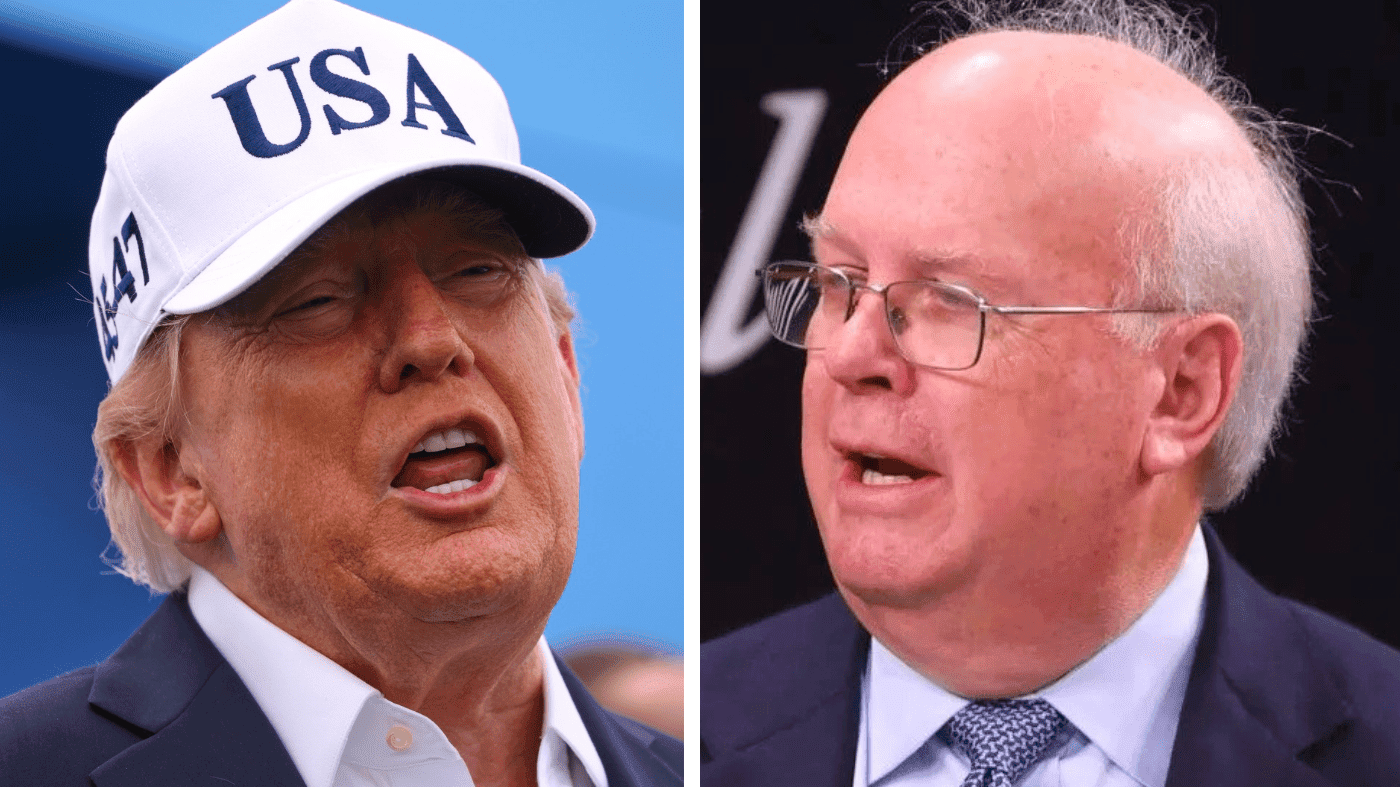
Former President Donald Trump launched a blistering attack on Republican strategist Karl Rove on Monday, branding the longtime GOP operative as "so bad for the Republican Party" and a "stone cold loser." The outburst came after Rove revealed he would vote for a Democrat in an upcoming Texas election, citing the Republican nominee's inflammatory social media post.
Speaking to members of the Headliners Club in Austin, Rove said he would cast his ballot for Democrat Jon Rosenthal in the race for the Texas Railroad Commission, a powerful regulatory body overseeing oil and gas. Rove told the audience he had not voted for a Democrat since backing former Texas Lt. Gov. Bob Bullock in 1994, according to The Texas Tribune. Three attendees said Rove also called the GOP nominee, Bo French, a "bigot."
Trump responded on Truth Social, accusing Rove of suffering from "a major case of Trump Derangement Syndrome" and claiming that his own political victories over the past decade had undermined Rove's influence. "He is so bad for the Republican Party, and completely wrong so often," Trump wrote. He also questioned why Fox News and The Wall Street Journal continue to give Rove a platform, calling him a "RINO [Republican in name only] Voice."
The controversy stems from a post French shared on X, the platform formerly known as Twitter, that featured a photo of University of Texas at Austin students celebrating after a football game. French wrote that he had "heard UT graduation this year looked like this" and added, "The problem is now obviously far worse than anyone imagined." He also shared a screenshot of another user's caption labeling the photo "Bollywood University."
Two students pictured in the photo, Dhairya Gupta and Rahul Kodali, both U.S. citizens, condemned French's post in an interview with The Dallas Morning News. Kodali, who said he has "been an American my entire life," pushed back against the implication that they were not truly American. Gupta, who immigrated at age 5 and later became a citizen, joined in the criticism.
French's post drew swift condemnation from Texas Republicans, including state House Speaker Dustin Burrows, who said the candidate could oppose immigration policies "without demeaning people because of their race or ethnicity — this post has crossed the line." Sen. John Cornyn (R-Texas) also weighed in, warning that such rhetoric could tear the party apart. "This is how great political parties self-destruct," he wrote online.
James Talarico, the Democratic candidate running to succeed Cornyn in November, thanked the senator for his statement and challenged his opponent, Texas Attorney General Ken Paxton, to condemn the post. Paxton responded by accusing Talarico of "a history of dividing Texans by race."
The episode highlights the ongoing fissures within the Republican Party as Trump continues to wield outsized influence, often clashing with establishment figures like Rove. Trump's attack on Rove is the latest in a long line of grievances against the strategist, who has been a frequent critic of the former president. Meanwhile, the Texas race has become a flashpoint in the broader national debate over immigration and cultural identity, with Democrats seizing on French's remarks to paint the GOP as increasingly intolerant.
As the midterms approach, the controversy underscores the challenges facing Republican candidates who must navigate a base energized by Trump's rhetoric while appealing to a broader electorate. Rove's decision to cross party lines is a rare break from GOP orthodoxy, signaling that even some conservative stalwarts are unwilling to tolerate what they see as outright racism.