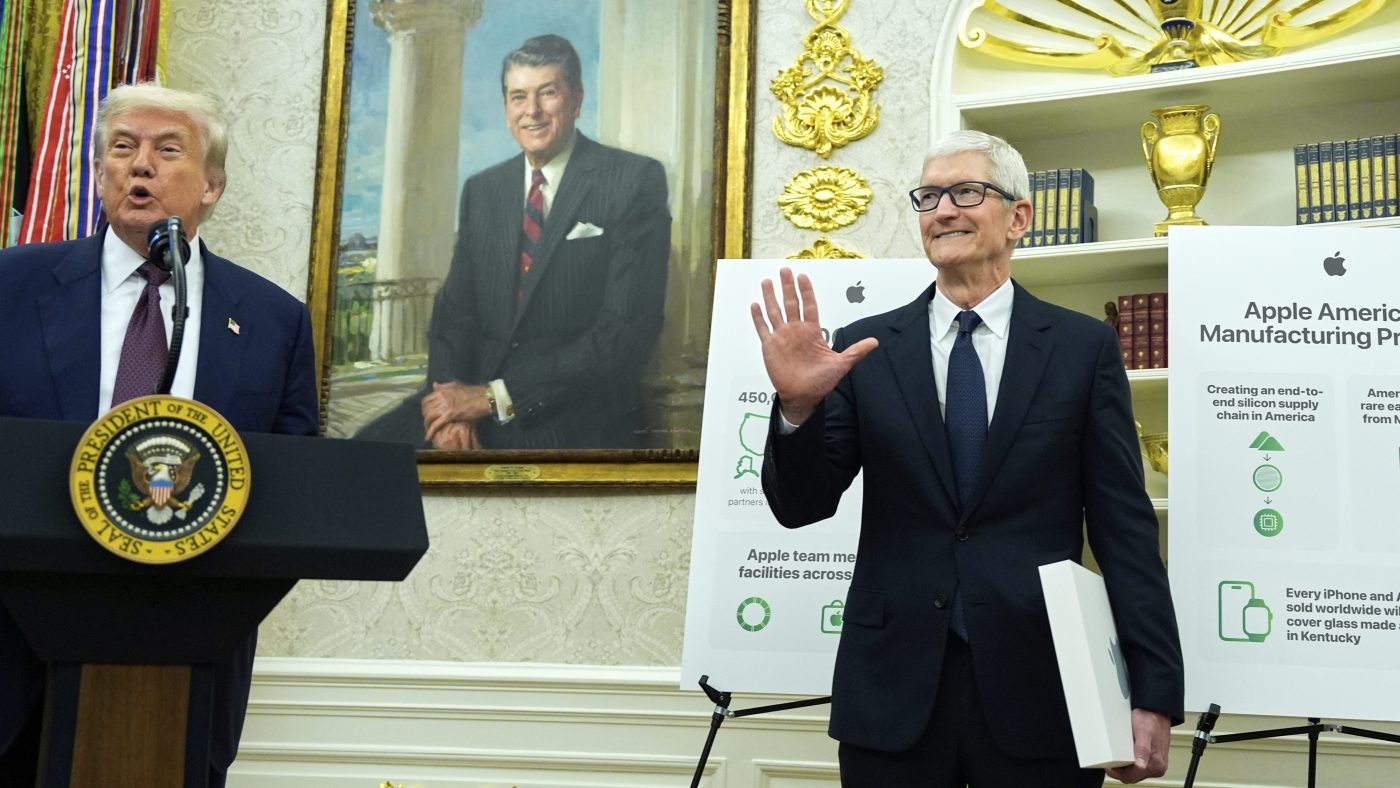
President Donald Trump announced early Thursday that Apple will partner with Intel to design and produce semiconductor chips in the United States, a move aligned with his administration's broader push to bring manufacturing back to American soil.
In a late-night post on Truth Social, Trump argued that while U.S. companies excel at design, they must also build domestically. He specifically highlighted the need for domestic production of chips used in artificial intelligence systems, a sector where global competition is intensifying.

“Stupid Presidents took our Economy for granted, and let Taiwan and others steal our Semiconductor Factories. They forgot to protect our Industries with TARIFFS,” Trump wrote. He added that by his second term, it was clear “America needed its Semiconductor Industry to come back to the U.S.A.”
Apple has historically relied heavily on Taiwan Semiconductor Manufacturing Company (TSMC) for its chip supply. This new partnership with Intel gives the iPhone maker an alternative source, reducing its dependence on a single foreign supplier.
The announcement follows Intel’s agreement last year to grant the U.S. government a 10 percent stake in the company, which now boasts a market capitalization exceeding $600 billion. Trump also took credit for Nvidia’s $5 million investment in Intel last year for chip design and manufacturing, as well as Intel’s recent collaboration with Elon Musk’s Terafab AI chip project involving SpaceX and Tesla.
Trump’s aggressive tariff policies on overseas production have pushed many tech firms to reconsider their manufacturing footprints. Apple itself announced an additional $600 billion investment in U.S. manufacturing last year to expand domestic output.
Intel’s stock surged 9 percent in premarket trading Thursday following Trump’s statement, signaling investor optimism about the deal’s potential impact on the company’s future.
Apple declined to comment on the partnership, and Intel did not immediately respond to requests for additional details. The move comes amid ongoing debates over trade policy and national security, with some lawmakers criticizing Trump’s approach to foreign relations. For instance, GOP senators have blasted Trump's Iran Strait deal as a 'JCPOA-Plus' blunder, while others have defended it as a necessary compromise.
Analysts say the Apple-Intel deal could reshape the global semiconductor landscape, but it also raises questions about the long-term viability of reshoring without sustained government support. The administration’s tariff-driven strategy has drawn both praise and skepticism from industry experts.