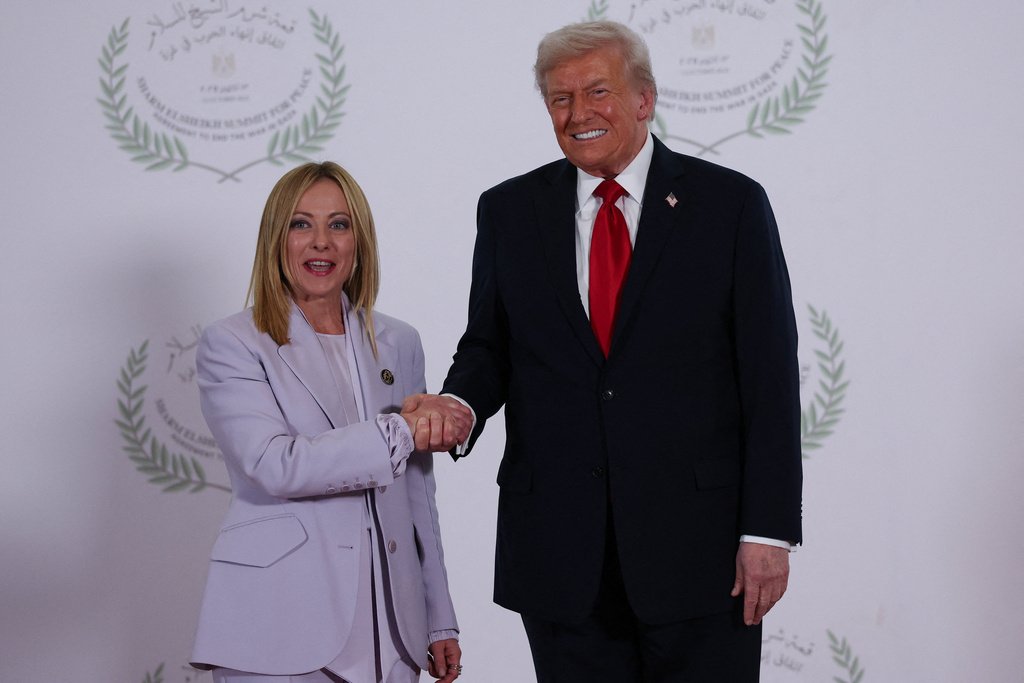
Italian Prime Minister Giorgia Meloni, once hailed as the bridge between the Trump administration and Europe, has publicly distanced herself from President Trump in a rift that signals a broader realignment of transatlantic alliances. The break, which began with Meloni criticizing U.S. military strikes in Iran and refusing to allow American bombers to refuel at an Italian base, marks a sharp reversal from her earlier role as Trump's most reliable European partner.
Meloni also declined to participate in mine-sweeping operations to reopen the Strait of Hormuz after Iran's initial blockade, siding with France, Spain, the U.K., and Germany. This decision disappointed Washington, given Italy's heavy dependence on Gulf energy: about 21 percent of its oil and gas imports transit the Strait, and Italy is a top European importer of Gulf liquefied natural gas. Trump expressed "shock" at Meloni's "lack of courage," and told reporters the two have not spoken for months, with no plans to call.
Domestic Pressures Force a Shift
Meloni's pivot is driven by a stark political calculus. Trump is the most unpopular U.S. president in Italy in decades, with a YouGov tracking poll showing only 12 percent of Italians view him favorably, while 80 percent hold an unfavorable opinion. The war in Iran and U.S. support for Israel are deeply unpopular across Italy's political spectrum, and skyrocketing energy prices—gasoline and diesel have risen over 50 percent in some regions—have slowed economic growth and squeezed households.
Meloni's approval rating has dropped to 39 percent, with a record 55 percent disapproving, according to a 2026 Statista survey. This unpopularity contributed to the loss of a March 2026 referendum on judicial reform, a major setback for her coalition. Polls confirmed that backlash was linked to her perceived closeness to Trump. After that defeat, Meloni seized an opportunity to further distance herself by publicly criticizing Trump's remarks about Pope Leo XIV, calling them "unacceptable." Trump had described the Pope as "weak" and "terrible" for his anti-war stance on Iran. Meloni, whose base includes conservative Catholics, argued religious leaders should not be dictated to by politicians.
Broader European Schism
The Meloni-Trump rift is part of a wider pattern. The recent electoral defeat of Hungarian Prime Minister Viktor Orban, a key Trump ally in Eastern Europe, and growing tensions with leaders of the U.K., France, Germany, and Spain, could lead to an irreversible realignment of U.S.-European interests. This comes as the Ukraine-Russia war enters its fourth year and the Gulf conflict remains unresolved. Meloni had worked closely with NATO Secretary General Mark Rutte to maintain alliance cohesion amid Trump's demands for greater European financial and military contributions.
For context, the growing divide echoes earlier strains, such as Trump's grip on the GOP and domestic controversies like the EEOC's lawsuit against the New York Times, which have polarized U.S. politics. Meanwhile, the Iranian threat to block U.S. warships in the Strait of Hormuz underscores the strategic stakes of Meloni's refusal to participate in military operations.
The transatlantic divorce between Trump and Meloni risks further eroding the generational partnership between the U.S. and Europe, putting NATO's future and European security at risk. Meloni, who once acted as a steady, responsible mediator, now views the alliance as a political liability that could derail her domestic agenda. The question remains whether this rift is reversible or marks a permanent fracture in the Western alliance.