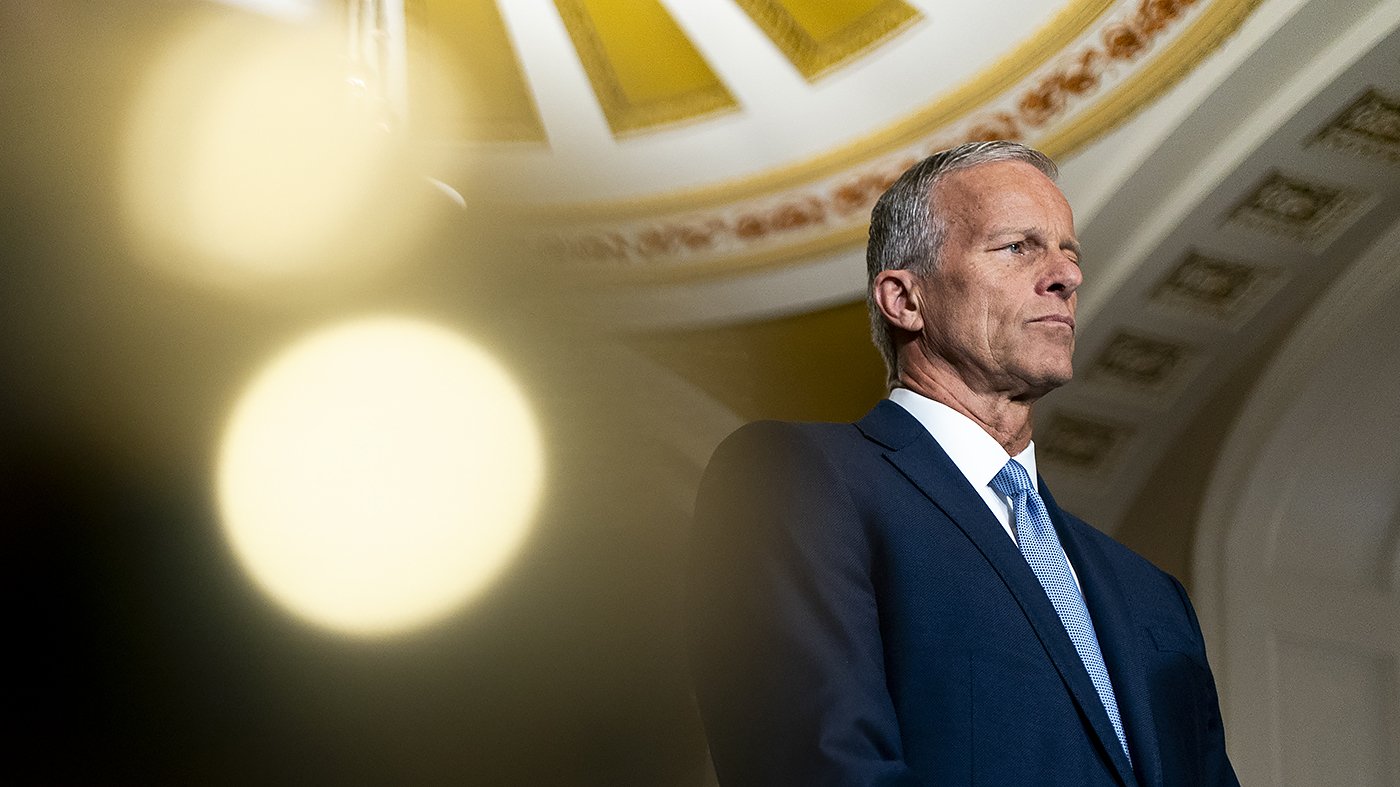
Senate Majority Leader John Thune (R-S.D.) is navigating a political minefield as the Senate barrels toward its August recess, with President Trump turning up the heat and internal GOP divisions threatening to derail the party's legislative agenda. The pressure comes from all sides: moderates worried about midterm fallout, hard-liners demanding concessions, outgoing Republicans eager to obstruct Trump, and the president himself, who has made his displeasure with Thune unmistakably public.
With just two weeks left before the break, Thune must steer through a crowded to-do list topped by a government funding bill and a third reconciliation package. The clock is ticking, attendance is uncertain, and the stakes are high for a party hoping to avoid a messy shutdown ahead of the midterms.
Thune's immediate priority is keeping the government open beyond the October funding deadline, but Trump is pushing hard for the Senate to take up the House-passed $95 billion reconciliation framework. That package includes $73 billion for the Pentagon and intelligence agencies, $12 billion for farmers, and $10 billion for election-related reforms—most notably the Safeguard American Voter Eligibility (SAVE America) Act, a voter ID measure that has been repeatedly blocked in the Senate. Trump has made the SAVE Act his top legislative demand, and his frustration with Thune's hesitance is boiling over.
The tension between the two leaders is escalating. At a Georgia rally last week, Trump quipped that “the Senate is a place you send things when you want them to die.” White House press secretary Karoline Leavitt followed up Thursday by telling reporters that Trump's “patience is running out” with Thune, drawing a sharp retort from the majority leader. On Friday, Trump took to social media to congratulate the House for passing the budget resolution and urged the Senate to follow suit before the recess, calling it “one of the most consequential Bills in America’s History.”
Thune, however, acknowledges he lacks the votes to advance the budget resolution. “As I’ve said before, you got to get to 50, and I can’t count to 50 right now on a budget resolution,” he told reporters. Key holdouts include retiring Sen. Thom Tillis (R-N.C.), who has vowed to block any bill containing the SAVE Act. “If I see a reconciliation bill come from the House with another failed attempt to confuse this election, I will use every device I have available to slow down the wheels of government,” Tillis thundered on the Senate floor.
Instead of pushing the House framework, Thune is exploring a bipartisan stopgap funding bill to keep the government running through early December. If that fails, he’s open to using reconciliation as a backup to avert a shutdown. “Let’s try the bipartisan route and see what happens,” he said. The strategy has backing from key Senate Republicans, but Trump’s insistence on the SAVE Act complicates any compromise.
Meanwhile, the Senate is also wrestling with high-stakes nominations. Dr. Erica Schwartz, nominated to lead the Centers for Disease Control and Prevention, is expected to advance from committee this week after securing the key vote of Sen. Bill Cassidy (R-La.). But Sean Kaufman, a nominee for a public health preparedness role, saw his committee vote pulled last week amid vaccine-safety skepticism, and his fate before recess remains uncertain.
Acting Attorney General Todd Blanche faces an even tougher path. He needs every Republican on the Judiciary Committee to back him, but outgoing Sens. John Cornyn (R-Texas) and Tillis have not committed, demanding assurances that a proposed $1.8 billion “anti-weaponization” fund is dead. A single GOP defection could stall Blanche’s nomination, and all Democrats are expected to oppose him on the floor. Sen. Lisa Murkowski (R-Alaska) has held multiple meetings with Blanche but hasn’t revealed her vote.
The partisan battles extend to director of national intelligence nominee Jay Clayton, who cleared the Intelligence Committee with unanimous Republican support and faces a floor vote this week. As Thune juggles these fights, the rift with Trump is only widening—a dynamic that could shape not just the summer sprint but the GOP’s midterm prospects. For more on the deepening divide, see how Trump is pushing GOP to kill the filibuster and how Trump's tariffs are threatening Republican midterm hopes.