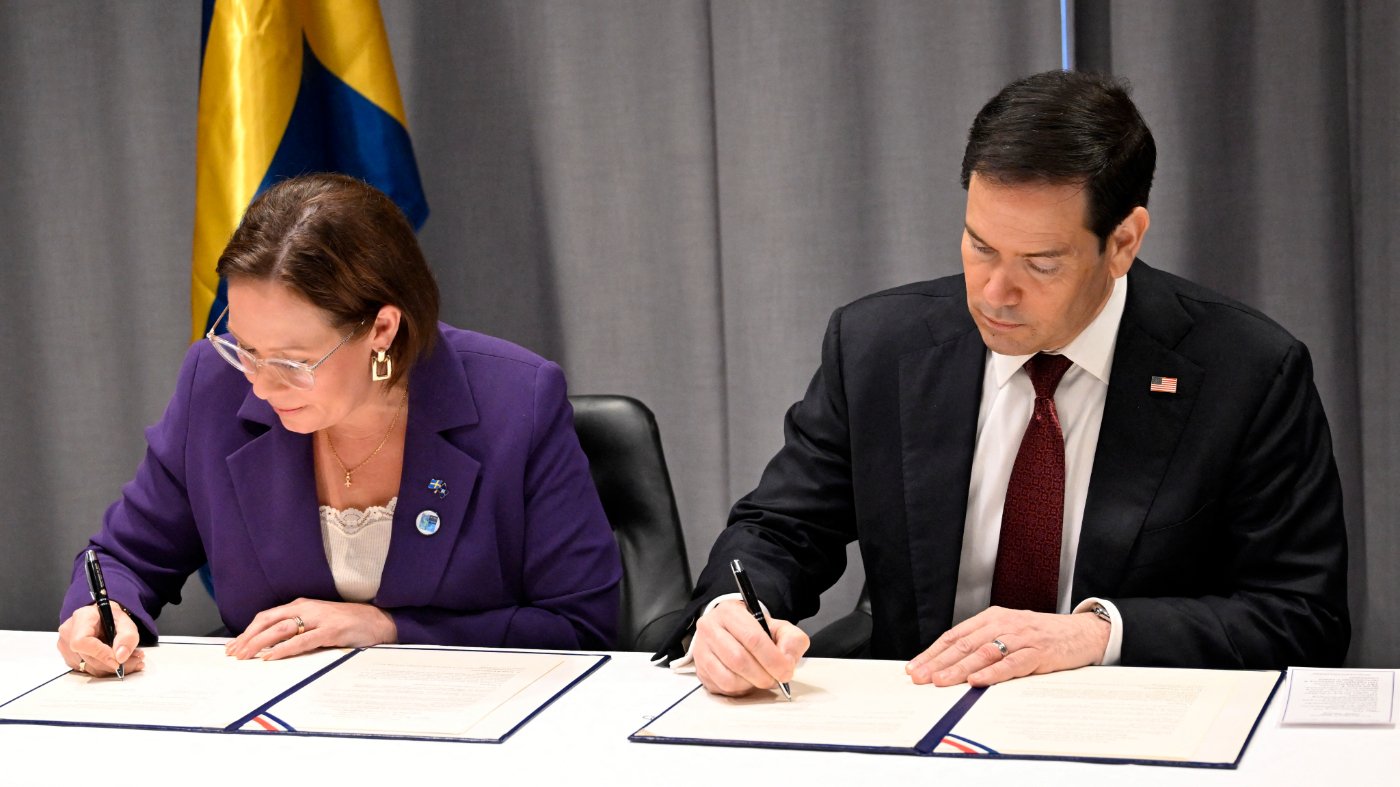
Last week, in the Swedish port city of Helsingborg, Secretary of State Marco Rubio and Swedish Foreign Minister Maria Malmer Stenergard signed what is being called a Technology Prosperity Deal. The memorandum of understanding covers artificial intelligence, next-generation mobile networks (5G and 6G), quantum computing, biomedicine, space, defense technology, and energy. It is the fifth such agreement the United States has signed globally—and the only one with a European partner.
The signing occurred on the sidelines of a NATO foreign ministers' meeting, buried under a pile of geopolitical crises and alliance logistics. For anyone tracking the architecture of American technological power in the 21st century, however, this deal deserves close attention.
As a board member of the Swedish American Chambers of Commerce USA and a longtime observer based in Texas, I have watched this relationship develop up close. What has unfolded between Washington and Stockholm over the past 12 months is far from routine diplomatic housekeeping. It is a quiet strategic realignment that has moved faster and more decisively than almost any comparable shift in U.S.-European relations today.
Consider the sequence: Sweden joined NATO in March 2024, ending two centuries of non-alignment. It signed a bilateral defense cooperation agreement with the United States. It opened new consulates general in Houston and San Francisco—targeting the two American cities most central to energy, life science, and technology. In March, Sweden became the first European Union member state to sign the Pax Silica Declaration, Washington's flagship initiative to secure global AI and semiconductor supply chains. And now, the Technology Prosperity Deal.
That is five concrete, bilateral commitments in roughly a year—not communiques, not summits, but signed agreements. The question worth asking: Why Sweden, and why does it matter for American interests?
Sweden is a country of 10 million people with a GDP comparable to a mid-sized American state. But its economic weight in the United States is disproportionate to its size. Swedish companies support approximately 280,000 jobs on American soil. Swedish foreign direct investment in the U.S. totaled $119 billion in 2024, making Sweden the fourth fastest-growing source of foreign direct investment in the country. Ericsson manufactures 5G equipment in Texas. AstraZeneca runs major pharmaceutical operations across the eastern seaboard. Volvo builds trucks in Virginia. These are not diplomatic talking points—they are factories, laboratories, and payrolls.
More important than what Sweden already contributes is what the new agreements make possible. The Technology Prosperity Deal is explicit about its ambitions: joint research on AI for advanced manufacturing, joint development of 5G and 6G standards, cooperation on subsea communication cables across the Arctic connecting North America and Northern Europe, and coordination on international telecommunications governance ahead of the 2027 World Radiocommunication Conference. These are not vague aspirations. They are the technical and regulatory arenas where the U.S. is competing directly with China for long-term dominance.
Sweden brings something specific to that competition. Ericsson is one of only two Western companies—alongside Nokia—capable of supplying end-to-end 5G infrastructure that excludes Chinese components. Sweden's Chalmers University and KTH Royal Institute of Technology rank among the world's leading institutions in quantum computing and materials science. Sweden's national AI strategy, adopted this past February, explicitly targets the full AI value chain from critical minerals to foundation models—aligning directly with the logic of Pax Silica.
For American companies in the sectors covered—AI infrastructure, defense technology, semiconductors, biomedicine, quantum—the agreements create a smoother path to Swedish partnerships and co-investment. For Swedish companies, they create a presumption of trust in U.S. federal procurement and research programs that did not previously exist. The State Department is already piloting a concierge service to streamline partner nations' access to American AI products. Sweden is now eligible, whereas most European nations are not.
There is a broader lesson here for American foreign policy, one that tends to get lost in debates about burden-sharing and tariffs. The most productive alliances are not built on obligation—they are built on mutual economic interest aligned with shared security values. Sweden is not cooperating with the U.S. because it has to. It is cooperating because its companies, its universities, and its government have calculated that the AI era is a moment in which positioning matters enormously, and that the American ecosystem is where that positioning happens.
That calculation should be welcomed, reinforced, and used. The Technology Prosperity Deal is a framework, not a result. What comes next—in laboratory partnerships, investment flows, standards negotiations, and defense co-production—is the actual test. The groundwork is laid. The question is whether Washington is paying enough attention to build on it. I would argue it is not yet. But last week was a start in the right direction.
André Persson is a board member of the Swedish American Chambers of Commerce USA, senior advisor to the SACC Texas board, and former chairman of the board of SACC Houston. He is based in Dallas, Texas.