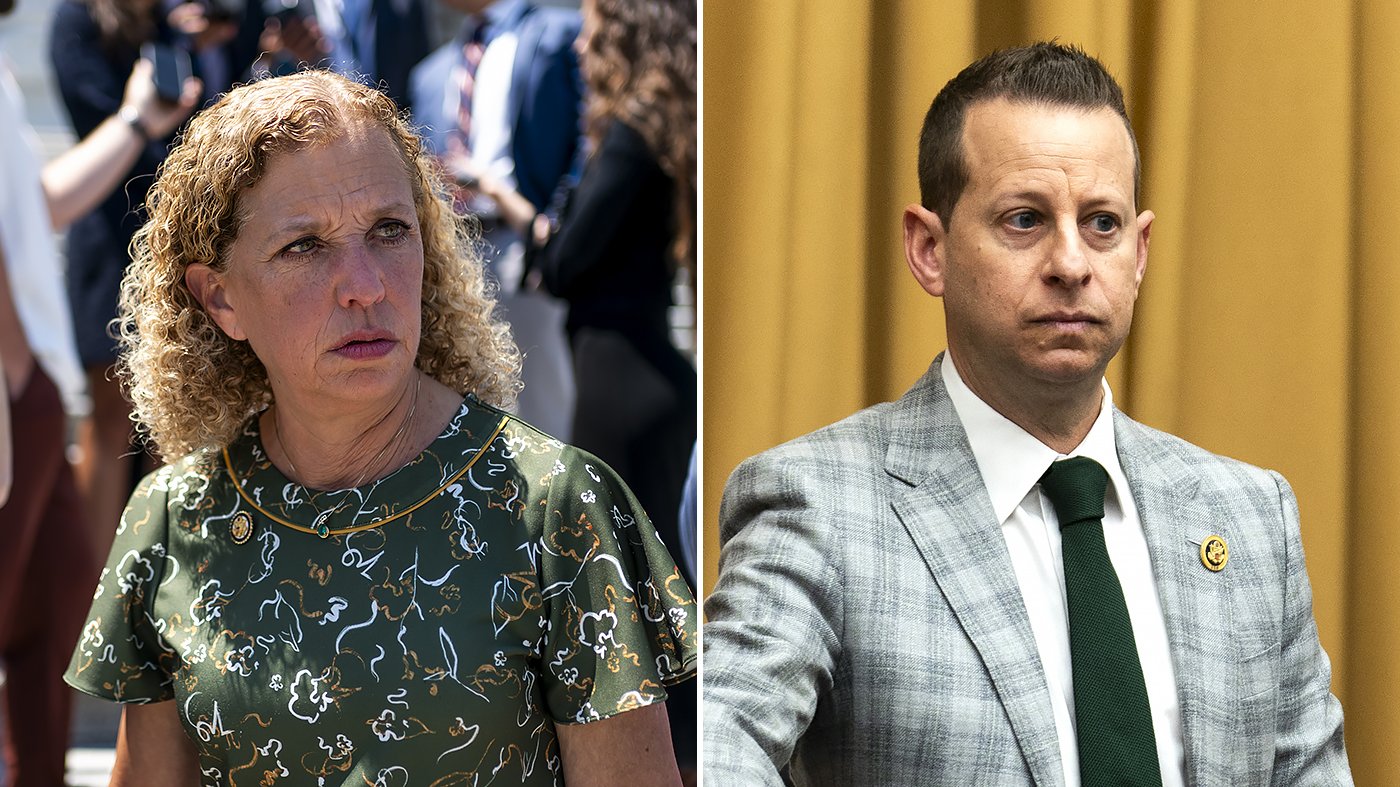
Two Democratic incumbents in South Florida are fighting for their political lives in Tuesday's primary, as progressive challengers seek to capitalize on newly redrawn districts and an anti-establishment wave within the party.
Rep. Jared Moskowitz, running in the newly created 25th Congressional District, is being challenged from the left by Oliver Larkin, a candidate backed by the Democratic Socialists of America (DSA). Larkin's campaign aims to extend a string of progressive primary victories this cycle, targeting a district that is considered a toss-up in November.

Meanwhile, Rep. Debbie Wasserman Schultz, who currently represents the old 25th District, is running in the solidly Democratic but significantly reshaped 20th District. She faces a crowded field that includes progressive organizer Elijah Manley, as well as several other Black candidates. The race has become a flashpoint over representation, as some local Black leaders argue the plurality-Black district should be represented by a Black lawmaker.
The primaries come after Florida's GOP-controlled legislature, at the urging of President Trump, pushed through a mid-decade redistricting plan designed to flip the state's congressional delegation from a 20-8 Republican advantage to a 24-4 one. The new map has forced several incumbents into unfamiliar territory and created a single highly competitive House seat—the 25th District—which Decision Desk HQ rates as a must-win toss-up for both parties.
Geoffrey Skelley, chief elections analyst at Decision Desk HQ, said Republicans might fall short of their net-four seat goal. He pointed to Moskowitz and Rep. Kathy Castor, who is unopposed in her primary in the Tampa-area 14th District, as Democrats' best hopes of holding on. "You can see the combination of the national environment and incumbents who are stronger than the Democratic baseline, and those things coming together, along with a little boost from incumbency to perhaps allow those Democrats to hold on despite everything," Skelley said.
In the 25th District, Larkin is pitching a working-class agenda and dismissing concerns that a left-wing platform could hurt in a general election. The district skews older and has significant Hispanic and Jewish populations. But Moskowitz leads in polls and fundraising, and his supporters argue his more moderate approach is the best fit for the battleground. "The things that worked in Colorado or worked in New York, like, it's just not this district," said Florida Democratic strategist Steve Schale, referring to past DSA wins.
DSA co-chair Ashik Siddique told The Hill that regardless of Tuesday's outcome, Larkin's competitive campaign shows "there is a real hunger, especially in a red state like Florida, for a working-class agenda." Skelley noted that progressive candidates have historically performed better in districts with younger voters, which could be a challenge for Larkin.
On the Republican side in the 25th, well-funded Boca Raton Mayor Scott Singer leads sparse polling, with former state Rep. George Moraitis and Joe Kaufman also in the race. The GOP primary winner will face the Democratic nominee in November.
In the 20th District, the Democratic primary is effectively the general election. Former Rep. Sheila Cherfilus-McCormick, who resigned in April amid allegations of financial misconduct, is attempting a comeback. She has denied wrongdoing and suggested the investigation was politically motivated. Manley, who has been endorsed by Rep. Rashida Tlaib (D-Mich.), has raised over $1 million, making him a serious contender.
But with several Black candidates splitting the vote, Wasserman Schultz, a seasoned House veteran with no scandal attached, could emerge victorious. She has defended her candidacy, telling the Associated Press she is not "air dropping" herself into the district and noting her history of representing diverse communities. Skelley cautioned that while Manley has resources, progressive Black candidates have not always succeeded in South Florida.
The primaries also come amid a broader national conversation about the Democratic Party's direction, with progressive victories in other states fueling hopes of a shift. However, as the DSA faces its final primary test in Florida, the outcome could signal whether that momentum can translate into a competitive district.
Tuesday's results will also be watched closely as a bellwether for Florida's broader redistricting battles, which have drawn national attention. And with Trump casting his mail-in ballot in the primary despite his past fraud claims, the political stakes remain high.