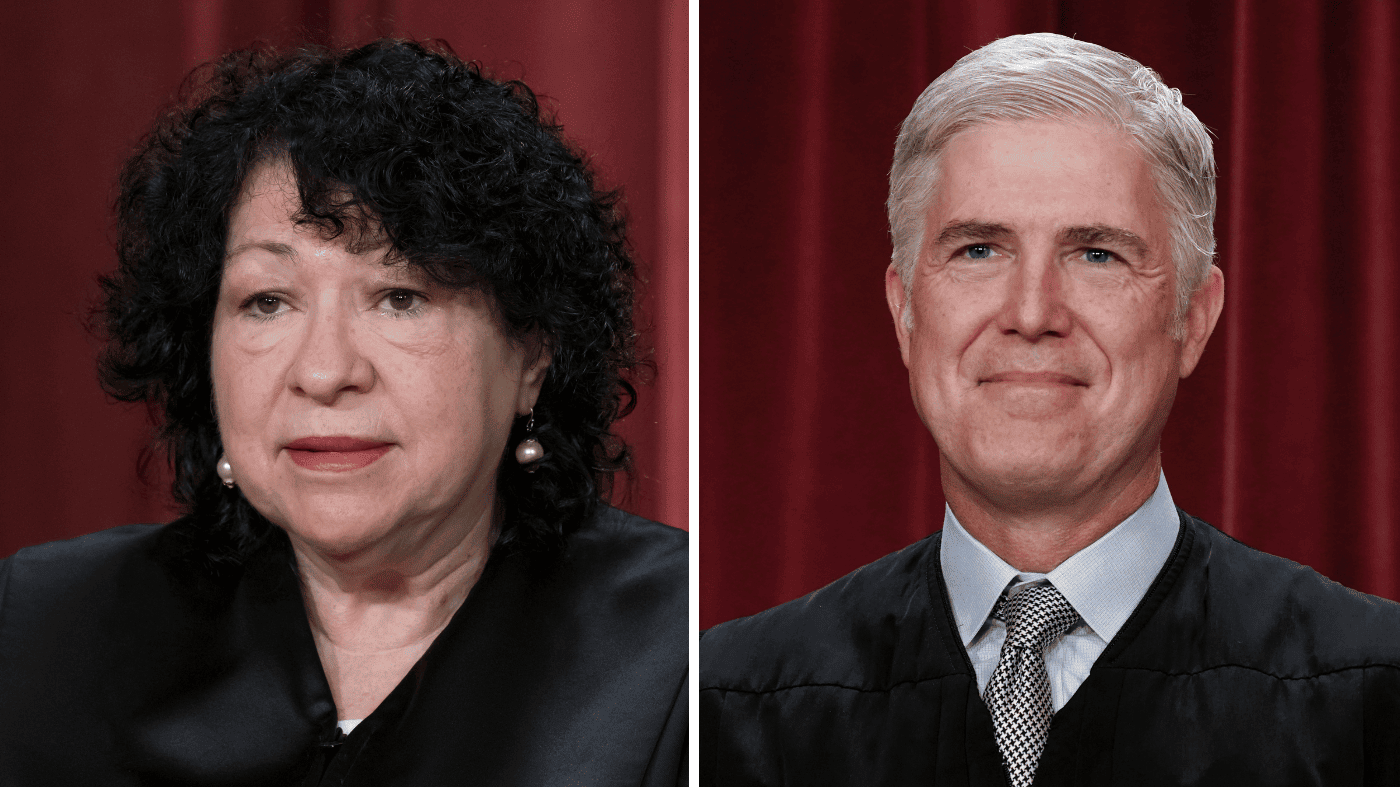
In a rare show of bipartisanship, Supreme Court Justices Sonia Sotomayor and Neil Gorsuch jointly condemned the federal government's handling of a Mexican national's illegal reentry case, pointing to what they called "serious constitutional problems" with the prosecution's approach.
The case involved Jesus Herrera-Salazar, who was prosecuted twice for illegally reentering the United States. Sotomayor, writing for herself and joined by Gorsuch, argued that the second prosecution violated the Fifth Amendment's Double Jeopardy Clause, which protects individuals from being tried twice for the same offense.
The justices were part of the Court's decision to decline reviewing Herrera-Salazar's appeal, a routine move for the vast majority of petitions. However, their accompanying statement highlighted concerns that the case presented "constitutional absurdity" that lower courts should avoid in the future.
Herrera-Salazar's legal saga began in 2020 when he was arrested in Texas and sentenced to prison for illegal reentry. After serving his sentence, he was placed on supervised release and required to stay on U.S. soil under law enforcement supervision. It was during this period that he was found in Oklahoma and subsequently charged and convicted of illegal reentry again.
He has since completed both sentences and was deported to Mexico in 2024, according to court records. Despite his removal, he continued to challenge the second conviction, asserting that it constituted double jeopardy.
The 10th U.S. Circuit Court of Appeals rejected his argument, ruling that each conviction represented a separate offense. Sotomayor and Gorsuch, however, suggested that the government's strategy of prosecuting continuous conduct by focusing on different time periods undermines the constitutional protection.
"When a defendant is convicted of a crime that involves continuous, uninterrupted conduct, our precedents and the logic of the Double Jeopardy Clause strongly suggest that the Government is barred from charging that defendant with the same continuous crime for a second time simply by focusing on a different time marker," Sotomayor wrote.
The two justices have previously joined forces on criminal justice issues, despite their contrasting appointments—Sotomayor by President Obama and Gorsuch by President Trump. Their latest joint statement underscores ongoing concerns about how immigration enforcement interacts with constitutional safeguards.
This case comes amid broader debates over immigration policy, including the Supreme Court's upcoming review of mandatory detention for long-term undocumented immigrants. While the Court declined to hear Herrera-Salazar's appeal, the justices' pointed remarks may signal a willingness to address similar issues in future cases.
Legal analysts note that the statement, while not binding, could influence lower courts as they handle cases involving repeated prosecutions for continuous conduct. The justices' rare alignment serves as a reminder that constitutional protections can transcend partisan lines.