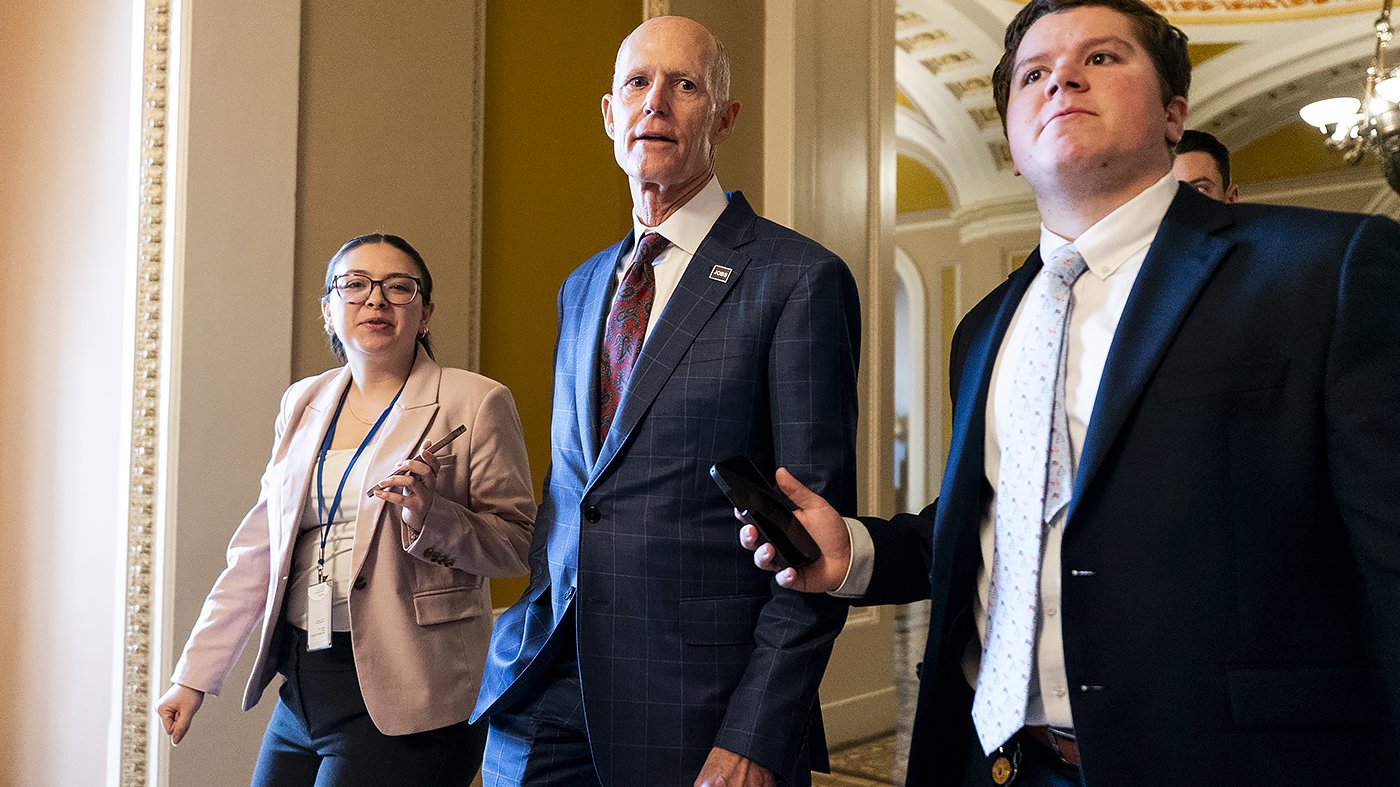
Florida Senator Rick Scott, a prominent ally of former President Donald Trump, declared his opposition Friday to a Department of Homeland Security funding agreement advanced by the Senate in the early morning hours. Scott criticized both the timing of the vote and the substance of the bill, which he said fails to adequately fund key immigration enforcement agencies.
"The Senate passed a bill to fund many DHS functions, but it did not fund ICE and only partially funded Customs and Border Protection. I opposed this bill," Scott stated. He accused Democratic lawmakers of prioritizing "illegal aliens" over national security, framing the funding omission as a deliberate policy choice.
Conservative Coalition Forms Against Senate Deal
Scott's position aligns him with the conservative House Freedom Caucus, whose members have uniformly panned the Senate's unanimous consent agreement. The deal funds most Homeland Security operations but specifically excludes appropriations for Immigration and Customs Enforcement and provides only partial funding for Border Patrol. This structure has become a flashpoint for Republicans who view robust immigration enforcement funding as non-negotiable.
The House Freedom Caucus is demanding significant revisions before supporting any DHS funding measure. Members insist any bill must include full funding for Border Patrol and ICE's transnational criminal investigative units. Additionally, they are pushing for the inclusion of new voter identification requirements, a policy priority for many conservatives that has faced stiff Democratic opposition.
Freedom Caucus Chair Escalates Rhetoric
Freedom Caucus Chairman Andy Harris (R-Md.) sharply criticized the Senate's action. "We can't believe that the Senate abdicated its responsibility this morning by not funding the child sex trafficking division of ICE, that they didn't fund the Border Patrol. I guess the Democrats want a wide open border," Harris said Friday.
Harris outlined a hardline strategy: "The only thing we're going to support is adding that funding into the bill, adding voter ID, sending it back to the Senate, make them come back in and do their work. The bottom line is, this deal is bad for America." This stance creates a significant obstacle in the House, where the conservative bloc has repeatedly demonstrated its ability to derail legislation that lacks its support.
House Leadership Seeks Alternative Path
The unified conservative opposition raises serious questions about whether the Senate-approved bill can pass the Republican-controlled House. Speaker Mike Johnson (R-La.) has already rejected the Senate deal. Instead, he has proposed a 60-day stopgap funding measure for DHS, a move that would avert an immediate shutdown but kick the substantive debate further down the road. This clean continuing resolution represents a direct challenge to the Senate's bipartisan agreement and reflects the deep divisions within the GOP conference.
Other Senate Republicans have echoed concerns about reducing ICE's budget. Senator Josh Hawley (R-Mo.) expressed skepticism earlier in the week, telling reporters, "I'm skeptical about voting to defund or to cut ICE funding. I would hope that we're not going to be asked to do that. I do not want to vote to defund ICE. I don't want to vote to cut ICE funding. I want ICE to be fully funded."
Broader Implications and Next Steps
The impasse over DHS funding is part of a larger pattern of congressional deadlock on homeland security and immigration matters. The Senate's decision to advance a bill without ICE funding reflects Democratic priorities and the political realities of a narrowly divided chamber, while House conservatives are leveraging their voting power to demand policy concessions. This standoff mirrors recent failures to reach a compromise, increasing the likelihood of a protracted funding fight.
With Speaker Johnson's stopgap proposal on the table, the immediate path forward involves negotiations between House leadership, the Freedom Caucus, and Senate counterparts. The outcome will test the GOP's ability to govern with a slim majority and could influence the political landscape ahead of the next election cycle, particularly on the potent issue of border security. The situation remains fluid, with the threat of a partial DHS funding lapse looming if no agreement is reached.