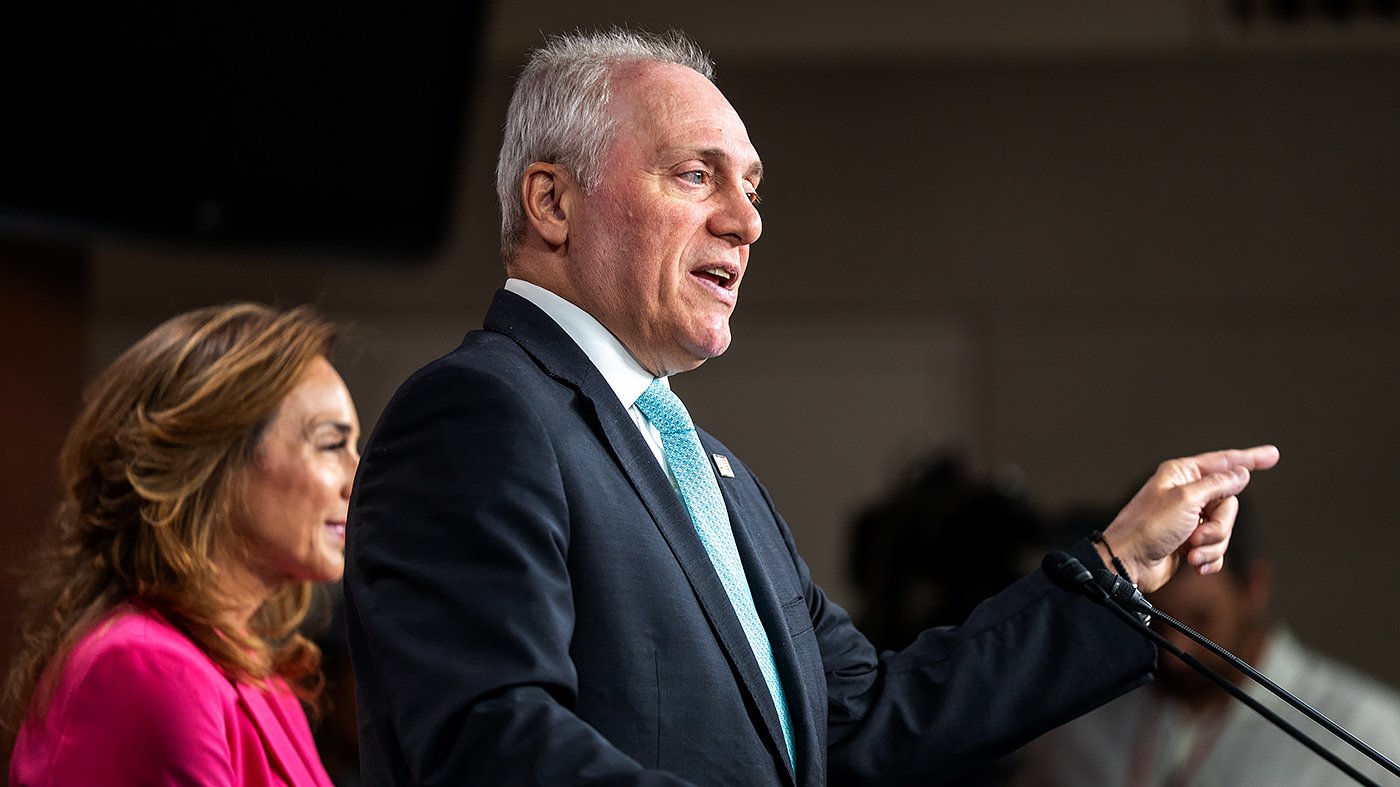
House Majority Leader Steve Scalise (R-La.) has stepped into a defining role as the elder statesman of House Republicans during President Trump’s second term, drawing on policy experience from the rocky first-term trifecta that few of his colleagues can match. As the No. 2 House Republican, Scalise provides a unique institutional memory, having been a top leader during the 2017 tax overhaul—a contrast to other conference leaders who rose later.
Scalise’s strengthened relationship with Trump and smoother working ties with leadership colleagues have positioned him as a top contender for the Speaker’s gavel if Republicans lose the House after the midterms. In an interview in his Capitol office, Scalise downplayed that prospect but emphasized his “unique skill set,” blending conservative policy roots from his tenure as Republican Study Committee chairman with trust built with Trump. “I think that goes back to being chairman of the Republican Study Committee,” Scalise said, noting his focus on details. “You’ve got to really take it serious and focus on the details, because the details are what matter.”
Scalise’s experience proved critical in crafting the One Big Beautiful Bill—later rebranded as the Working Families Tax Cut—which extended tax cuts and pushed partisan spending priorities. He was the only House leadership member who had navigated the 2017 Tax Cuts and Jobs Act reconciliation. Scalise recalled that in Trump’s first term, “he was not in sync with all of leadership. Some were fighting President Trump,” pointing to the fraught relationship with then-Senate Majority Leader Mitch McConnell and former Speaker Paul Ryan. That friction, he said, “wasted the first six months with everybody being on different pages.”
To avoid a repeat, Scalise began planning early for a potential 2024 GOP trifecta. He flew to Mar-a-Lago six months before the election to discuss legislative priorities with Trump, incorporating ideas like the “No Tax on Tips” provision. “Our relationship has grown through the years to where we not only trust each other, but he also knows that I have a really good understanding of how the House works,” Scalise said. “We’ve been able to bridge some gaps through some of that trust.” He tasked committees with aggressive deadlines and target numbers, ensuring the bill reached Trump’s desk by July 4.
The House GOP’s dynamics have shifted dramatically during Scalise’s nearly two decades in Congress, with narrow majorities and emboldened hard-liners causing near-weekly rebellions. Scalise said leadership now focuses on bringing factions together, often through direct confrontations. “They think leadership’s stopping them from getting it, when it’s really other colleagues of theirs that won’t vote for that stuff,” he said. “Have them in the room, sitting across the table from their own colleagues. You can hash out a lot of problems in an hour-and-a-half, two-hour meeting of some yelling and screaming.”
Scalise credits Speaker Mike Johnson (R-La.) for embracing such “intense fellowship,” noting their 30-year relationship. “The Speaker’s got incredible patience. He and I have a great relationship. I do think that helps,” Scalise said. This contrasts with his more complicated ties to former Speaker Kevin McCarthy, though Scalise declined to compare leadership teams. Meanwhile, Trump’s approval has dipped to 36% in a new poll, adding pressure on the GOP to hold the House amid Democratic hopes for a majority despite internal rifts.