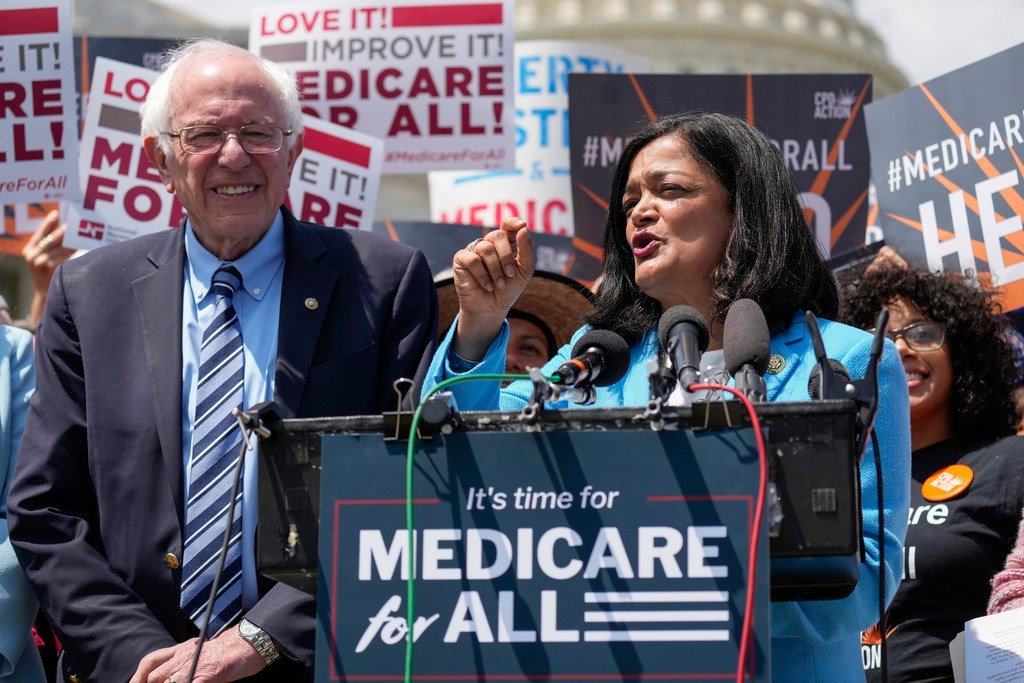
Senator Bernie Sanders has branded his healthcare overhaul as "Medicare for All," a phrase that polls well because Medicare is the most popular health insurance program in the country. But critics say the label is a bait-and-switch: the goal is not to expand the current Medicare program but to abolish it and replace it with a centralized, government-run system that resembles the United Kingdom's National Health Service.
Under Sanders' plan, the existing mix of private employer-based coverage, individual plans, and government programs like Medicare and Medicaid would be scrapped. In their place, the government would pay all medical bills, funded by higher taxes, with no premiums. But as recent efforts to crack down on Medicare fraud show, the current program is far from perfect—yet it enjoys broad support.

Merrill Matthews, writing for The World Signal, argues that Sanders' proposal is deceptive. "Medicare is the most popular health care program in America," Sanders' Senate website says, yet his plan would eliminate the very program he claims to expand. Medicare has multiple parts—Part A for hospital care, Part B for doctor visits, Part C (Medicare Advantage) for private plans, and Part D for prescription drugs—none of which would exist under Medicare for All.
One of the most glaring omissions is Medicare Advantage, which relies on private insurers and is chosen by 55% of eligible seniors. Sanders' plan would ban private coverage, forcing all seniors into a single government system. This is a stark contrast to President Obama's promise during the Affordable Care Act debate that "if you like your health plan, you can keep it," which was later named Politifact's 2013 "Lie of the Year." Sanders makes no such promise; he openly intends to end every current health plan.
Public satisfaction with current coverage is high: a recent NBC News poll found 82% of Americans are satisfied with their healthcare, and 90% of seniors on Medicare say they are satisfied, with 42% very satisfied. Meanwhile, the British Social Attitudes survey, running for 40 years, found only 26% satisfaction with the NHS and 51% dissatisfaction. Matthews asks why the U.S. would replace a system with 90% approval for one with 26%.
Proponents of Medicare for All point to the flaws of the current system, including high costs and unequal access. But Matthews counters that government-run systems face their own problems. The NHS, for example, has warned of layoffs without additional funding, faces long waits for non-urgent treatment (up to 18 weeks), and often lacks the newest drugs and technologies available in the U.S.
Medicare's survival, Matthews argues, depends on the private insurance market, which cross-subsidizes the program. Providers earn more from private insurers, allowing them to continue accepting Medicare patients. Putting everyone into a government system would eliminate that subsidy, likely leading to greater shortages and rationing.
Matthews also warns of the political dynamics: when healthcare is fully government-controlled, the politically powerful and well-connected—like members of Congress—will still get the care they need, while ordinary citizens wait. "Sanders won't have to wait for care; you will," he writes.
The debate over Medicare for All is not new. Sanders has long championed the idea, and it has gained traction among progressives. But as the torch passes to a new generation of Democratic socialists, the question remains whether the American public will embrace a system that, by the numbers, is far less popular than what they currently have.
In the end, Matthews concludes, "Medicare for All" is a misnomer. It is not Medicare, and it is not for all—it is a risky experiment that would dismantle the most popular health program in the country in favor of a model that has failed to satisfy its own citizens.