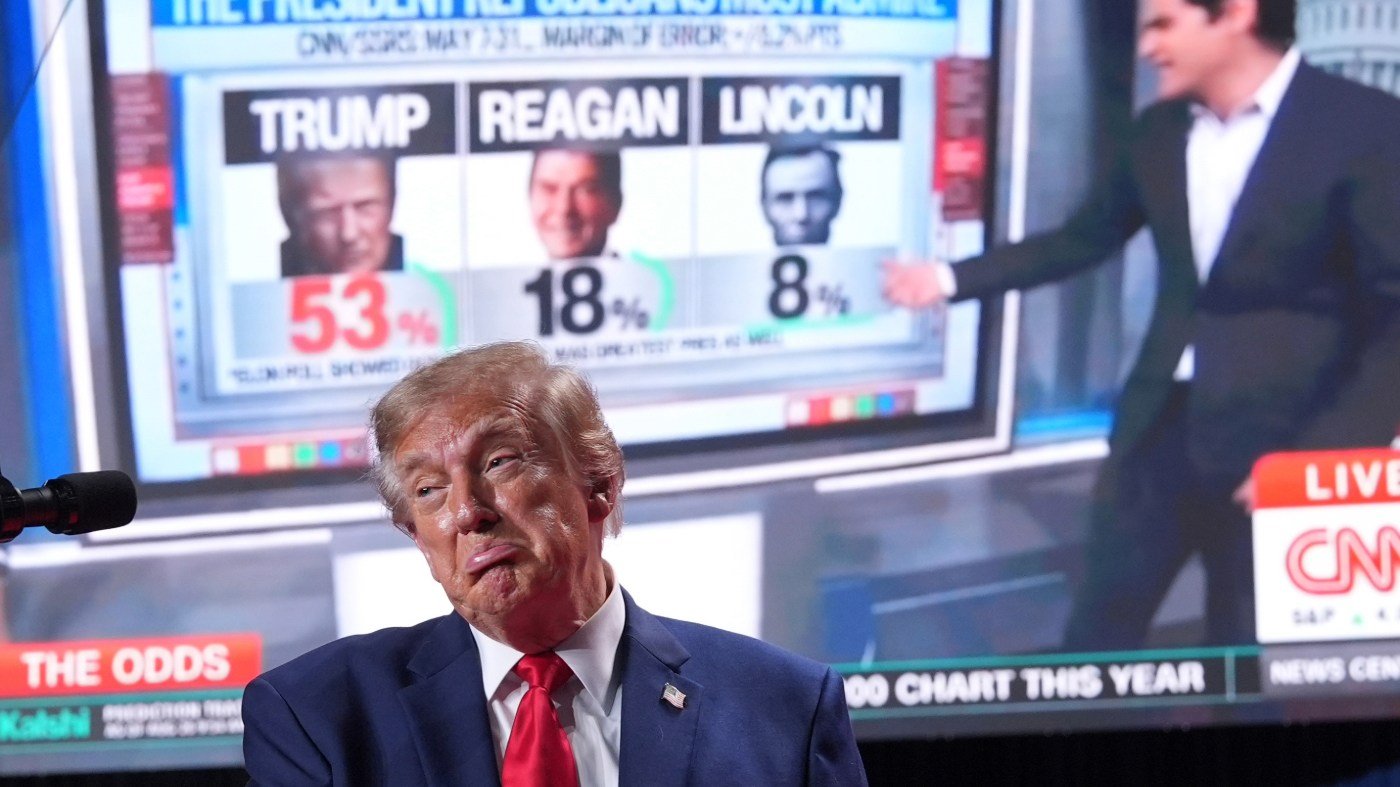
President Trump's familiar plea to supporters—"Pretend, please, I'm on the ballot"—has become a rallying cry as he tries to rally Republicans ahead of the midterms. But his strategy of relying on his personal popularity may be less about electioneering than about a deeper political instinct: using taxpayer money to buy votes.
The White House recently launched a television ad, funded by the U.S. government, that features Trump speaking directly to the camera, urging viewers to join his "final battle" to "demolish the deep state" and "expel the warmongers from our government." The ad has drawn sharp criticism, including from within his own party. Senator Thom Tillis (R-N.C.) said, "I hate it. I tell you, it feels like Viktor Orbán talking to the Hungarian people."

The comparison to Hungary's former leader is apt. After 16 years in power, Orbán, facing a tough reelection in 2025, resorted to a flurry of populist handouts: capping mortgage rates, subsidizing housing for public-sector workers, exempting young voters and mothers from income tax, boosting pensions, and injecting cash into restaurants and tourism. His party lost in a landslide anyway.
Trump has shown a similar tendency when under political pressure. His pledge to give every adult a $5,000 dividend if Republicans keep control of Congress is a textbook example of fiscal clientelism. Vice President JD Vance has floated a plan to make transfer payments to stay-at-home spouses—but not to single working parents. Both proposals are direct cash transfers, which make Orbán's earnings-contingent payouts look modest by comparison.
Budget hawks have criticized the cost and feasibility of these giveaways. Legal scholars question whether the government-funded ads violate the Hatch Act, which bars federal employees from partisan political activity, or the appropriations ban on using funds for "publicity or propaganda." Several watchdog groups have filed complaints, but resolution before election day seems unlikely.
Defenders of the ads argue they are public service announcements, not propaganda, and that since Trump is not on the ballot, campaign finance rules don't apply. But the line between public information and partisan electioneering is thin.
This pattern—using state resources to reward supporters and woo swing voters—is a classic feature of clientelism, as seen in Argentina's Peronism, India's pre-election cash distributions, and America's own Tammany Hall and Daley machine. Whether it's Trump, Orbán, or Vance, opening the fiscal purse to appease a grumbling public is a move straight out of history's playbook.
The upcoming midterms are a referendum on this approach. Polls suggest Republicans may lose their majority, and many voters are weary of Trump's tactics. The question is whether Democrats can offer a credible alternative to fiscal populism. As Edward Lopez, an economist, notes, "It will make a big difference if we reject clientelism and move on with our lives in America's constitutional republic."