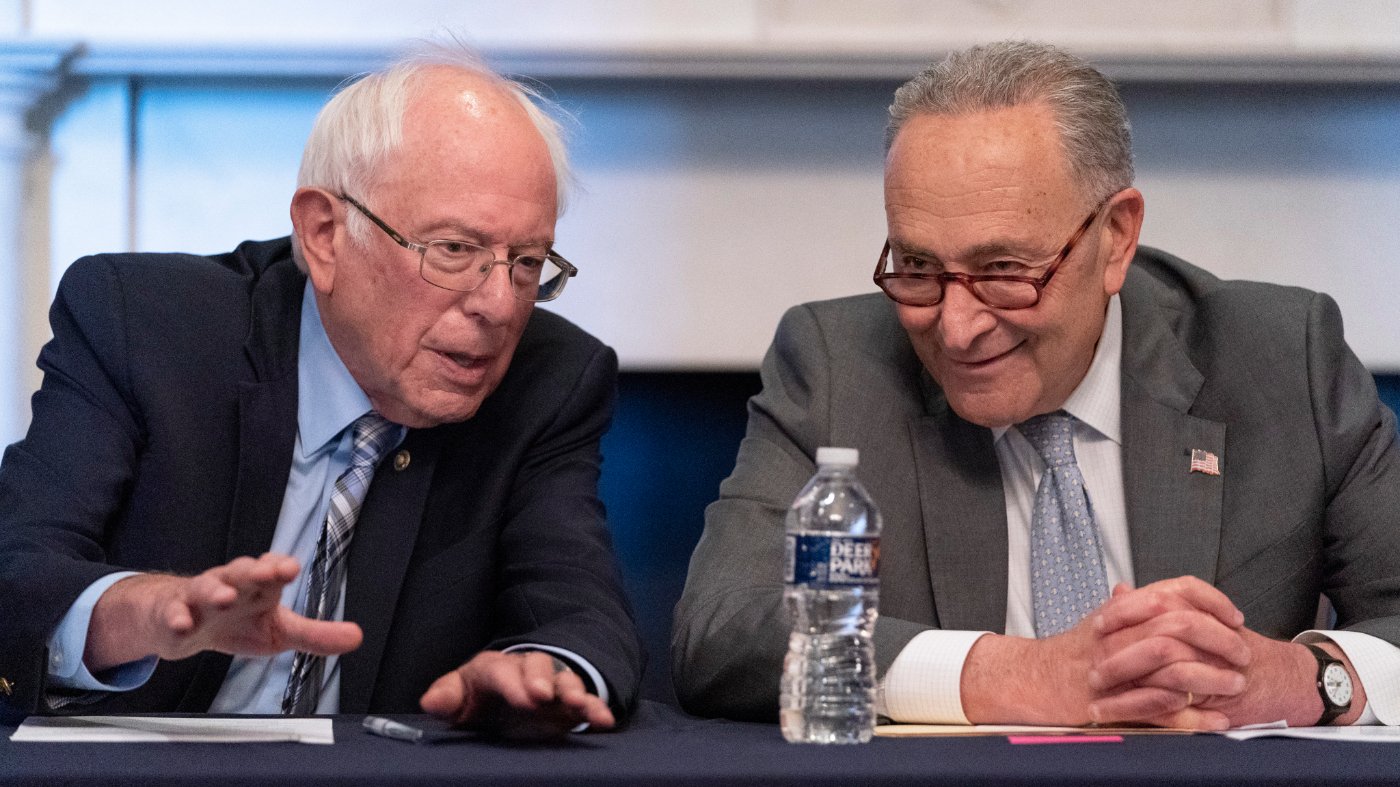
For much of this election cycle, Senate Minority Leader Chuck Schumer has tried to project an image of a Democratic Party still controlled from the center, funneling institutional support toward establishment-approved candidates in hopes of reclaiming the Senate majority in November. But a string of progressive primary victories—fueled by endorsements from Senator Bernie Sanders and Representative Alexandria Ocasio-Cortez—has upended that plan, exposing a party in the midst of a profound ideological struggle.
The most striking example came in Maine, where Schumer threw his weight behind Governor Janet Mills to challenge Republican Senator Susan Collins. Sanders instead backed Graham Platner, a progressive activist who won the nomination with more than 70 percent of the vote—despite a series of scandals, including allegations of abusive behavior, a tattoo resembling a Nazi symbol, and reports of inappropriate communications while married. Mills dropped out after it became clear she couldn't compete. The outcome has left some Senate Democrats questioning Schumer's recruiting strategy, with several urging him to stay out of contested primaries altogether. The controversy over Platner's past has also sparked internal debate about the party's standards for its nominees, as detailed in recent reporting.
In Michigan, Sanders has endorsed Abdul El-Sayed, a former state health official, in the open Senate race. El-Sayed has been joined on the trail by left-wing influencer Hasan Piker, whose comments on Israel have drawn accusations of antisemitism. The progressive pair has framed the contest as a referendum on what El-Sayed calls a Democratic establishment "significantly dominated by big-money interests." Polling shows El-Sayed leading his primary opponents—Representative Haley Stevens, whom Schumer recently backed, and state Senator Mallory McMorrow—by double digits with 28 percent of the vote. But the same surveys indicate that El-Sayed would give former Representative Mike Rogers, the Republican frontrunner, the best chance of flipping the seat. That dynamic has alarmed centrist strategists who fear a far-left nominee could hand Republicans a winnable race.
Sanders has also made a slate of House endorsements nationwide. In New Jersey, he backed Adam Hamawy, a left-wing candidate who won his crowded primary by 14 points. Hamawy testified in 1995 in defense of Omar Abdel-Rahman, the blind cleric later convicted for his role in the 1993 World Trade Center bombing, claiming that Abdel-Rahman's remarks about "conquering the land of the infidels" had been taken "out of context." The endorsement has drawn criticism as one of Sanders's most radical to date.
In Pennsylvania, Ocasio-Cortez intervened in the state's 3rd Congressional District, where state Representative Chris Rabb won the Democratic nomination with about 45 percent of the vote. Her backing, alongside endorsements from "Squad" members Ilhan Omar, Rashida Tlaib, and Summer Lee, signaled that national progressives are increasingly willing to consolidate behind candidates who challenge the party's leadership on issues ranging from Israel to economic policy.
To be clear, the establishment wing is not dead. Schumer-aligned candidates remain on the ballot in several competitive primaries, and the party's center-right faction still holds significant institutional power. But the pattern is unmistakable: when Sanders or Ocasio-Cortez intervene, their candidates often win—sometimes forcing the establishment's preferred contender out of the race entirely.
What's unfolding in 2026 is more than a fight over individual seats. It's an early indicator of what the Democratic Party actually stands for—and who gets to define it heading into 2028. If El-Sayed, Platner, Hamawy, and Rabb all reach the general election, Democrats will be testing whether unapologetically progressive candidates can win in states like Michigan and Maine, or whether a far-left agenda hands Republicans an easy contrast on liberal extremism. A string of progressive wins would embolden the party's left flank ahead of a wide-open presidential primary in 2028; a string of losses would give Schumer and the establishment fresh ammunition to argue for a more centrist approach.
Regardless of the outcome, this year's midterms will reverberate well beyond November. The party's path back to power—and its core identity—will run directly through these races. As Douglas E. Schoen and Carly Cooperman, pollsters and co-authors of "America: Unite or Die," put it, "It's apparent that Democrats can and should no longer avoid this conversation."