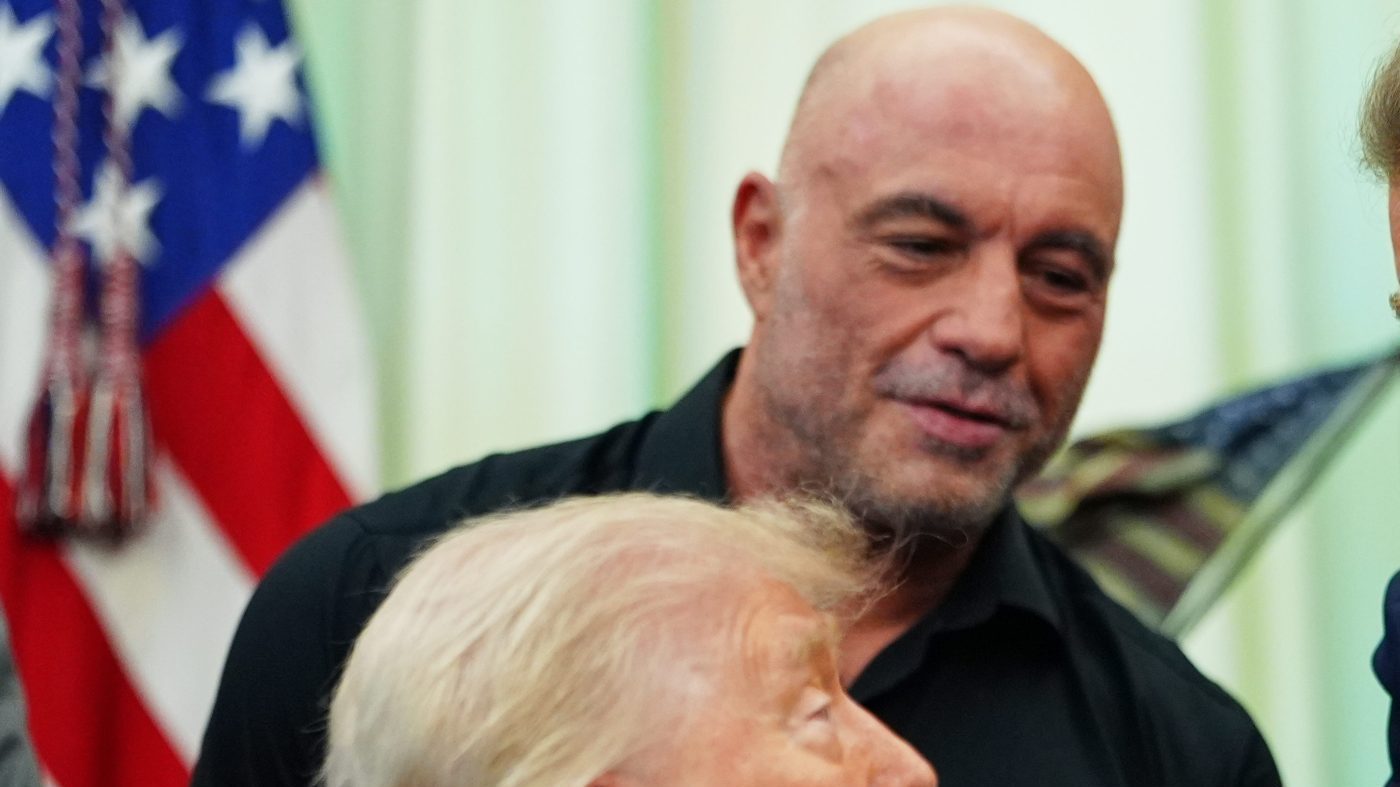
Joe Rogan used his platform on Wednesday to launch a blistering critique of democratic socialism, branding the ideology as fundamentally flawed and accusing its supporters of being "Marxists" whose views are shaped by manipulative social media content rather than genuine political conviction.
"It sucks," Rogan said on his podcast, dismissing the notion that young people are organically gravitating toward socialist ideas. "People are really arguing, 'Oh maybe being socialist is cool.' Like, this is all coming out of social media. One hundred percent." He added that it's "not natural" for people to read Marx and conclude, "What a great idea, let's implement this."

Rogan's comments come amid a broader political battle over the influence of democratic socialists within the Democratic Party. The president has repeatedly targeted progressive figures, recently calling for the deportation of "hardcore communist bastards" and naming New York City Mayor Zohran Mamdani (D) as an example. He has also attacked Michigan Senate candidate Abdul El-Sayed (D), who does not identify as a democratic socialist, labeling him a "Communist loser who hates Jews and Israel." The president has described communism as "the greatest threat to our country in history," even ranking it above World War I, World War II, and Pearl Harbor.
While socialism and Marxism share historical roots, they are not synonymous. Socialism broadly refers to systems where the public owns and controls the means of production to meet human needs, while Marxism is a specific theoretical framework developed by Karl Marx and Friedrich Engels that analyzes class struggle and predicts capitalism's collapse. Rogan, however, conflated the two, arguing that "very few of these quote unquote Marxists that you find on social media are even aware of the consequences, the historical consequences of these strategies and what it ultimately leads to."
"It's like checkers," he said. "You're going to have a military that controls everything you do. As soon as you give up everything to the state, well the state has the guns and you have nothing and they tell you what to do."
His guest, conservative commentator Steve Hilton, reinforced the point by recalling the failures of Soviet-era state-run grocery stores in Hungary, which he described as "terrible." Hilton was responding to Mamdani's proposal for government-run grocery stores to address affordability—a policy that critics have seized upon to label the mayor a Marxist, though he has not identified as one.
The attacks from Republicans, and the efforts by some establishment Democrats to distance themselves from progressives, come as democratic socialists have won a series of high-profile primaries. New York and Colorado have seen democratic socialists secure nominations, while a progressive claimed Michigan's Senate nod and a center-left candidate narrowly beat a DSA-backed rival in Wisconsin's gubernatorial primary. These results have intensified debates over the party's direction, with some insiders warning that the surge could complicate efforts to win back the House.
Kelly Dietrich, founder and CEO of the National Democratic Training Committee, urged unity, saying that with "major battleground state primaries, like Wisconsin and Michigan, behind us, Democrats now need to unite around one overriding priority: defeating MAGA Republicans, winning back governing power, and making it far harder for Donald Trump to continue advancing a harmful agenda." She stressed that Democrats must focus on "kitchen-table issues" like lowering costs at the grocery store and gas pumps, while holding the Trump administration accountable for policies that are "driving prices higher."
Rogan's broadside adds another layer to the ongoing struggle within the Democratic Party, as some strategists worry the socialist label could hurt the party's chances in November. Yet progressives argue that their grassroots appeal and focus on economic inequality are winning over voters, even as some former officials insist socialist candidates don't define the party. The tension is likely to persist as the general election approaches.