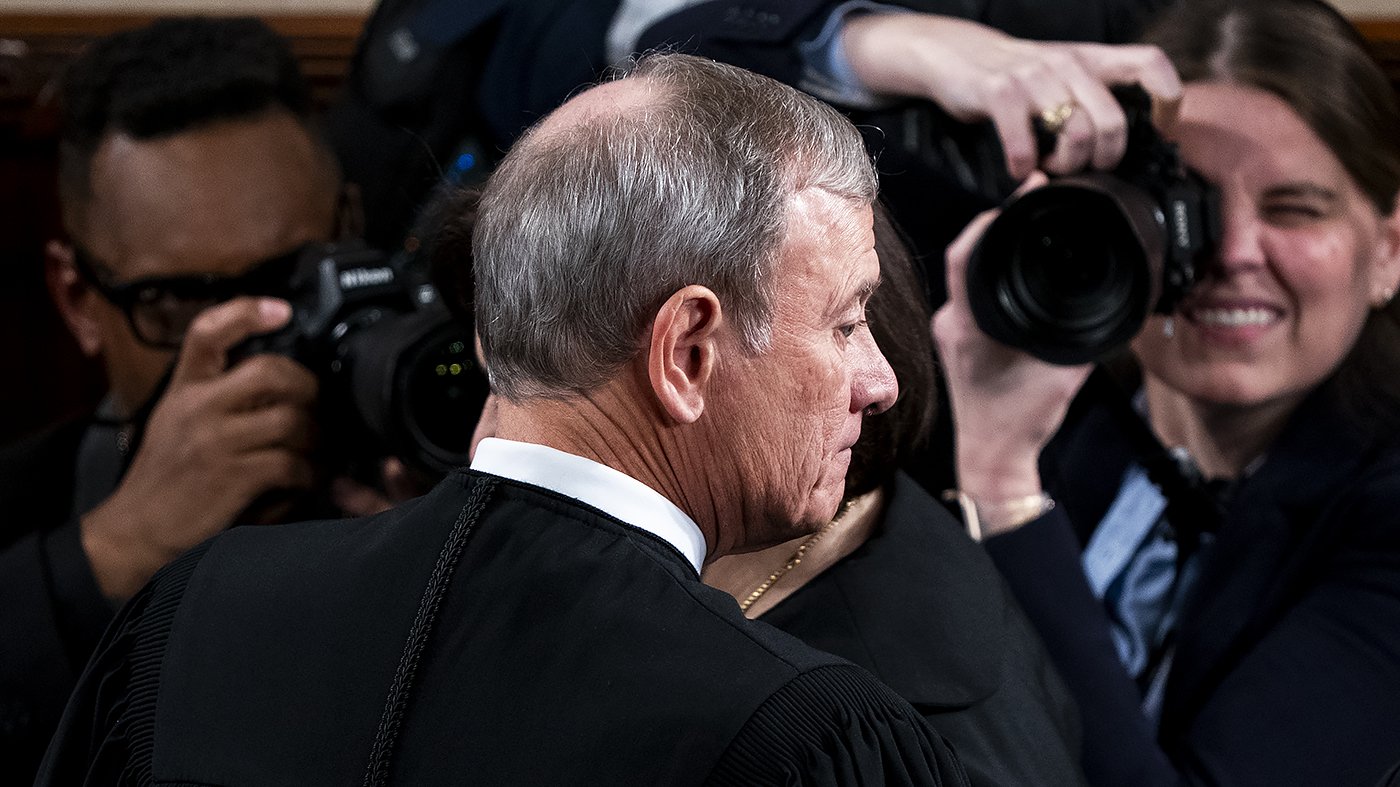
Chief Justice John Roberts found himself repeatedly intervening to maintain procedural order during Supreme Court arguments this week, as the court's liberal justices dominated questioning in a contentious hearing about border asylum policy. The dynamic highlighted ongoing tensions on the bench and tested Roberts's ability to manage increasingly assertive questioning sessions.
Justices Sonia Sotomayor and Ketanji Brown Jackson together accounted for 46 percent of the words spoken by the nine justices during arguments in a case examining the Biden administration's border asylum policy. Their persistent questioning of government lawyer Vivek Suri prompted multiple interruptions from Roberts and other conservative justices.
"Would you complete your answer?" Roberts directed at Suri on Tuesday, cutting off Sotomayor mid-exchange. At another point, Roberts and Justice Amy Coney Barrett spoke simultaneously to interject as Jackson peppered the lawyer with questions, with Jackson responding, "Can I just finish?"
The friction wasn't limited to Tuesday's session. During Monday's arguments about whether mail-in ballots received after Election Day should be counted—a case where conservative justices expressed skepticism about post-election counting—Sotomayor attempted to question a lawyer out of turn, prompting Roberts to raise his voice: "Justice—Justice." Sotomayor apologized as Roberts reminded her it was Justice Samuel Alito's turn under the court's modified questioning system.
That system, implemented during COVID-19 remote arguments and maintained for portions of in-person sessions, requires justices to question lawyers in order of seniority during designated periods. Roberts has attempted to balance this structured approach with traditional free-flowing exchanges, but the first portion of arguments frequently devolves into overlapping dialogue.
Conservative commentator Ed Whelan noted on social media that Sotomayor "asks a 3-minute question, cuts off response after 10 words, talks for another 30 seconds, cuts off response after 5 words, and again and again" during the asylum arguments. Roberts at one point gave Suri a visible nod, seemingly encouraging him to answer despite the interruptions, before verbally intervening.
Broader Context of Judicial Tensions
The public display of procedural friction comes as the Supreme Court faces increased scrutiny over its internal dynamics and public perception. While Roberts has long emphasized the court's institutional integrity and nonpartisan nature, these argument sessions reveal the challenges of managing strong judicial personalities with divergent ideological approaches.
The court's workload continues to involve high-stakes constitutional questions, from Fourth Amendment challenges to government surveillance programs to questions about qualified immunity for law enforcement. The chief justice's struggle to maintain decorum during arguments reflects broader tensions as the court navigates politically charged dockets.
Separately, The World Signal has learned that federal authorities are investigating a series of threatening pizza deliveries to judges' homes nationwide. The U.S. Marshals Service confirmed an active investigation into these incidents, where unordered pizzas arrive at judges' residences—a tactic meant to signal that their addresses are known to potential threats. This development underscores the heightened security concerns facing the judiciary amid polarized political climate.
As the Supreme Court term progresses, observers will watch whether Roberts can establish more consistent control over argument sessions or whether the current dynamic of frequent interruptions becomes the new normal. The chief justice's ability to manage these proceedings affects not only the court's efficiency but also its public image as an institution above partisan fray.