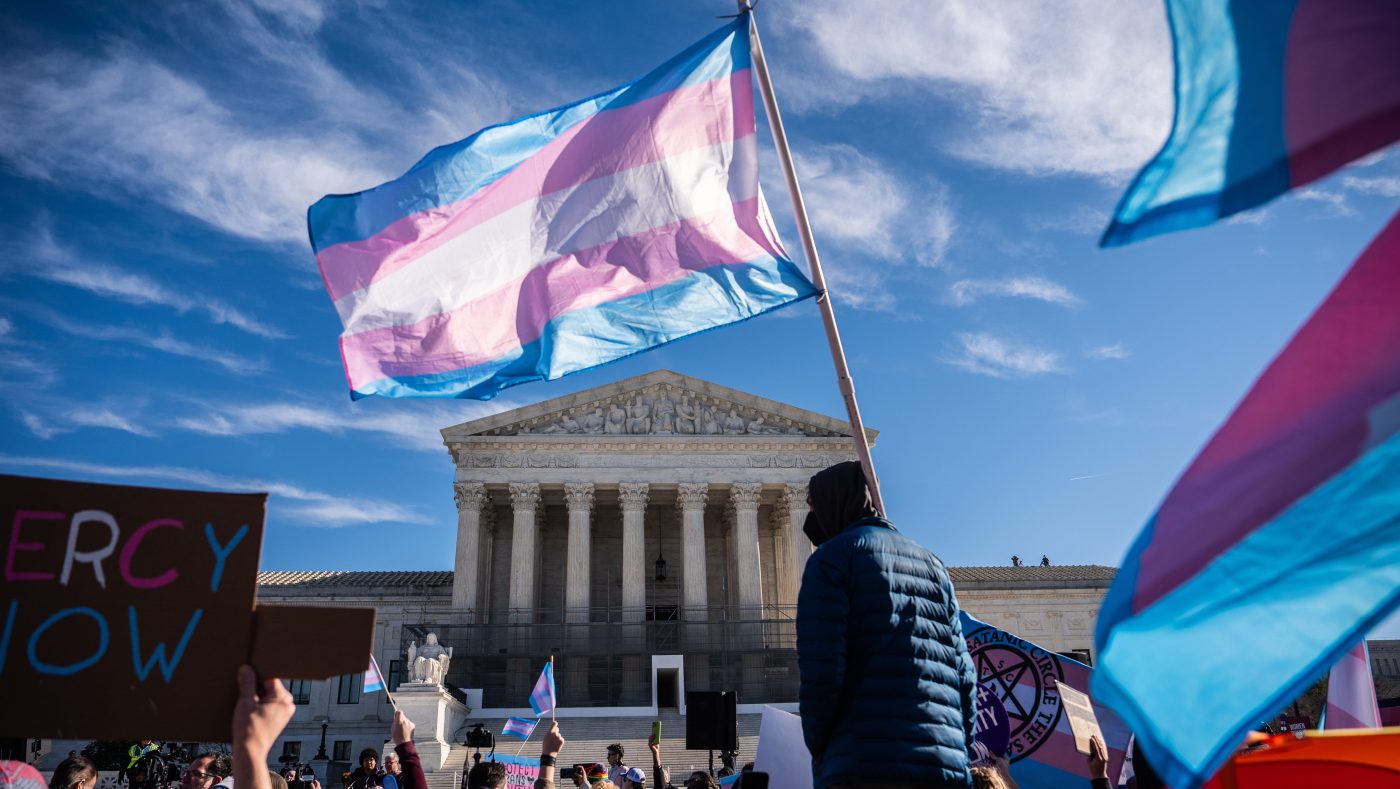
Republican-led states defending their bans on transgender athletes in women's sports are brimming with confidence that the Supreme Court will side with them—and they believe a liberal justice may join the majority.
West Virginia Attorney General JB McCuskey told me in an interview that he expects the ruling to be 8-1 or 7-2, with Justice Elena Kagan as a potential swing vote. “We were very, very encouraged by Justice Kagan’s questioning,” McCuskey said. “She was very, very thoughtful, and it was very clear to me that she understood the weight of what this meant.”

Idaho Attorney General Raúl Labrador was more cautious but still bullish. “I feel confident that we’re going to have a majority of the court,” Labrador told me. “And I would not be surprised if we get one or two of the liberal justices on some of the issues.” He laughed off McCuskey’s vote-counting, saying, “I don’t like to count numbers before.”
The Supreme Court is expected to rule by early July on whether states can bar transgender girls from competing on girls’ and women’s school sports teams. The decision will affect bans in roughly two dozen states. Transgender athletes argue the restrictions violate the 14th Amendment’s equal protection clause and Title IX, the federal law banning sex discrimination in education.
McCuskey and Labrador successfully pushed the Court to take up the case. Oral arguments in January suggested the conservative majority is leaning their way, and most court watchers I speak to agree a victory is likely. “When you watch a male athlete defeat every single swimmer by great lengths, you just realize that this just doesn’t make any sense,” Labrador said. “So, I think what the Supreme Court is doing, is they’re just bringing common sense back to the American people.”
A new development has added fuel to the debate. Becky Pepper-Jackson, the teenage transgender girl challenging West Virginia’s ban, recently won the state title in women’s AAA shot put with a throw of 11.88 meters, beating the runner-up by more than half a meter. McCuskey seized on the result: “In West Virginia, the current state champion of the shot put is a biological male who beat every single biological female in the state as a 15-year-old sophomore.”
Yet McCuskey notably used female pronouns for Pepper-Jackson during our conversation, referring to the minor as “B.P.J.” in court filings. “These are kids, right?” he explained. “Which is why I’m very, very thoughtful about how I describe B.P.J., how I describe her pronouns, etc.” He added that Pepper-Jackson “will be welcomed by our athletic departments” to compete on boys’ teams.
The case intersects with broader legal battles over transgender rights, including recent Supreme Court rulings on gerrymandering that have shown the Court’s willingness to weigh state interests against individual protections. Some observers see parallels to the bipartisan backlash that has stalled parts of Trump’s agenda, though the transgender athlete issue has largely split along party lines.
The Supreme Court will release additional opinions at 10 a.m. EDT Thursday, with the transgender athlete decision expected by early July. For now, the Republican attorneys general are projecting a win that could reshape the landscape of women’s sports nationwide.