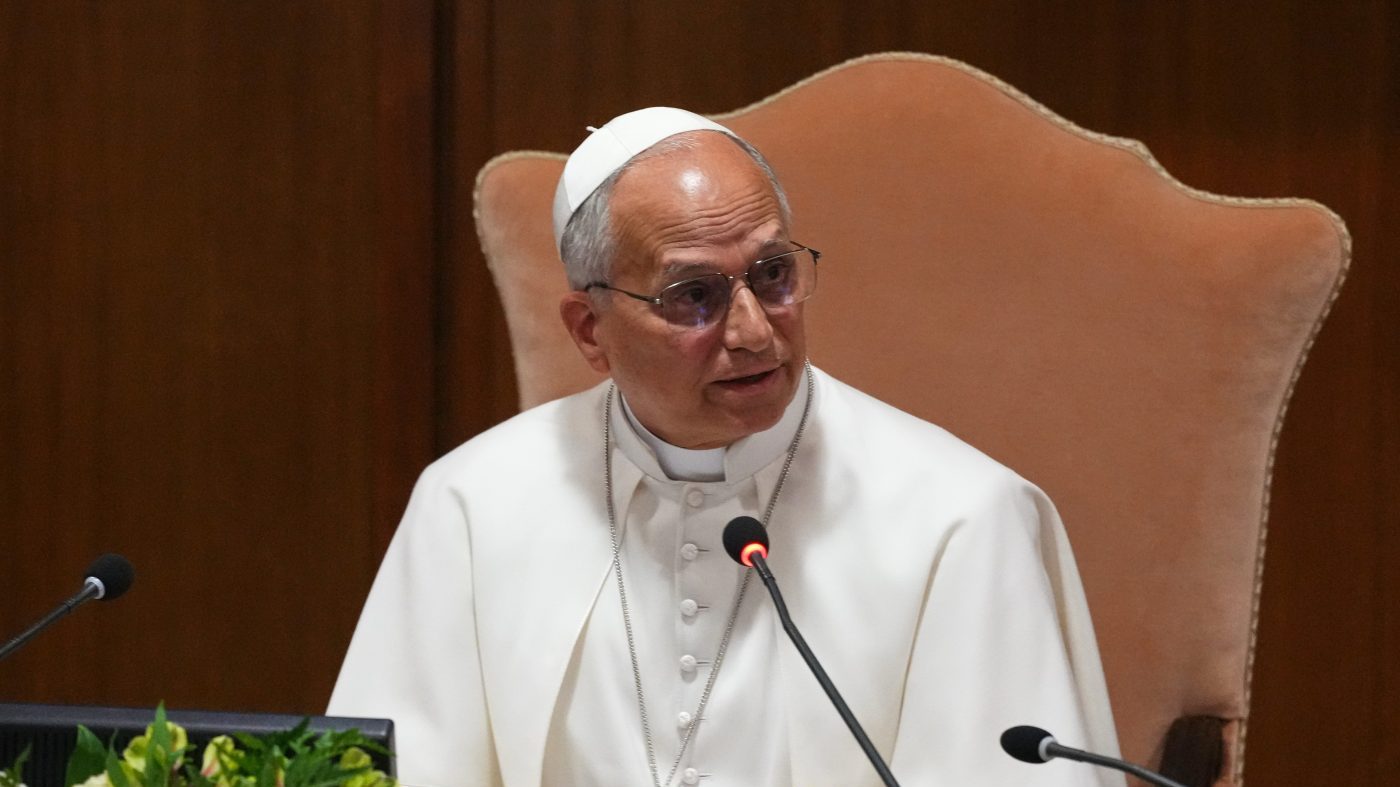
Pope Leo XIV issued a sweeping warning on artificial intelligence in his first encyclical on Monday, urging policymakers to apply the brakes on rapid AI deployment and craft regulations that safeguard human dignity and justice.
The document, titled “Magnifica Humanitas,” marks the first major teaching document from the first U.S.-born pope. In it, he calls on governments to act with “clarity to establish adequate regulatory tools capable of upholding justice and curbing the distorting effects of technological power.” The encyclical draws heavily on the legacy of Pope Leo XIII, whose 1891 encyclical “Rerum Novarum” defended workers’ rights during the second Industrial Revolution.

Since succeeding Pope Francis last May, Leo has repeatedly flagged AI’s threats to children, workers, and human dignity. In his first address to cardinals, he described the technology as posing “new challenges for the defense of human dignity, justice and labor.”
The pontiff acknowledged that technology “should not be considered, in itself, as a force antagonistic to humanity,” but insisted that society must ensure AI tools are “oriented toward the good.” He noted that the long-term effects of AI on individual dignity and the common good remain unpredictable.
“New technologies open up a horizon extending in directions that are imaginable but not yet fully predictable,” Leo wrote. “This complicates the assessment of their potential impact and the long-term effects they may have on both the dignity of individuals and the common good.”
To address these challenges, the pope called for open ethical discussions to prevent a small group from controlling AI’s direction. He urged a deliberate approach: “Calling for prudence, rigorous evaluation and even, at times, a slower pace in adopting AI does not mean opposing progress; instead, it is an exercise of responsible care for the human family.”
“What is needed is a more active political involvement that is capable of slowing things down when everything is accelerating, and of protecting the opportunities for communities still to be able to participate and ask questions,” he added.
Christopher Olah, co-founder of the AI company Anthropic, attended the Vatican launch. Anthropic is embroiled in a legal battle with the Trump administration after Defense Secretary Pete Hegseth designated the firm a supply chain risk and President Trump ordered civilian agencies to stop using its products. The moves followed Anthropic CEO Dario Amodei’s demand that the government not use the company’s Claude chatbot for fully autonomous lethal weapons or mass surveillance of Americans.
Olah welcomed the pope’s leadership, saying: “We need more of the world — religious communities, civil society, scholars, governments — to do what His Holiness has done here: to take this seriously, to look closely, and to push events in a better direction,” as reported by the Associated Press.
In the U.S., bipartisan concerns about AI risks persist, though many lawmakers emphasize the need for American companies to compete with Chinese rivals. Progressive Sen. Bernie Sanders and Rep. Alexandria Ocasio-Cortez proposed legislation in March to halt new data center construction until federal safeguards are in place. Meanwhile, the Trump administration has sought to unleash U.S. companies in the AI race against China, a dynamic that contrasts with the Vatican’s call for caution.