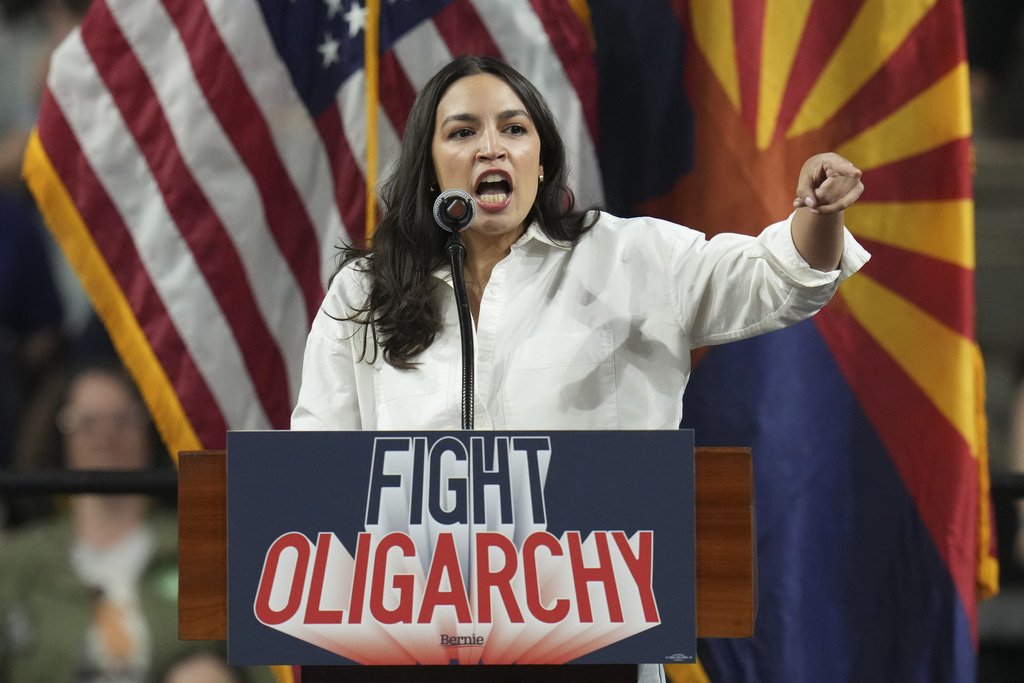
Representative Alexandria Ocasio-Cortez (D-N.Y.) is stepping up efforts to drive Black voter turnout ahead of the 2026 midterms, delivering a fiery address at Ebenezer Baptist Church in Atlanta—the former pulpit of Dr. Martin Luther King Jr. Her appearance signals a broader strategy to replicate the multi-racial coalition that propelled Barack Obama to the White House.
“What happens to Georgia, happens to New York. What happens to Tennessee, happens to California. What happens to Louisiana, happens to all of us,” Ocasio-Cortez told the congregation, pushing back against Republican redistricting efforts that have diluted Black political influence. “We are not going back!” she declared, drawing cheers from the crowd.

The New York Democrat’s recent schedule includes a voting rights rally in Alabama and the Power Rising Summit in Chicago, a gathering focused on mobilizing Black women. Her outreach comes as GOP-led redistricting in Southern states has reduced the number of majority-Black congressional districts, a key component of Democratic electoral strength.
Ocasio-Cortez is also tapping into the energy from her joint appearances with Senator Bernie Sanders (I-Vt.) on the “Fighting Oligarchy Tour.” Sanders, though not running for president, has seen his endorsed candidates win recent primaries. According to Politico, his slate “cleaned house on Tuesday, a coast-to-coast show of force.” The hope is that a coalition of Sanders’ predominantly white activist base, Black voters, and Latino turnout can create a Democratic wave in November.
Her approach echoes Obama’s 2004 convention speech, where he declared there is no “Black America and white America and Latino America and Asian America: There is a United States of America.” Obama won Black voters overwhelmingly and captured roughly two-thirds of Hispanic voters in both 2008 and 2012. But in 2024, former President Donald Trump made inroads with both groups, even against a Black female opponent, Kamala Harris.
Recent polling, however, shows that support for Trump among Black and Latino voters has eroded. A May New York Times-Siena poll found 83% of Black voters and 71% of Hispanic voters view Trump negatively. Among Latinos who voted for Trump in 2024, a quarter now say they would not do so again, according to a UnidosUS survey. This shift was evident in a February Texas state Senate race where Republicans lost a district Trump had carried by 17 points, prompting Governor Greg Abbott to urge the Trump administration to recalibrate its hardline deportation policies.
In Texas, where Latinos make up about a quarter of the electorate, state Representative James Talarico, the Democratic Senate candidate, holds a 12-point lead among Latino voters in a recent Texas A&M poll. His opponent, Attorney General Ken Paxton (R), has a record of supporting aggressive deportation tactics and suing Latino voting rights groups, accusing one of “subverting the election process” by registering illegal immigrants.
Ocasio-Cortez is already one of the most prominent Latino politicians in the country and is frequently mentioned as a top contender for the 2028 Democratic presidential nomination. On the Republican side, Secretary of State Marco Rubio, a former Florida senator, is a potential heir to the MAGA movement. A 2028 matchup between two Latino candidates would be historic, but each must first navigate the demographics and controversies of their respective parties. As Ocasio-Cortez works to blend the energy of Sanders’ movement with Black and Latino turnout, the 2026 race is heating up—and the 2028 campaign has already begun.