Former President Barack Obama reignited a decades-old debate last week, calling for a legal guarantee that the Justice Department operate free from White House interference. In a Late Show interview with Stephen Colbert aired May 5, Obama argued the attorney general should serve as “the people’s lawyer,” not the president’s “consigliere” — a pointed critique of the current administration’s weaponization of federal law enforcement.
Obama didn’t name President Donald Trump directly, but the target was unmistakable. Trump has repeatedly demanded the Justice Department investigate and prosecute his political adversaries. Last September, he posted on Truth Social a direct message to then–Attorney General Pam Bondi: “Pam: I have reviewed over 30 statements and posts… same old story [of] all talk, no action. Nothing is being done. What about Comey, Adam ‘Shifty’ Schiff, Leticia??? They’re all guilty as hell but nothing is being done.”
Bondi resigned in April amid that relentless pressure. While the Justice Department opened criminal inquiries into several names on Trump’s enemies list, only former FBI Director James Comey has been indicted — on charges tied to a photo of seashells spelling “86-47,” allegedly a threat against the president’s life.
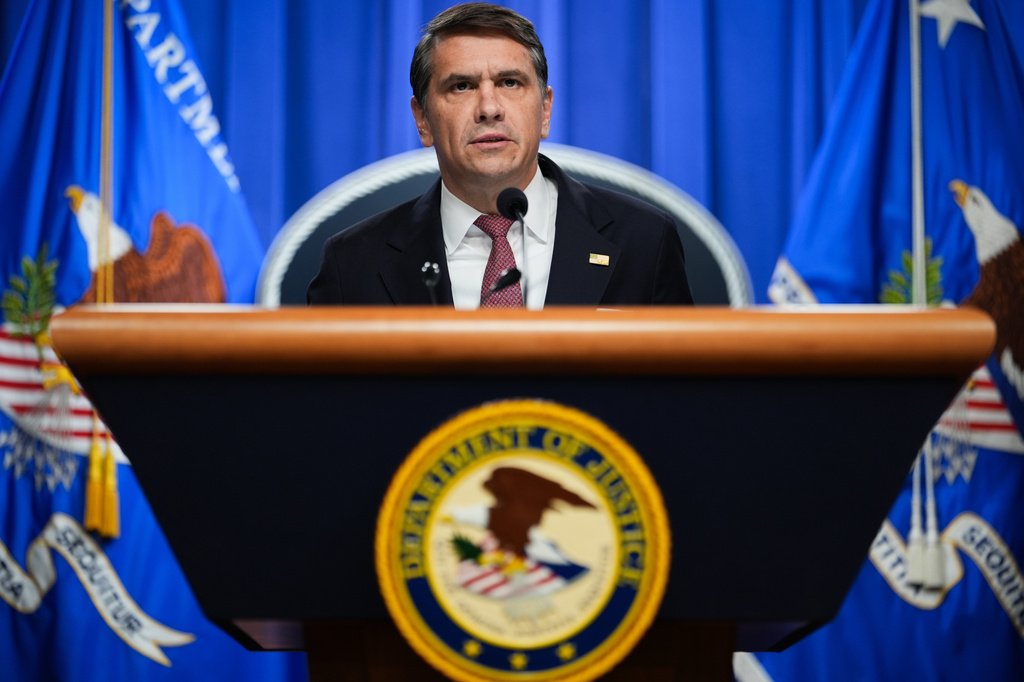
Obama’s proposal to “codify” the norm of DOJ independence would require a cooperative Congress and a president willing to accept limits on executive power — both in short supply. Trump’s former personal lawyer, Todd Blanche, now serves as acting attorney general, blurring the line between legal counsel and political enforcer.
The situation echoes the Watergate era. Under President Richard Nixon, Attorney General John Mitchell — a former law partner — turned the Justice Department into a political weapon. After Mitchell left to run Nixon’s 1972 reelection campaign, the botched break-in at the Democratic National Committee headquarters and subsequent cover-up led to Mitchell’s conviction and Nixon’s resignation. Nixon then ordered Attorney General Elliot Richardson to fire special prosecutor Archibald Cox; Richardson and his deputy resigned in the “Saturday Night Massacre,” until Solicitor General Robert Bork finally dismissed Cox.
The 1978 Ethics in Government Act created an independent counsel mechanism, later ruled constitutional by the Supreme Court in Morrison v. Olson (1988). But the law expired in 1999, replaced by Justice Department regulations under Attorney General Janet Reno. The Office of Special Counsel was supposed to insulate investigations from partisan manipulation, but instead became a political lightning rod. While it produced some successful prosecutions, the experience showed that no statutory fix can fully prevent a determined president from politicizing the Justice Department.
Restoring DOJ independence will require more than legislation. It demands a cultural shift — future presidents must respect the boundary, and Congress must reclaim its oversight role. As Trump’s shadow diplomacy has shown, the administration often bypasses traditional institutions. Whether the next Congress or president can reverse this trend remains an open question.
Don Wolfensberger, a 28-year congressional staff veteran and author of Congress and the People, notes that reforms can produce unintended consequences. But the core challenge is political will. Without it, Obama’s dream of a truly independent Justice Department may remain just that.