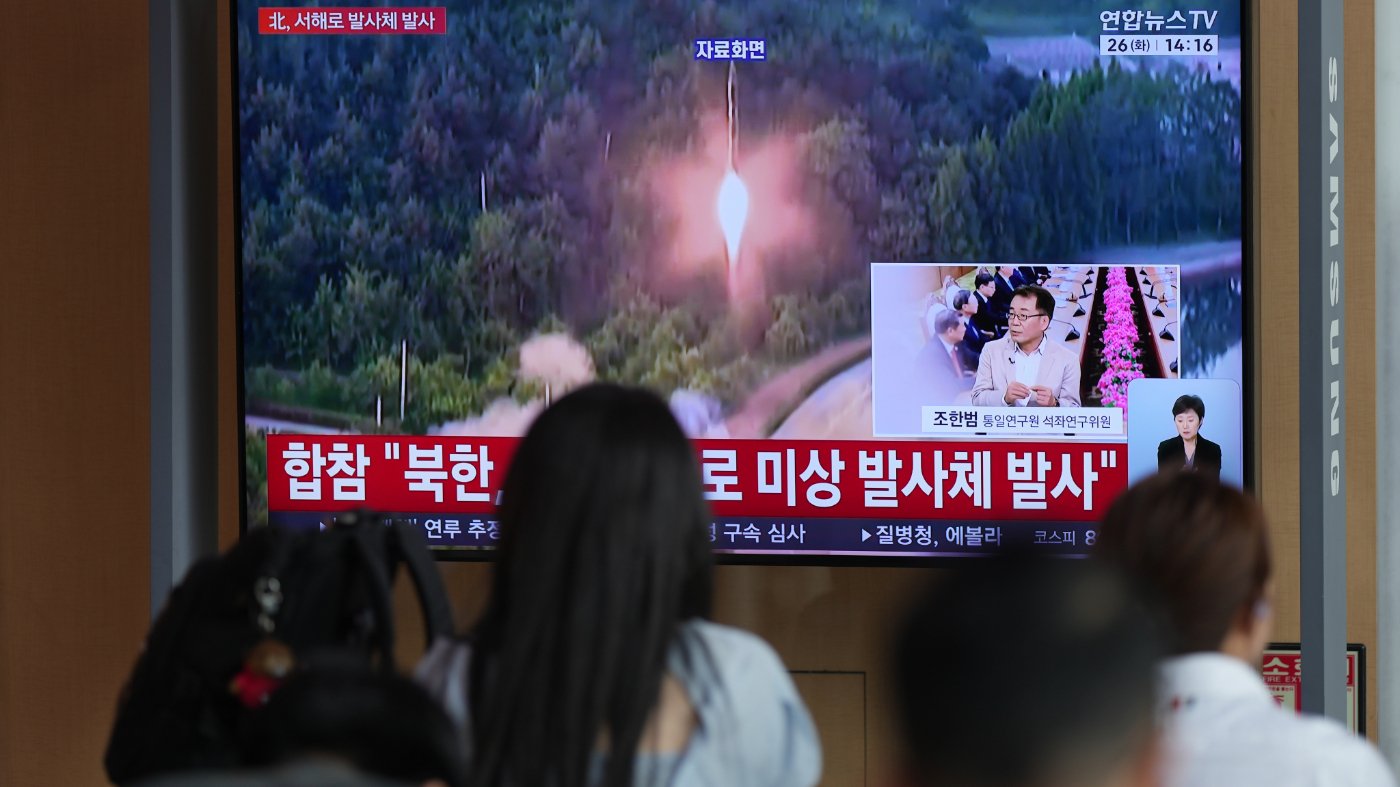
North Korea has taken a significant step toward automating its nuclear retaliation capabilities, amending its constitution in March to mandate an immediate nuclear strike if a foreign attack kills leader Kim Jong Un. The move, approved during the first session of the 15th Supreme People’s Assembly, adds a chilling dimension to the regime's already aggressive nuclear posture.
The revised Article 3 of North Korea's nuclear policy law states that if the command and control system over state nuclear forces is endangered by hostile attacks, “a nuclear strike shall be launched automatically and immediately.” This language mirrors the logic behind Russia's notorious “Dead Hand” system, known in Russian as Perimeter, which can launch a full nuclear arsenal without human intervention.
Greg Scarlatoiu, president of the Committee for Human Rights in North Korea, told The World Signal that Pyongyang’s nuclear weapons “are meant for a single purpose: providing a deterrent to secure the Supreme Leader’s personal security.” He noted that Kim’s regime was “rattled by successful U.S. operations to remove the top leaders of Venezuela and Iran,” which likely accelerated the constitutional change.
The Ghost of Dead Hand
Russia activated its Perimeter system in 1985, during the height of the Cold War. It monitors military frequencies, radiation, air pressure, heat, and seismic activity. If those sensors suggest a nuclear attack has occurred, Perimeter launches a command rocket that transmits launch codes to silos. Once turned on manually at the start of a crisis, the system can decide to end the world without any human input.
Military.com writer Blake Stilwell described the system as “like something out of one of the worst James Bond movies.” After Russian President Vladimir Putin put nuclear forces on high alert following the 2022 invasion of Ukraine, Stilwell warned that Putin “might have taken Russia’s doomsday device on notice as well.”
The United States operates a similar monitoring network but explicitly requires a human to authorize any nuclear launch. That distinction is critical, as the 1983 Soviet False Alarm incident demonstrated. On September 26, 1983, Lieutenant Colonel Stanislav Petrov was on duty at the Serpukhov-15 early-warning center when alarms indicated five American Minuteman missiles had been launched from Montana. More than 30 reliability checks confirmed the attack—but Petrov trusted his gut and ignored the warnings. “I was drenched in sweat,” he later recalled. “People were shouting, the siren was blaring. But a feeling inside told me something was wrong.” His intuition saved millions of lives; the alarm was triggered by sunlight reflecting off clouds.
China’s Quiet Interest
North Korea’s technical ability to field an automated system remains unclear. Bruce Bechtol, a North Korea military expert at Angelo State University, said he has “seen nothing that indicates that North Korea has a Dead Hand system.” However, China may be exploring similar capabilities. Chinese officials rejected U.S. proposals in May 2024 to limit the use of artificial intelligence in controlling nuclear launches, after President Joe Biden raised the issue with Xi Jinping in November 2023. Washington has little visibility into China’s nuclear command-and-control architecture, raising concerns that Beijing could develop its own version of Perimeter.
Peter Huessy, of the National Institute for Deterrence Studies, argues that such automatic systems send a clear message: “Don’t try to attack us because you’ll end up dead too.” He contends that while the U.S. has no first-strike plans, “rogue nations do.” The existence of Dead Hand–style systems, he warns, is intended to neutralize America’s ability to use its nuclear arsenal to deter conventional aggression. As the U.S. grapples with rising tensions in the Middle East and Eastern Europe, the prospect of an automated nuclear trigger in Pyongyang adds a volatile new element to global security.