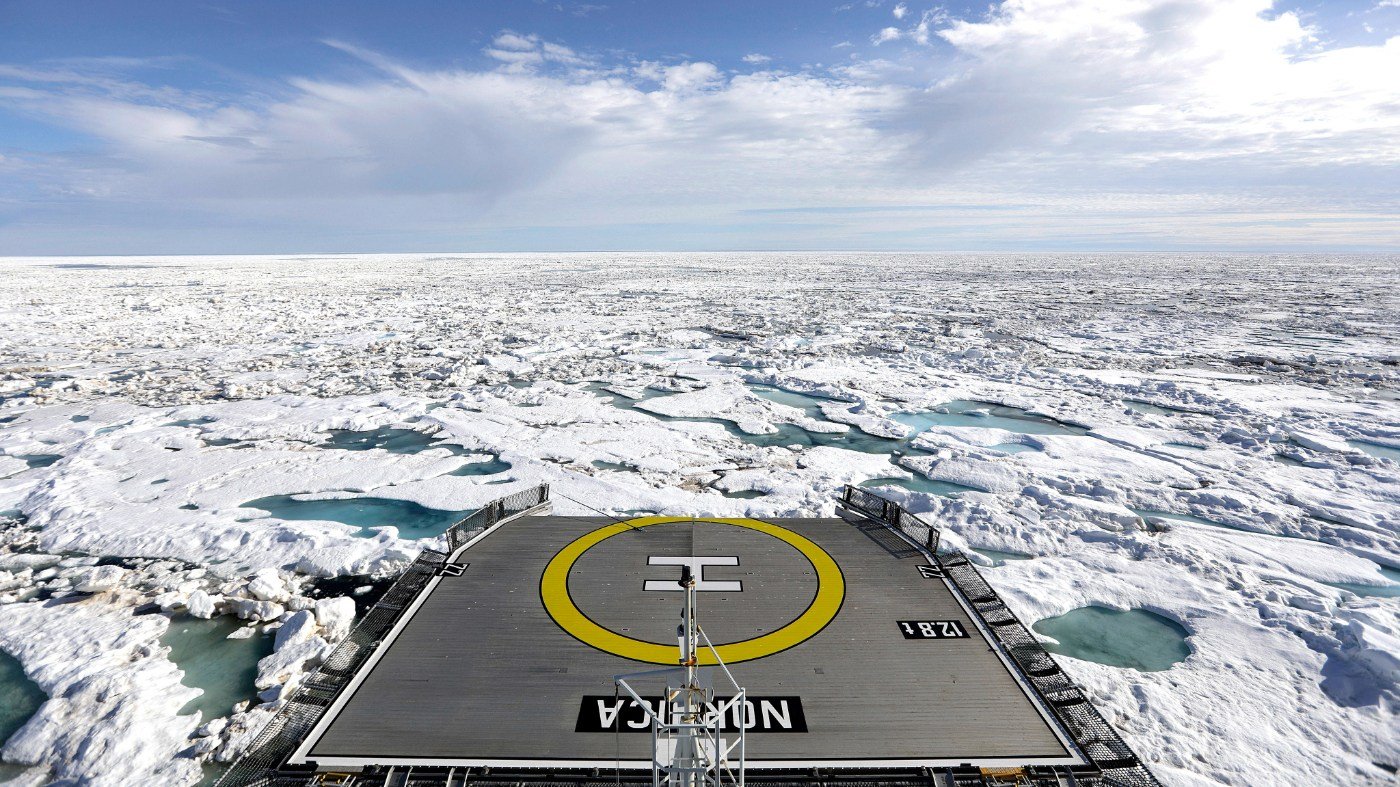
The Trump administration has quietly pulled federal support for the Arctic Report Card, the premier annual assessment of Arctic environmental and security conditions, according to its editors. The move, confirmed earlier this month, comes as the region becomes a focal point for great-power competition and rapid climate-driven change.
In a May joint statement, the United States and its allies declared that “close cooperation on Arctic security and economic development among our nations is more important than ever.” Yet the cancellation undermines that stance, stripping decision-makers of a trusted, timely source of data that has informed policy for nearly two decades.

Arctic at a crossroads
The Arctic is warming faster than any other region on Earth, with September sea ice now covering roughly half the area it did in the 1980s. This has opened new shipping routes, including the Northern Sea Route along Russia’s coast, which is being rapidly developed. This year, at least six Chinese operators are planning container and bulk shipping services to Russia and expanding into Western Europe, while South Korea is finalizing its first Arctic cargo ship for a trial crossing this summer.
These changes are not just economic—they carry profound security implications. NATO is scrambling to keep pace with Russian submarine activity, and US military vessels are increasingly shadowing Chinese research ships. The European Policy Center recently urged the European Union to make security the top priority in its Arctic strategy, a shift from its previous focus on peaceful cooperation.
Data as a national security asset
The Arctic Report Card, produced by NOAA with contributions from about 100 scientists across a dozen countries, translates raw environmental data into usable insights. It has been cited by the Congressional Research Service, NATO’s January report on climate security, and the Arctic Council’s monitoring programs. Its findings directly support military planning, infrastructure development, and community resilience.
Without federal support, this critical intelligence pipeline will go dark. The editors warn that the data access systems built over two decades will become stale, and a trusted source will be lost. “Any business, town or development group needs this data informing their decisions,” said Twila Moon, deputy lead scientist at the National Snow and Ice Data Center and lead editor of the report.
Environmental and economic stakes
The 2025 edition highlighted alarming trends: more than 200 Alaskan watersheds show signs of “rusting rivers”—increased acidity and toxic metal contamination that threaten drinking water and fisheries. Melting glaciers and permafrost thaw are triggering floods and landslides, damaging infrastructure and endangering lives. Coastal erosion accelerates as sea ice retreats, removing land and property.
For businesses, towns, and development groups, this data is not optional—it is essential for making informed decisions about everything from shipping routes to construction projects. The report’s cancellation leaves a void that no other source can fill.
Leadership at risk
The move contradicts the administration’s own stated priorities. White House science adviser Michael Kratsios recently wrote that “never have science and technology been more central to our nation’s security and prosperity,” and that global competitors are racing to challenge American leadership. The Arctic is a key arena in that race.
“With the Arctic heating up, this is not the time to weaken our Arctic leadership,” Moon said. The editors and authors vow to continue their work, but without federal backing, the task becomes far more difficult. The decision leaves the United States blind at a moment when the Arctic’s strategic importance is soaring.